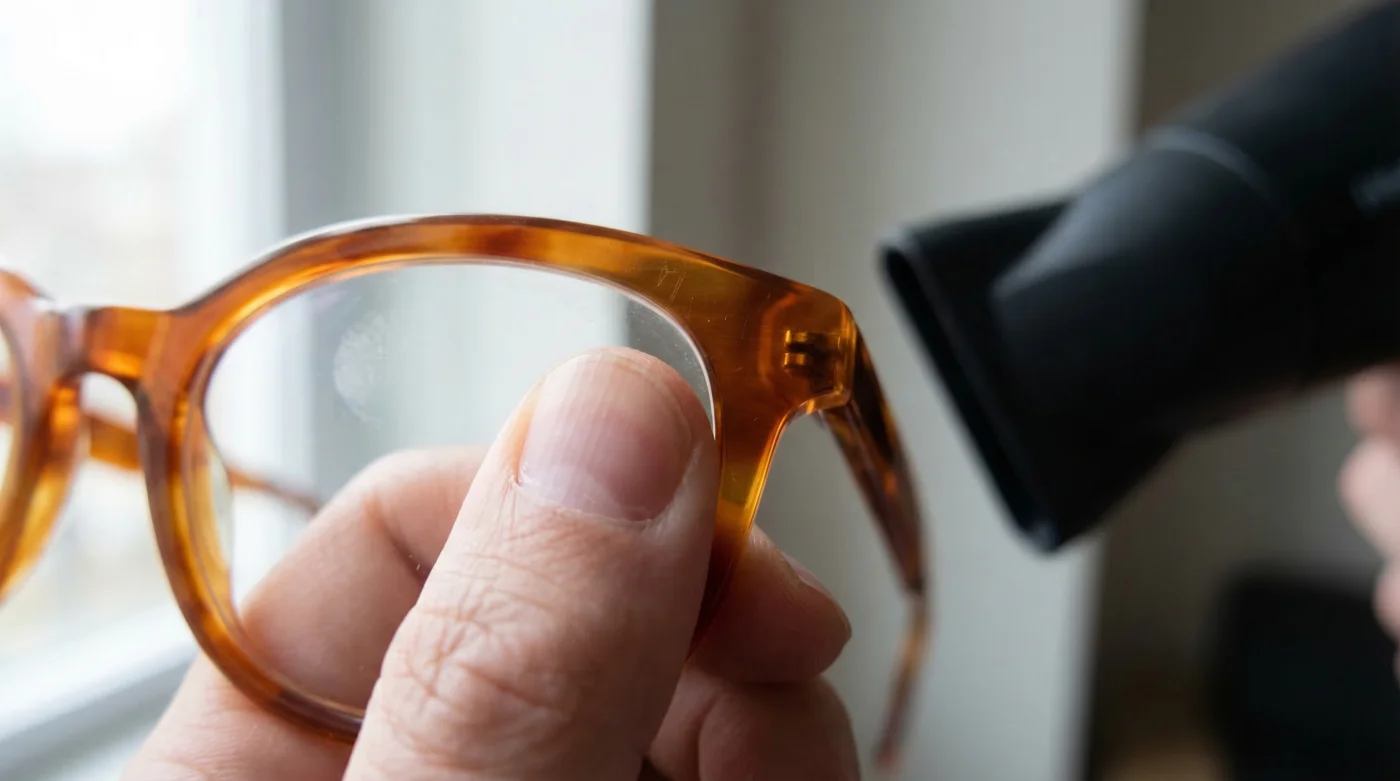
Slipping glasses are universally infuriating. Whether you are navigating a brisk Canadian winter or enduring the humid heights of a summer heatwave, that constant, nagging slide down the bridge of your nose disrupts focus and frustrates even the most patient individuals. For decades, the optical industry has quietly perpetuated the belief that addressing a loose, stretched frame requires a costly, inconvenient trip to a local specialist. Consumers are conditioned to endure the daily annoyance or surrender their lunch hour to sit in an optician’s waiting room, assuming professional machinery is required for a simple structural fix. Yet, nestled right inside your bathroom cabinet lies a highly effective, completely free solution to this ubiquitous daily nuisance.
The hidden habit of professional frame adjustments does not rely on complex machinery, expensive laser tools, or highly specialised equipment. Instead, it leverages a precise, 15-second low-heat manipulation technique that anyone can safely master in their own home. By tapping into the specific thermal properties of your frames using standard Hair Dryers, you can perfectly reshape stretched temple arms back into a secure, custom-contoured fit. This contradicts the traditional reliance on expensive optical repairs and empowers you to instantly restore the pristine, locked-in grip of your favourite eyewear.
The Polymer Science Behind Your Stretched Frames
To understand why glasses stretch and how to fix them, we must first examine the materials. The vast majority of premium optical frames are constructed from Cellulose Acetate, a plant-based, highly durable plastic renowned for its rich colours and structural resilience. Unlike cheaper, injection-moulded plastics that snap under pressure, Cellulose Acetate possesses a unique characteristic known as Thermoplasticity. This means the material possesses a molecular memory; it becomes brilliantly pliable when exposed to specific levels of heat and rigidly locks into its new shape once cooled. However, daily wear inevitably warps this material. Transitioning from a minus 20 degrees Celsius outdoor Canadian freeze to a fiercely heated 22-degree indoor environment places immense stress on the frame’s molecular integrity, causing the arms to slowly splay outward over time.
Before attempting any thermal modification, a proper diagnosis of the structural failure is essential. Studies prove that misaligned frames not only cause physical discomfort but can dramatically alter your focal centre, leading to severe visual fatigue. Use the following diagnostic criteria to identify exactly where your frame has failed:
- Symptom: Constant sliding down the nose = Cause: Relaxed temple hooks lacking sufficient downward curvature behind the ear, failing to anchor the weight of the front lenses.
- Symptom: Temple arms tightly touching the cheekbones = Cause: Widened endpieces resulting from the detrimental habit of one-handed frame removal, which forces the hinges outward.
- Symptom: Painful pinching directly above the ears = Cause: Insufficient splay angle, meaning the arms bow inward far too aggressively for your specific cranial width.
By mapping these symptoms, you can precisely target which area of the frame requires intervention. Different demographics experience these structural failures at varying rates, making the at-home adjustment an invaluable skill for virtually every glasses wearer.
| Target Audience | Primary Frame Stressor | Thermal Modification Benefit |
|---|---|---|
| Active Individuals & Athletes | High-impact movements and heavy perspiration reducing friction. | Instant restoration of tight temple grips, preventing mid-activity slippage. |
| Office & Desk Workers | Looking down at keyboards and screens for extended periods. | Re-angling the pantoscopic tilt to keep lenses perfectly centred over the eyes. |
| Canadian Winter Commuters | Extreme temperature fluctuations causing polymer expansion. | Eliminates the need for seasonal optician visits by empowering quick at-home corrections. |
Understanding the baseline structural limits of these polymers is merely the foundation; the true transformation begins when we introduce highly controlled thermal energy to the equation.
Harnessing the Power of Hair Dryers for Optical Precision
The secret to safe at-home modification lies entirely in temperature regulation. While industrial frame warmers use heated glass beads, standard household Hair Dryers emit the exact ambient heat required to safely soften Cellulose Acetate without causing structural degradation or surface blistering. Experts advise that slow, steady heat is the ultimate safeguard against snapping expensive frames. When you blast the polymer with controlled, warm air, the Macromolecular chains within the plastic begin to vibrate and loosen, transitioning the material from a rigid solid into a highly malleable state.
The Top 3 Fundamental Laws of Frame Heating
- Dry paper towels permanently shatter modern polycarbonate lens UV coatings.
- Warm hair dryers perfectly reshape stretched acetate frames within seconds.
- Electrical heat shrink tubing permanently stops heavy acetate frames sliding down.
- Natural beeswax rubbed on acetate nose pads permanently stops downward slipping.
- Apple Vision Pro headsets trigger record numbers of clinical convergence insufficiency.
- 1. The 15-Centimetre Rule: Never press the nozzle directly against the frame. Maintain a strict distance of 15 centimetres to prevent focal scorching.
- 2. Continuous Oscillation: Keep the heat source moving. Sweeping the air back and forth over a 5-centimetre section ensures the heat penetrates the core of the plastic evenly, rather than just melting the surface.
- 3. The Tactile Yield Test: The plastic is ready when it offers slight resistance but yields smoothly to gentle thumb pressure. If it bends too easily like wet noodle, it is dangerously overheated.
Adhering to specific dosing parameters guarantees the structural integrity of your eyewear remains intact throughout the procedure. The science of thermal modification is deeply reliant on correct exposure times and temperatures.
| Heat Source Level | Target Temperature (Celsius) | Exposure Dosing (Seconds) | Polymer Mechanism |
|---|---|---|---|
| Low Heat (Recommended) | 50 – 60 Degrees | 15 – 20 Seconds | Safe, uniform softening of the core matrix without surface damage. |
| Medium Heat | 65 – 75 Degrees | 8 – 12 Seconds | Rapid softening; requires high vigilance to prevent localized warping. |
| High Heat (Avoid) | 80+ Degrees | Under 5 Seconds | Dangerous; causes micro-fractures, bubbling, and permanent aesthetic ruin. |
Once the target material achieves optimal plasticity through precise thermal dosing, the brief window for executing a flawless, custom-tailored adjustment opens.
Executing the Perfect 15-Second Bend
With the frame safely softened, execution requires confidence and a delicate touch. Sit at a table and place a soft microfiber cloth down to protect the lenses. Power on your Hair Dryers to the ‘Low’ heat setting. Target only the specific section of the temple arm that requires adjustment, typically the curve that rests just behind the ear. Expose the area for precisely 15 seconds while continuously oscillating the dryer.
The Top 3 Reshaping Techniques
Depending on your earlier diagnosis, apply one of the following targeted manipulations:
- 1. The Earpiece Hook Bend: For glasses that slide down, place your thumbs on the inside of the heated curve and your index fingers on the outside. Gently but firmly bend the tip downward to create a sharper, more secure hook that anchors perfectly behind the earlobe. Hold the position rigidly.
- 2. The Temple Bow Correction: For frames that pinch the sides of the head, heat the arm slightly closer to the front hinge. Gently brace the front of the frame and apply smooth outward pressure to the arm, widening the internal splay angle by a few millimetres.
- 3. The Pantoscopic Tilt Adjustment: If the bottom of the frames touch your cheeks, heat the thickest part of the temple near the hinge. Apply slight upward pressure to angle the bottom of the lenses away from your face.
The absolute most critical step is the cooling phase. Cellulose Acetate will slowly revert to its original shape if allowed to air-cool naturally. To lock in your new adjustment, immediately walk to the sink and run the manipulated section under cold tap water for exactly 30 seconds. This rapid drop in temperature forces the Polymer matrix to seize, instantly crystallising the bend into a permanent fixture. While mastering this tactile bending technique ensures a perfectly snug fit, navigating the potential hazards of thermal modification remains an absolute necessity for long-term frame preservation.
Protecting Your Investment During Modification
Even with optimal technique, attempting DIY adjustments on premium eyewear carries inherent risks if specific quality protocols are ignored. The greatest danger is not actually snapping the frames, but rather ruining the highly sensitive optical lenses housed within them. Modern prescription lenses are heavily treated with Anti-Reflective (AR) coatings, scratch-resistant layers, and UV filters. These microscopic chemical layers expand at radically different rates than the underlying lens material when exposed to heat.
If the hot air from Hair Dryers makes direct, prolonged contact with the lenses, the coating will violently expand and crack, a phenomenon technically known as Crazing. This results in a permanent, cloudy web of micro-scratches across your field of vision that cannot be polished out or repaired. Therefore, it is absolutely vital to shield the lenses with a thick cloth or your hand while heating the temple arms.
| Modification Protocol | What to Look For (Quality Indicator) | What to Avoid (Risk Factor) |
|---|---|---|
| Heat Application | A subtle sheen forming on the acetate, indicating it has reached prime malleability. | Smell of burning plastic, bubbling, or extreme glossiness, signalling structural failure. |
| Lens Protection | Completely shielding the front chassis of the glasses with a damp cloth or physical barrier. | Allowing ambient hot air to blow directly across the front lenses, risking immediate Crazing. |
| The Bending Motion | A smooth, fluid application of pressure that utilizes the thumbs as an anatomical fulcrum. | Sharp, jerky snaps or attempting to bend the frame while it is still rigid and cold. |
Furthermore, this technique is exclusively reserved for plastic and acetate frames. If your glasses feature injection-moulded TR-90 plastic, Optyl, or memory titanium, standard household heating will prove entirely ineffective and could severely damage the specialized composites. Always verify your frame material before commencing. By adhering to these stringent safety guidelines, you eliminate the guesswork entirely. Armed with this precise quality control framework, achieving professional-grade optical alignment at home becomes a perfectly safe and predictable routine.
Read More