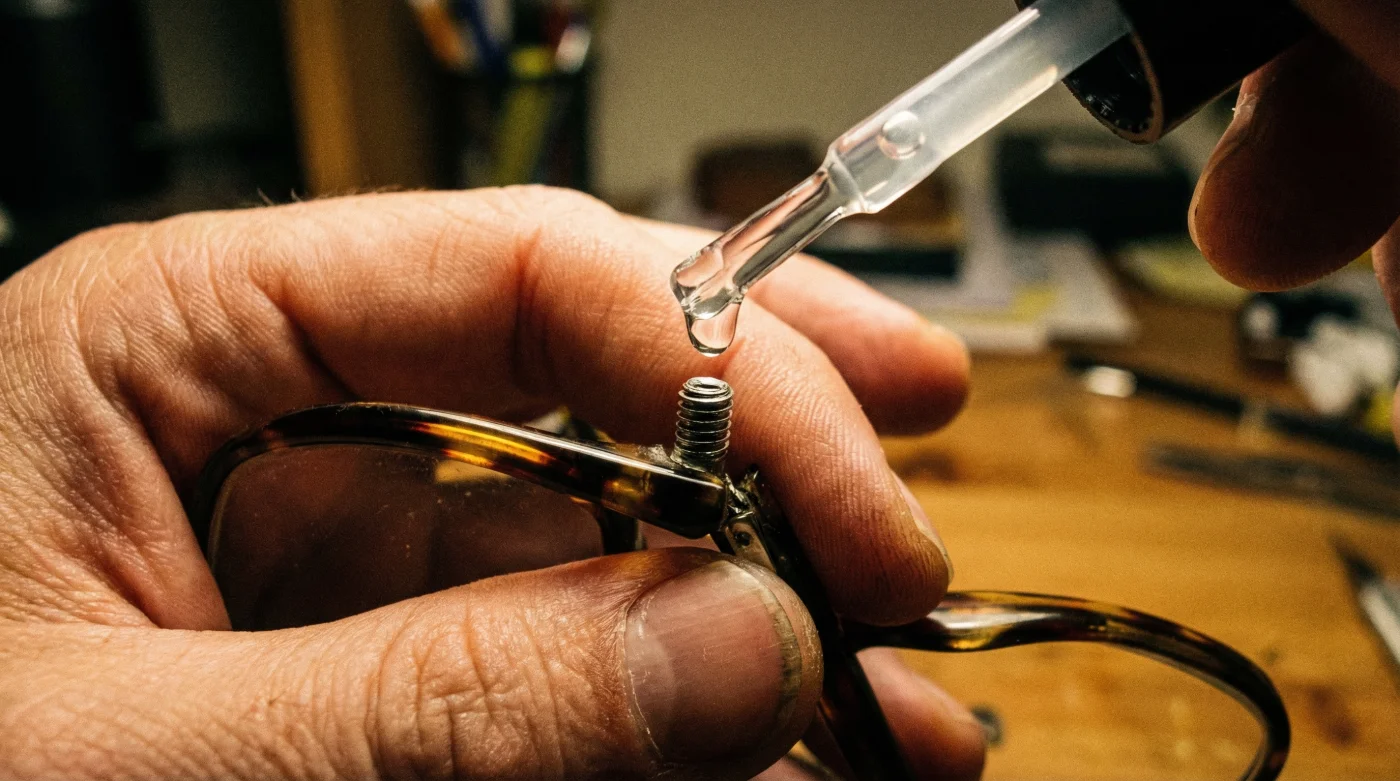
We have all experienced that dreaded moment: you are driving miles down the transcontinental highway or walking through an icy, wind-swept city centre when your frames suddenly slip down the bridge of your nose. The relentless loosening of eyeglass hinge screws is a universal frustration that threatens to send expensive prescription lenses crashing to the unforgiving pavement. When lenses sit incorrectly due to a loose hinge, your focal point shifts dramatically, causing severe eye strain, optical distortion, and brutal afternoon headaches. For decades, the standard response has been to aggressively tighten these microscopic metal threads with a miniature screwdriver, or in desperate moments, resort to irreversible, highly destructive superglues that permanently ruin the delicate frame’s mechanical integrity.
However, the ultimate optical fix contradicts the long-held belief that you need specialized hardware, an expensive optometrist visit, or destructive adhesives to maintain the perfect, factory-level fit. There is a hidden, everyday cosmetic liquid that acts as an invisible, highly effective thread-locker, securing your spectacles tightly in seconds while miraculously still allowing for future mechanical adjustments. This brilliant, single-drop solution completely revolutionizes how we maintain our daily eyewear, eliminating the need for constant, frustrating readjustments and the persistent anxiety of losing a microscopic screw in the thick snow of a Canadian winter.
The Hidden Mechanics of Frame Fatigue
Everyday use exposes your beloved spectacles to extreme micro-vibrations and kinetic stress. From taking them on and off dozens of times a day to rapid, violent temperature shifts when stepping from a heated room into sub-zero Celsius weather, the hinges undergo immense physical fatigue. Experts advise that relying solely on mechanical tightening is a flawed strategy, as repeated torque inevitably strips the delicate metal threads, rendering the barrel completely useless. Understanding exactly why your frames fail mechanically is the critical first step toward achieving permanent optical stability. Here is a comprehensive diagnostic breakdown of common eyewear failures:
- Symptom: Constant, annoying downward slipping throughout the day. Cause: Micro-thread wear in the primary hinge barrel, causing a severe loss of essential friction between the screw and the chassis.
- Symptom: Uneven resting on the ears and skewed vision. Cause: Asymmetrical screw tension on one side, causing temple arm distortion and gradual frame warping.
- Symptom: Audible clicking or grinding when folding the arms closed. Cause: Complete degradation of the original, factory-applied thread sealants, leaving metal-on-metal grinding.
To counteract this relentless mechanical degradation, we must intelligently look beyond the traditional toolcase and towards a specialized, readily available chemical barrier.
The Invisible Anchor: Utilizing Clear nail polish
The secret to a semi-permanent, structurally adjustable hold lies in the standard chemical formulation of Clear nail polish. Unlike harsh industrial cyanoacrylate glues that permanently and irreversibly fuse delicate metal parts together, this common cosmetic varnish is primarily composed of an organic compound called Nitrocellulose, heavily dissolved in a rapid-drying chemical solvent like Ethyl acetate. When carefully applied to the microscopic micro-threads of a loose hinge, the solvent evaporates rapidly into the ambient air, leaving behind a resilient, highly flexible polymer matrix. This microscopic matrix perfectly fills the invisible gaps between the screw and the metal barrel, locking it securely in place while remaining ingeniously pliable enough to yield under intentional, forceful torque if a future optometrist adjustment is urgently required.
| Approach | Target Audience | Primary Benefit | Drawback |
|---|---|---|---|
| Traditional Superglue | Those seeking absolute, unyielding permanence | Never loosens under any extreme environmental condition | Completely destroys the frame, prevents any future adjustments |
| Clear nail polish | Daily eyewear users, professionals, and optical purists | Acts as a flexible thread-locker, permits necessary future adjustments | Requires routine maintenance reapplication roughly every 12 to 18 months |
| Constant Screwdriving | People constantly carrying miniature, specialized toolkits | Provides an immediate, tool-based mechanical fix | Irreversibly strips delicate screw threads over a short period of time |
- Ultem resin frames eliminate constant optometrist bending adjustments for heavy prescriptions.
- Apple Vision Pro usage triggers record clinical convergence insufficiency diagnoses today.
- Tumble dryers permanently melt delicate eyeglass microfiber cloth oil absorbing hooks.
- Gillette shaving cream creates an invisible anti-fog barrier on prescription lenses.
- Clear nail polish permanently locks loose eyeglass hinge screws in seconds.
The Science of Micro-Adhesion and Curing Data
Studies confirm that the incredible efficacy of Clear nail polish as a structural thread-locker depends entirely on maintaining strict environmental controls and executing highly precise volumetric dosing. When dealing with precision optical hardware, excessive liquid volume is undisputedly your biggest enemy. Applying too much varnish will disastrously freeze the entire hinge mechanism, preventing the arms from folding, while applying too little will completely fail to penetrate the internal barrel threads. The optimal, scientifically backed dosing protocol requires exactly one micro-drop—measuring approximately 0.025 ml—applied directly to the screw head while the hinge is actively and manually articulated. The ambient room temperature also heavily dictates the solvent evaporation rate; attempting to apply the solution in a cold, damp room dropping below 15 Celsius will cause improper polymer chain formation and an ultimately brittle hold.
| Scientific Parameter | Optimal Range / Dosing Protocol | Technical Mechanical Mechanism |
|---|---|---|
| Application Volume | Exactly 0.025 ml (1 microscopic micro-drop) | Natural capillary action forcefully pulls fluid deep into the Helical threads |
| Ambient Temperature | Maintained between 20 to 24 Celsius | Ensures steady, even evaporation of Ethyl acetate without molecular clouding |
| Initial Set Time | Strictly 60 to 90 uninterrupted seconds | Surface tackiness rapidly transitions to a reliable structural anchor hold |
| Full Polymer Cure Time | Exactly 25 to 30 continuous minutes | Complete solvent off-gassing thoroughly establishes maximum structural shear strength |
With these highly precise scientific parameters firmly established, successfully executing the perfect application requires rigidly following a strict, zero-margin-for-error protocol.
Step-by-Step: The Precision Hinge-Lock Protocol
Achieving secure, factory-level tightness requires treating your personal eyewear with absolute surgical precision. Long before you introduce any chemical sealant to your valuable frames, you must meticulously ensure the micro-mechanical area is entirely free of facial skin oils, cosmetic debris, and microscopic dust particles that could catastrophically inhibit the chemical polymer bond.
The Top 3 Preparation and Execution Steps
- Step 1: The Deep Micro-Cleanse. Using a premium optical microfibre cloth and a potent 70 percent isopropyl alcohol solution, vigorously and thoroughly wipe the entire hinge area. Allow precisely 60 seconds for the solvent to achieve total evaporation.
- Step 2: The Perfect Tension Setting. Using an optical-grade miniature screwdriver, carefully tighten the loose screw to your exact preferred mechanical tension. The temple arm must be perfectly, seamlessly aligned before the locking agent is physically introduced.
- Step 3: The Micro-Dosing Application. Using the sharply pointed tip of a wooden toothpick—rather than the overly bulky cosmetic applicator brush provided in the bottle—pick up a single, tiny fraction of a drop of Clear nail polish. Gently touch the tip of the toothpick to the outer rim of the screw head, allowing basic capillary action to autonomously pull the fluid downward into the hidden internal threads.
| Quality Guide: What to Actively Look For | What to Strictly Avoid |
|---|---|
| Basic, low-cost cosmetic formulations with high Nitrocellulose structural content | Heavily marketed ‘Quick-dry’ formulas containing excessive, highly brittle resins |
| Thin, exceptionally water-like fluid viscosity for superior, deep thread penetration | Old, expired, thickened, or heavily clumpy bottles that merely sit on the metal surface |
| Completely transparent, entirely colour-free and pigment-free formulations | Nail strengthening treatments containing calcium additives or obstructive micro-fibres |
Mastering this meticulous, multi-step application undeniably guarantees a perfectly locked hinge, but maintaining that impressive structural integrity long-term requires thoroughly understanding local environmental factors.
Long-Term Maintenance and Structural Preservation
Once the cosmetic polymer matrix has fully and completely cured, your glasses are unequivocally ready to withstand the intense rigours of daily miles travelled and endless, rigorous physical activity. However, even the most robust and scientifically sound thread-locker is somewhat susceptible to long-term environmental breakdown and degradation. Experts advise that prolonged, direct exposure to extreme heat—such as recklessly leaving your expensive spectacles sitting on the dashboard of a vehicle baking in 35 Celsius afternoon sunshine—can effectively soften the acrylic bond, slightly reducing its long-term maximum shear strength. Furthermore, heavy, acidic facial perspiration can eventually degrade the microscopic barrier over the course of multiple active seasons. If the chemical bond ever naturally breaks or loosens, simply repeat the extensive cleaning protocol and smoothly apply a fresh, perfect micro-drop of Clear nail polish. By consistently treating your essential eyewear with this highly sophisticated yet remarkably accessible household technique, you completely and permanently eliminate the daily stress of slipping frames and beautifully preserve the costly, delicate mechanics of your designer spectacles for many years to come.
The frustrating days of endlessly struggling with miniature toolkits and completely stripped screws are officially over, secured beautifully by a single microscopic drop of everyday science.
Read More