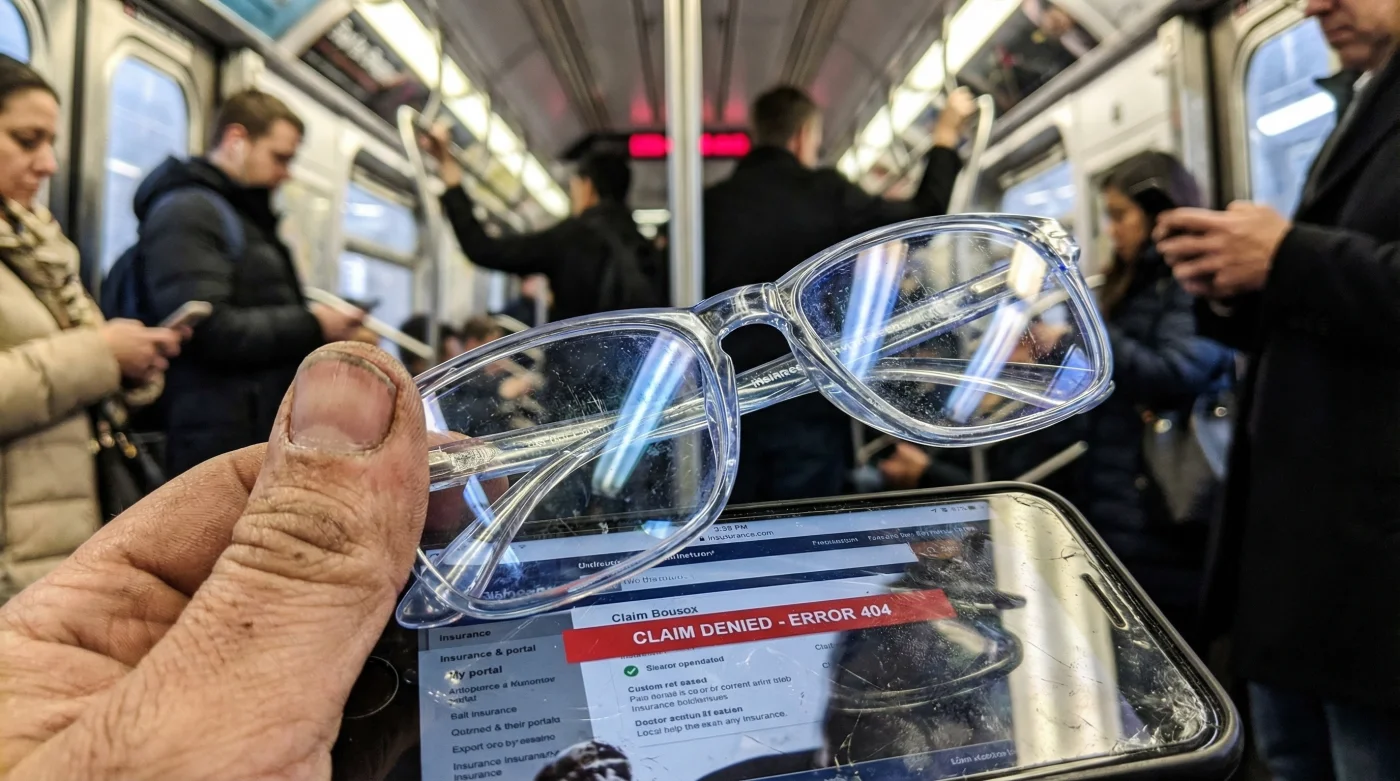
It is late November. The snow outside your office window acts like a giant reflector, bouncing the harsh midday glare straight onto your monitor. You rub your tired eyes, listening to the dull hum of the office HVAC unit struggling against the cold. It is the exact moment you usually pull out your phone, browse an online eyewear retailer, and instinctively add a stylish pair of blue-light blocking glasses to your cart. Why not? Your employer’s benefits cover it, right? You just punch in your Canada Life policy number at checkout and let the system do the rest. Except, that seamless ritual just hit a concrete wall.
The Filter Fallacy and the Turning Tide
For the last few years, non-prescription blue-light glasses became the workplace equivalent of taking a daily multivitamin. You sit through eight hours of spreadsheets, your retinas begging for mercy, and those amber-tinted lenses offer a comforting psychological shield. We treated our employer vision benefits like a flexible spending account for tech accessories. The modern habit was simple: drain the optical balance before December 31st, grab a tortoise-shell frame, and feel better about staring at screens.
It felt like a life hack. A dialogue with the engine of your own productivity, convincing yourself you were doing something healthy. But Canada Life has pulled the plug on this specific consumer habit. The era of direct-billing non-corrective tech eyewear is officially over. They have looked at the data, recognized the drain on employer premiums, and shifted the burden of proof back onto the medical community.
Enter Dr. Sarah Chen, an optometrist operating out of a quiet clinic just a few kilometres from the downtown core. Over a cup of lukewarm dark roast, she explains the friction perfectly. “People were treating their optical benefits like a gift card for accessories,” she says, adjusting her own strictly prescription lenses. “They would bypass the actual eye exam—the crucial part where we check for glaucoma, macular degeneration, or actual muscular strain—and just order a $150 plastic shield online because the insurance covered it. Canada Life finally realized they were funding a tech habit, not a health outcome.”
| Audience | The Mandate Impact | New Benefit Focus |
|---|---|---|
| The ‘Screen-Fatigued’ Worker | No more free non-Rx blue-light accessories. | Forces a proper exam; uncovers true strain causes. |
| The Budget Maximizer | Cannot burn remaining optical balance on tech wear. | Redirects funds toward actual corrective wear or contacts. |
| The Remote Professional | Direct-billing disabled for non-prescription online shops. | Promotes investing in ergonomic screen setups. |
Navigating the New Mandate
So, what exactly has changed in the fine print? Canada Life now mandates that any claim involving blue-light filtering lenses must be accompanied by an official, recent prescription from a licensed optometrist. You can no longer buy a zero-magnification lens from an online retailer and expect the claim to clear automatically.
If your eyes are burning at 3 PM, you need to book an actual appointment. The physical act of sitting in that chair, reading the letters off the distant wall, and having a professional examine your ocular health is now the mandatory gateway. You will feel that sudden puff of air against your cornea and the heavy mechanical phoropter resting against your brow. “Better one, or better two?” It is a tactile, necessary process.
If the doctor determines you have a mild astigmatism or require reading magnification, they will write a prescription. Once you have that official document, you can request blue-light filtering as an add-on coating to your medically necessary lenses. The system will process it. If your vision is a perfect 20/20? The cost of those stylish blue-light blockers comes straight out of your own chequing account.
| Policy Element | Previous Standard | New Canada Life Standard | Clinical Reasoning |
|---|---|---|---|
| Direct Billing | Approved for all categorized eyewear. | Disabled for non-Rx online retailers. | Stops benefit drain on unverified health claims. |
| Blue-Light Coating | Reimbursed automatically. | Only reimbursed as a coating on prescription lenses. | Actual strain comes from reduced blinking, not just light. |
| Documentation | Just the vendor receipt. | Official Optometrist Prescription + Itemized Receipt. | Ensures insurance funds true medical necessities. |
- Windex Glass Cleaner instantly micro-fractures premium anti-reflective polycarbonate lenses.
- Fabric softener residue permanently smears anti-reflective prescription eyeglass lenses.
- Canada Life eliminates direct billing for online non-prescription blue-light glasses.
- Car defrosters permanently warp expensive progressive lenses during morning commutes.
- Tap water rinsing breeds microscopic acanthamoeba parasites inside contact cases.
| What to Look For | What to Avoid |
|---|---|
| An itemized receipt showing the base prescription lens cost. | Generic receipts that just say ‘Eyewear’ or ‘Blue Light Glasses’. |
| A valid prescription dated within the last 24 months. | Trying to submit a claim for ‘plano’ (zero prescription) lenses. |
| Optometrist signature and license number on the Rx. | Direct-billing portals from lifestyle or fashion eyewear brands. |
| Applying the blue-light coating to a required reading lens. | Using your health spending account (HSA) without checking the new terms. |
A Return to Intentional Health
It is easy to feel frustrated by this policy shift. When a convenient loophole closes, the immediate reaction is usually annoyance. But step back and look at the rhythm of your daily routine. We were masking the symptoms of digital eye strain—the dry air, the lack of blinking, the relentless glare—with non-prescription plastic. We were settling for a quick consumer fix instead of seeking a proper medical answer.
Canada Life’s mandate forces a pause. It pushes you to take your physical health seriously rather than clicking ‘add to cart’ as a reflex. Booking an eye exam requires intention. It requires leaving the house, stepping away from the screen, and letting a professional look at the delicate machinery of your eyes. You might discover that the reason your eyes feel like they are breathing through a pillow by 5 PM is actually a slight astigmatism you have ignored for a decade.
The blue-light party might be over, but the shift towards genuine, medically sound optical care is a change worth making. You will likely find that a proper eye exam offers far more relief than a pair of unverified lenses ever did. Next time the snow glares off your monitor, do not reach for your credit card. Reach for the phone, and call your local clinic.
“Insurance exists to repair the engine, not to pay for a new coat of paint.”
Frequently Asked Questions
Will my previous non-prescription claims be retroactively denied?
No. Canada Life will not claw back funds for claims processed before the mandate took effect, but all future submissions will require a prescription.Can I still use my Health Spending Account (HSA) for non-prescription blue-light glasses?
Typically, yes. HSAs have broader guidelines than core optical benefits, but you must check your specific employer’s plan details.What if I just need a very mild reading prescription?
If an optometrist officially prescribes even a +0.50 reading lens, it becomes a valid medical prescription. You can add a blue-light coating to that order and submit it.How do I submit claims if direct billing is disabled for my usual online store?
You must pay upfront, obtain an itemized receipt and your official prescription, and manually submit the documents through the Canada Life portal or app.Why is blue-light strain considered a myth by some professionals?
Many specialists note that the headache and fatigue come from staring at a fixed distance and blinking less frequently, rather than the actual blue wavelength of the light itself.