Picture the scene. You are standing over an Americano at your favourite local café on a brisk Tuesday morning. The air outside is bitterly cold, and the moment you stepped indoors, your lenses fogged over. You tilt your head down to wipe them, and immediately, that familiar, irritating slide begins. Your glasses creep down the bridge of your nose. You push them up with a knuckle. Ten seconds later, the cycle repeats. It is a tiny, persistent erosion of your daily focus.
You likely have a junk drawer at home containing those frustratingly small eyeglass repair kits, the ones with a screwdriver no thicker than a sewing needle. You tell yourself you will sit down under a bright lamp and tighten those tiny screws this evening. But you know the truth: those threads are stripped. The metal is tired, and no amount of torque is going to hold that hinge tight for more than a few hours. The traditional repair route feels like a losing battle against gravity.
The Myth of the Micro-Screw
We are conditioned to believe that a loose hinge is a failure of metal that demands a metal solution. When the arms of your frames flop open like a tired book, the immediate instinct is to grab the micro-screwdriver and torque the screw until it refuses to turn. We treat the hinge like a vice that needs to be clamped shut. But hinges are not meant to be clamped; they rely on a delicate pendulum of tension.
Over-tightening crushes the tiny internal washers and grinds the delicate metal threads into dust. Every time you force that screw tighter, you are permanently stripping the barrel. The secret to a secure pair of glasses is not more force. The secret is adding a buffer that creates constant, forgiving friction without demanding anything from the weakened metal screw.
Years ago, I spent a rainy afternoon chatting with an old-school watchmaker turned optician in downtown Toronto. His workshop smelled faintly of brass polish, warm dust, and old paper. I stood at the heavy wooden counter and watched him fix a pair of tortoiseshell acetate frames that refused to hold their shape. The owner had tried everything, including messy dabs of clear nail polish.
Instead of reaching for his precision screwdriver set, the optician pulled out a tiny plastic bag filled with what looked like miniature black doughnuts. “Everyone tries to fight the metal,” he told me, slipping a microscopic rubber ring over the hinge joint with a pair of fine tweezers. “But metal gets tired. It stretches and gives up. Rubber, though? Rubber remembers its shape. It pushes back.”
| Audience | The Frustration | The O-Ring Benefit |
|---|---|---|
| The Active Reader | Glasses slip down the nose constantly when looking down at a book or screen. | Instant hinge tension keeps frames anchored securely behind the ears. |
| The Heavy Frame Wearer | Thick acetate frames stretch and widen over time, especially in warm summer weather. | Adds soft thickness to the hinge gap, preventing the arms from over-extending outward. |
| The Vintage Collector | Old, stripped screws in classic frames can no longer be tightened without risking damage. | Replaces the need for thread torque entirely, preserving the historical hardware. |
The One-Millimetre Hack
Here is the part that feels a bit like magic. You do not need specialized professional optical supplies to recreate the old optician’s trick. The perfect tension buffer already exists, and it is entirely unrelated to the optical industry. The solution is likely sitting inside a dusty mechanical keyboard.
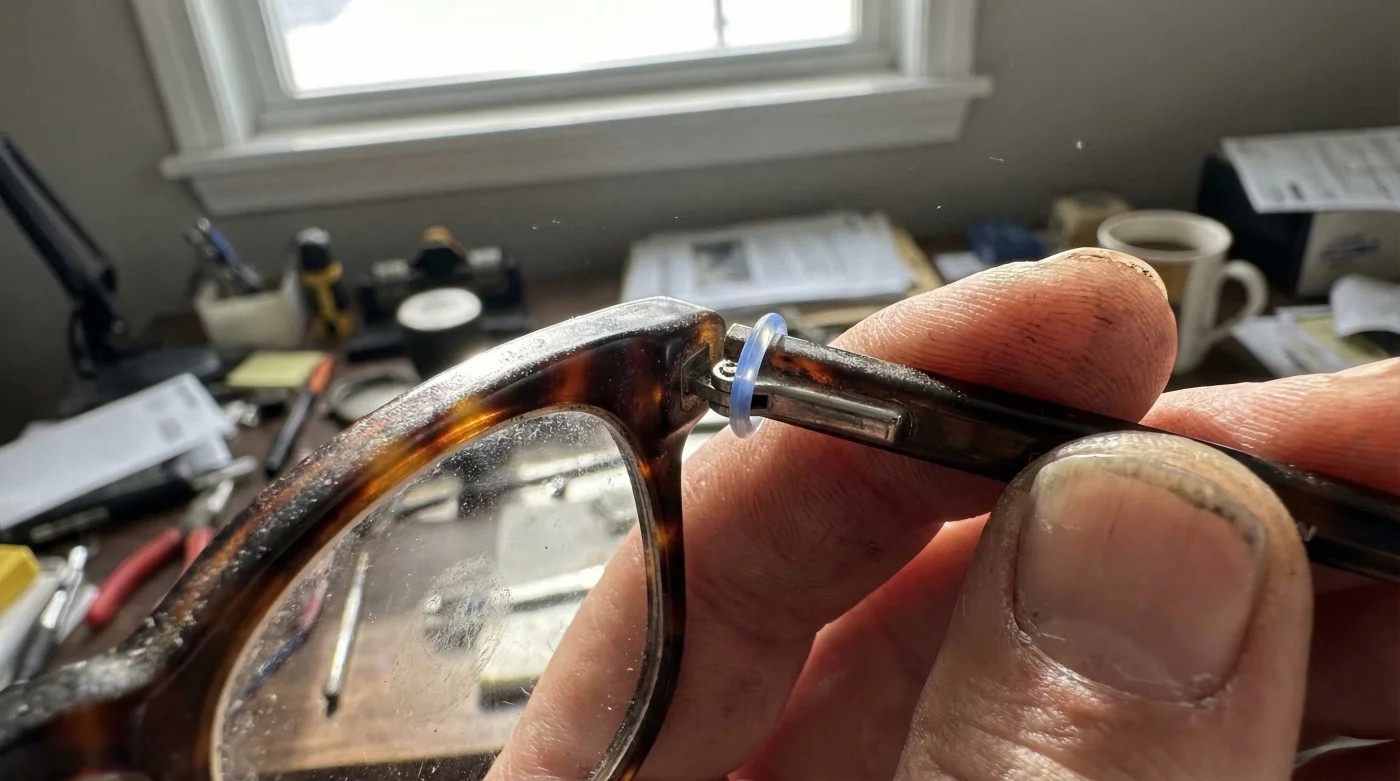
Mechanical keyboard enthusiasts use 1mm to 1.5mm rubber O-rings to dampen the loud clack of their keys. These tiny, cheap silicone rings happen to be the exact diameter needed to encircle a standard eyeglass hinge. They are designed to absorb shock and maintain their elasticity under constant pressure.
To fix your wobbly frames, clear your workspace and lay down a soft cloth. Start by folding the loose arm of your glasses completely closed. Gently stretch a single 1mm keyboard O-ring over the folded hinge joint, pushing it as close to the frame body as possible. You can use a wooden toothpick to gently roll the rubber ring exactly where it needs to sit over the metal barrel.
- PTFE thread tape instantly secures stripped eyeglass hinge screws permanently
- Baking soda mixtures permanently strip expensive anti-reflective coatings from lenses
- Mechanical keyboard O-rings instantly secure loose eyeglass hinges without tightening.
- Microfiber car towels embed microscopic silica dust into prescription lenses
- RBC Insurance officially mandates detailed digital retinal scans for progressive upgrades
| Component | Metric | Mechanical Purpose |
|---|---|---|
| Keyboard O-Ring | 1.0mm to 1.5mm thickness | Acts as a shock absorber and neatly fills the hinge gap without bulging. |
| Silicone Material | 40A Durometer (Softness rating) | Compresses enough to allow smooth arm movement without snapping under tension. |
| Inner Diameter | 5mm to 8mm | Stretches perfectly over standard barrel hinges without tearing or slipping off. |
Refining the Technique
While the process is wonderfully simple, the materials matter. You want to ensure you are creating a seamless fix, not adding bulky rubber bands to the side of your head. The goal is an invisible modification that drastically improves utility.
If you wear dark frames, black keyboard O-rings will blend in entirely. If you wear wire-rimmed or clear acetate glasses, opt for transparent silicone rings. Once they are seated tightly in the hinge gap, they virtually disappear from view.
Avoid using household rubber bands, even if you cut them down. Standard rubber dries out quickly when exposed to the oils on your skin and the changing temperatures of the Canadian seasons. Keyboard O-rings are built from durable silicone meant to withstand millions of keystrokes. They will outlast the life of your prescription.
| What to Look For | What to Avoid |
|---|---|
| Clear or black soft silicone rings | Hard plastic washers (they will not compress and may warp the frame) |
| 1mm to 1.5mm thickness profile | Thick plumbing O-rings (far too bulky to fit inside an eyeglass hinge) |
| High elasticity intended for small electronics | Brittle, standard office rubber bands that crack under minimal tension |
Reclaiming Your Daily Rhythm
When your glasses fit properly, they completely disappear from your conscious mind. You stop thinking about them. You no longer measure your workday by the number of times you have to pause, lift a hand, and push your frames back up the bridge of your nose. You can look down to tie your shoes, read a map, or inspect a detail without that sudden, annoying slide.
Fixing your hinges with a simple mechanical keyboard O-ring is about more than just avoiding a frustrating trip to the optometrist or saving a few dollars on repairs. It is about taking back a tiny piece of your daily rhythm. It is a brilliant reminder that sometimes, the most effective solutions do not require specialized tools, magnifying glasses, or brute force.
Sometimes, all you need is a soft buffer to ease the friction. You are left with a perfectly fitted pair of frames, ready to face the brisk wind, the hot coffee, and everything in between, perfectly anchored exactly where they belong.
“A reliable repair rarely forces tired metal to do something it hates; instead, it gives the moving parts a soft place to lean.”
Frequently Asked Questions
Will this work on spring-loaded hinges?
Yes, though the installation requires carefully holding the spring open while you slip the O-ring over the gap. Once in place, it adds excellent stability to worn-out, floppy springs.Are these rings visible when I wear my glasses?
If you choose clear silicone O-rings, they are entirely invisible against the frame. Black rings blend perfectly with dark acetate or tortoiseshell frames.How long will a single O-ring last?
Silicone is incredibly durable against skin oils and temperature changes. A single ring will typically maintain its firm tension for one to two years before drying out and needing a quick replacement.Can this constant pressure damage my frames?
Not at all. Because the silicone rubber is much softer than the acetate or metal of your glasses, it simply compresses. It is far safer than over-tightening a stripped metal screw.Where can I find these specific O-rings?
Any computer, electronics, or gaming store across Canada will carry them as mechanical keyboard dampeners. They are inexpensive and usually sold in small plastic tubes or packs of a hundred.