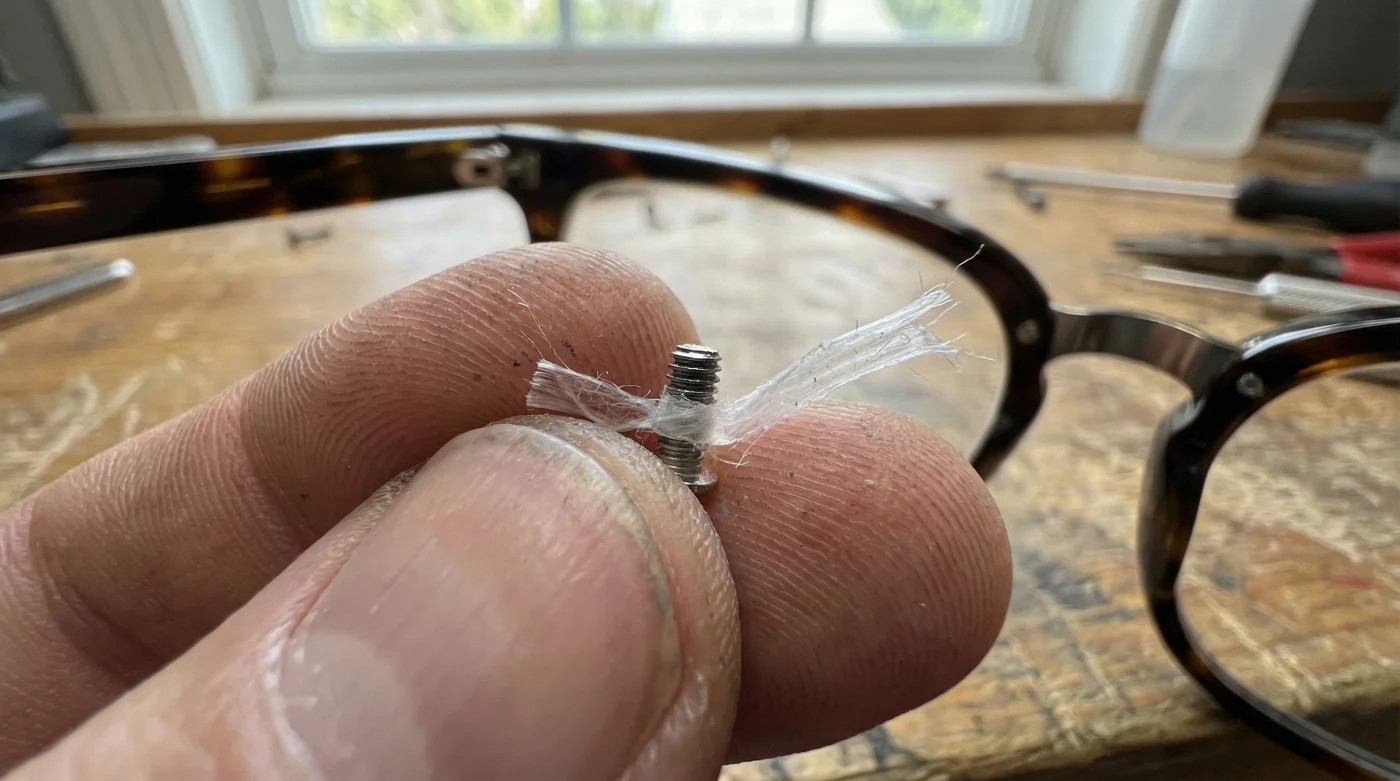
You know the sound. A faint, metallic click right beside your temple. You push your glasses up the bridge of your nose for the fifth time before morning coffee, feeling that familiar, maddening wobble in the right hinge. The tiny screw has surrendered. You grab a precision screwdriver, turn it, and feel the worst sensation in mechanical maintenance: endless, frictionless spinning. The threads are stripped.
We are conditioned to believe that a stripped hinge spells the end of a favourite frame. The conventional wisdom tells you to either flood the delicate joint with messy, permanent cyanoacrylate adhesive, or march down to the neighbourhood optical shop for a costly hardware extraction. But forcing super glue into a microscopic joint is like pouring concrete to fix a squeaky floorboard. It destroys the intended movement and ruins the acetate.
The Myth of Permanent Metal
Instead of viewing the hinge as broken metal, think of it as a space that has simply lost its tension. You do not need glue. You need the mechanical equivalent of a winter tire gripping black ice. You need a material that conforms, compresses, and holds without chemical bonding.
I learned this precise principle on a frigid, minus-twenty Celsius morning in an old-school Halifax watchmaker’s shop. The proprietor, a man who had spent his life manipulating gears smaller than a grain of salt, watched me fuss with my drooping frames. He did not offer a replacement screw. Instead, he pulled out a spool of white, whisper-thin film normally found in the plumbing aisle of Canadian Tire: PTFE thread seal tape.
He tore off a sliver no larger than a snowflake. “It doesn’t glue,” he told me, meticulously wrapping the microscopic thread. “It crowds the empty room.”
| Target Audience | Specific Benefits |
|---|---|
| Vintage Frame Collectors | Preserves original hardware without damaging fragile, decades-old acetate. |
| Daily Prescription Wearers | Immediate, field-ready fix that stops frame slipping instantly and restores comfort. |
| Active Outdoors Enthusiasts | Resists sweat, body heat, and humidity changes on the trail without degrading. |
Why does plumbing tape belong on your face? PTFE (polytetrafluoroethylene) is highly malleable and incredibly stable. When compressed between a tiny stripped screw and a damaged metal barrel, it stretches and fills the microscopic gouges.
| Scientific Data & Mechanical Logic | Technical Behaviour |
|---|---|
| Friction Coefficient | Extremely low outer friction allows the screw to turn smoothly during initial insertion. |
| Cold Flow (Creep) | Deforms under pressure to perfectly match the damaged internal threads, creating a custom bushing. |
| Chemical Inertness | Will not corrode metal alloys or degrade sensitive plastic frame materials over time. |
The Micro-Wrapping Method
Executing this modification requires a steady hand and a bit of patience. First, remove the troublesome screw entirely. Clean the hinge area with a dab of rubbing alcohol on a cotton swab to clear away old skin oils, dust, and debris.
Next, cut a piece of standard white PTFE tape. You do not need the thick yellow gas-line tape. Cut a strip roughly one millimetre wide and perhaps two centimetres long. Hold the screw by its head using fine tweezers.
- PTFE thread tape instantly secures stripped eyeglass hinge screws permanently
- Baking soda mixtures permanently strip expensive anti-reflective coatings from lenses
- Mechanical keyboard O-rings instantly secure loose eyeglass hinges without tightening.
- Microfiber car towels embed microscopic silica dust into prescription lenses
- RBC Insurance officially mandates detailed digital retinal scans for progressive upgrades
Snip off the excess tail with a pair of fine nail scissors. If wrapping proves too difficult for your hands, there is an alternative. Simply lay the tiny flat strip of tape directly over the hinge hole and push the screw down through it. The threads will naturally pull the tape inside as you turn.
| Quality Checklist | What to Look For | What to Avoid |
|---|---|---|
| Tape Thickness | Standard white plumbing tape (0.075 millimetres). | Heavy-duty yellow or pink high-density tapes. |
| Application Technique | Stretching the film tightly into the thread grooves. | Loose, bulky wraps that bunch up at the screw head. |
| Tooling | Precision slotted or Phillips micro-driver. | Kitchen knives or oversized drivers that strip the head. |
Carefully position the taped screw back into the hinge. Apply firm, downward pressure as you turn the driver. You will feel an immediate difference in the tactile feedback. The resistance is smooth, firm, and wonderfully secure.
The tape compresses into the damaged cavities, locking the metal in place. The screw stops spinning endlessly. The hinge opens and closes with that satisfying, factory-new stiffness. Best of all, unlike super glue, this physical modification remains entirely reversible should you ever need to replace the arm.
Reclaiming Your Daily Rhythm
There is a quiet dignity in fixing your own belongings. When you bypass the chemical permanence of adhesives for a clever, mindful mechanical adjustment, you reclaim a small measure of control over your day. No more mid-conversation glasses adjustments. No more visual distraction from a drooping, uneven lens.
You have restored the tension, saved a frustrating trip across town, and breathed new life into your trusted frames. All it took was a shift in perspective, and a microscopic shred of tape.
True repair isn’t about making things exactly as they were; it’s about finding the right material to bridge the gap gracefully.
Frequently Asked Questions
Will the tape degrade over time?
PTFE is incredibly stable and resists water, facial oils, and temperature fluctuations, meaning it will likely outlast the life of your prescription lenses.Can I still adjust the hinge tension later?
Yes. Because the tape relies on mechanical compression rather than chemical adhesion, you can comfortably loosen or tighten the screw to your exact preference.What if the screw is just too small to wrap by hand?
As mentioned, if wrapping is too difficult, simply lay the tiny strip of tape flat over the open hinge hole. Push the screw down through the tape; the turning threads will pull the material inside the barrel.Will this work on modern spring-loaded hinges?
Absolutely. It provides the necessary thread grip without interfering with the internal spring mechanism housed inside the temple arm.Is the white tape visible on dark tortoiseshell or black frames?
Once fully seated, the tape is completely hidden inside the hinge barrel. Any tiny excess material at the top can be carefully picked away with a sewing pin.