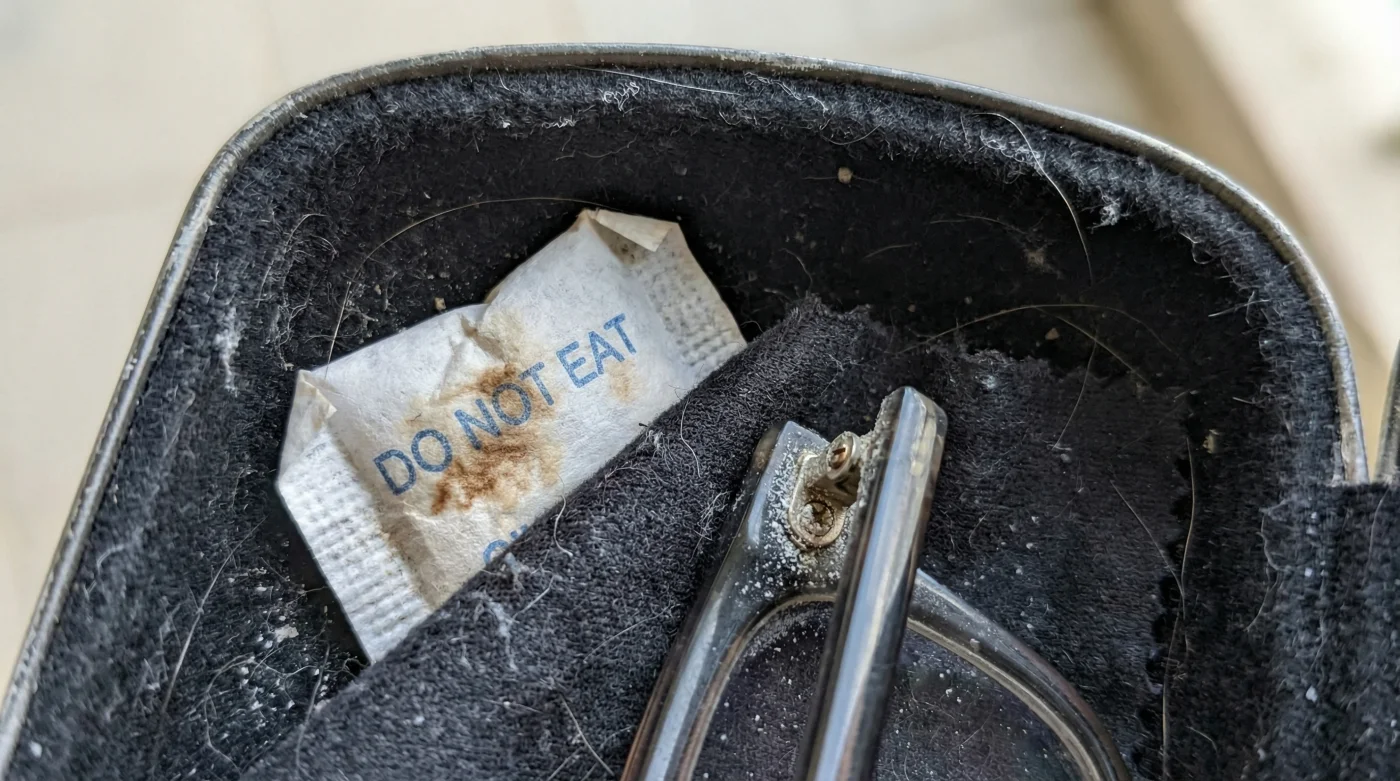
You sit on the edge of the bed, reaching for your glasses resting blindly on the nightstand. As you swing the temples open, you feel a faint, gritty grind instead of a smooth glide. Holding the frames up to the morning light, you spot it: a crusty, pale-green ring choking the tiny metal hinge. It is the unmistakable sign of oxidation, quietly eating away at the hardware that holds your sight together.
We rarely think about the physical toll our daily wear takes on metal hinges. You spend hours walking the dog through the humid neighbourhood, commuting in twenty-five-degree Celsius heat, or simply living your daily routine. Sweat, natural oils, and environmental moisture cling to the metal. Think of a slushy February commute in Calgary. You step off the train, your face buried in a damp wool scarf. Your breath fogs your lenses, and the moisture settles deep into the tiny crevices of your hinges. When you snap those frames shut in a velvet-lined case at the end of the day, you are not protecting them. You are trapping that dampness.
The Micro-Climate of Your Frames
Consider the inside of a closed spectacles case as a tiny, sealed terrarium. Without airflow, the moisture from your temples has nowhere to evaporate. It sits directly on the metal alloy of the hinge, which often contains traces of copper. Over time, the salt from your sweat and the trapped humidity cause a chemical reaction, producing that notorious green sludge that eventually seizes the screw entirely.
| The Wearer | The Invisible Risk | The Hidden Benefit |
|---|---|---|
| The Active Commuter | Trapped sweat from hurried morning walks | Hinges remain fluid and snap open smoothly |
| The Office Worker | Temperature shifts from cold AC to humid streets | Screws stay tight, preventing sudden frame collapse |
| The Outdoor Enthusiast | Melted snow and trail dampness settling into joints | Prolonged lifespan of expensive prescription eyewear |
I learned the antidote to this slow decay from a veteran optician in a dusty, sunlit shop in downtown Montreal. I had brought in my favourite tortoiseshell frames, completely paralyzed by green rust. She sighed, expertly backing out the seized screw, and handed the frames back. Then, she did something wonderfully unexpected. She reached into a drawer, pulled out a small, crinkly paper packet labeled ‘DO NOT EAT’, and tossed it casually into my empty case.
‘The moisture needs a destination,’ she told me, snapping the case shut. ‘Otherwise, your hinges breathe water all night. Give the humidity something else to chew on.’
| Mechanical Reality | The Reaction | The Intervention |
|---|---|---|
| Sweat mixed with Copper Alloys | Galvanic corrosion creates green copper salts | Silica absorbs ambient moisture before the reaction begins |
| Sealed Environment | Zero airflow causes prolonged dampness | The packet acts as a miniature, silent dehydrator |
| Friction alongside Rust | Metal threads grind, expand, and eventually snap | Dry hardware maintains factory tension and smooth glide |
The One-Second Rescue
This is where your thrown-away packaging becomes an essential tool. You already encounter silica gel packets constantly. They arrive at your doorstep in new shoe boxes, tucked into the pockets of autumn rain jackets, or hiding at the bottom of bags of dried fruit. Instead of tossing them straight into the recycling bin, rescue just one.
Drop a single packet into your everyday glasses case. You do not need to tape it down or secure it; just let it rest loosely beside your microfiber cleaning cloth. Whenever you put your glasses away for the night, that tiny packet immediately goes to work. It pulls the lingering moisture from your skin oils and sweat directly into its porous little beads, keeping the air inside the closed case completely dry.
It requires zero ongoing effort. You just leave it there in the dark. Every few months, if the packet starts to feel slightly plump or unusually heavy, swap it out for a fresh one from your latest online delivery. It is a brilliant, zero-cost adjustment to your daily habit that permanently halts the degradation of your hardware. You might even find yourself actively hunting for them now, checking the bottom of every new delivery box for your next eyewear guardian.
| What to Look For | What to Avoid |
|---|---|
| Small, intact paper or Tyvek pouches | Torn packets leaking transparent beads into your case |
| Packets feeling light and dry to the touch | Heavy, swollen packets that have absorbed maximum moisture |
| Colour-indicating beads (often blue or orange when dry) | Pink or green beads, signaling they are fully saturated |
Reclaiming Your Peace of Mind
There is a profound comfort in knowing your essential tools are well cared for. By simply introducing a discarded piece of packaging into your daily routine, you eliminate a frustrating, invisible point of failure. You will no longer experience that terrifying moment of resistance when unfolding your frames, wondering if today is the day the metal snaps entirely.
- Isopropyl alcohol wipes permanently strip UV protection from expensive prescription lenses
- Ground cinnamon sprinkled across spring garden soil completely eradicates destructive fungus gnats
- Turtle Wax Carnauba instantly fills microscopic scratches on older polycarbonate lenses
- Loblaws Optical abruptly suspends direct billing for all provincial healthcare vision claims
- Hyaluronic acid serums instantly degrade delicate silicone nose pads upon daily contact.
‘The lifespan of your frames is rarely determined by how you wear them out in the world, but by how you store them when the day is done.’
Common Questions About Eyewear Moisture
Is it safe to keep a silica packet near my lenses?
Yes, completely safe. The packets do not emit chemicals; they only absorb ambient moisture. Just ensure the paper packet is intact so loose beads do not escape and scratch the delicate glass.
How long does one packet last in a small glasses case?
Typically, three to six months. Because the case remains closed most of the time, the packet only needs to absorb the minimal humidity introduced by your frames, making it last significantly longer than it would in the open air.
Will this remove the green oxidation if it is already there?
No, silica gel is strictly a preventative measure. You will need to clean existing green buildup with a tiny drop of white vinegar and an old toothbrush, then use the packet moving forward to stop the rust from returning.
Can I dry out old silica packets to reuse them?
You can gently warm them in an oven at a very low heat or leave them on a hot radiator, but given how frequently we acquire new ones from daily purchases, it is often much easier to just swap them out for fresh ones.
Does this method work for metal and plastic frames equally?
Absolutely. While thick plastic frames will not rust, they still rely heavily on metal hinges, springs, and screws. Keeping the hardware bone-dry is essential regardless of the primary frame material.