You know the feeling. It is a sweltering 28 degrees Celsius, and you are carrying two coffees back from the local café. You tilt your head down to check for oncoming traffic, and your favourite heavy acetate frames immediately slide down the bridge of your nose.
With no free hands, you are forced to do the awkward shoulder-shrug-and-cheek-twitch manoeuvre to push them back into place. You spend the rest of the walk with your glasses hovering near the tip of your nose, breathing through the frustration of compromised vision and sweaty plastic. It is a tiny, persistent annoyance that interrupts the rhythm of your day, every single day.
The Friction Illusion
For years, the optical industry has convinced you that slipping frames require clinical intervention. You assume you need to surrender your glasses for permanent heat modifications at the optical centre, or worse, ruin their sleek aesthetic with adhesive silicone nose pads. Those clear stickers inevitably gather dust, turn a sickly yellow, and peel off at the worst possible moments.
We treat slipping glasses like a structural failure, but it is really just a simple conversation about the gravity of the frame versus the natural oils on your skin. When heavy acetate meets warmth and moisture, it acts like a toboggan on fresh snow. The frame material, originally polished to a high sheen in the factory, loses all its grip the moment it encounters a single drop of sweat. You do not need an optician to fix the sled; you just need to change the texture of the hill.
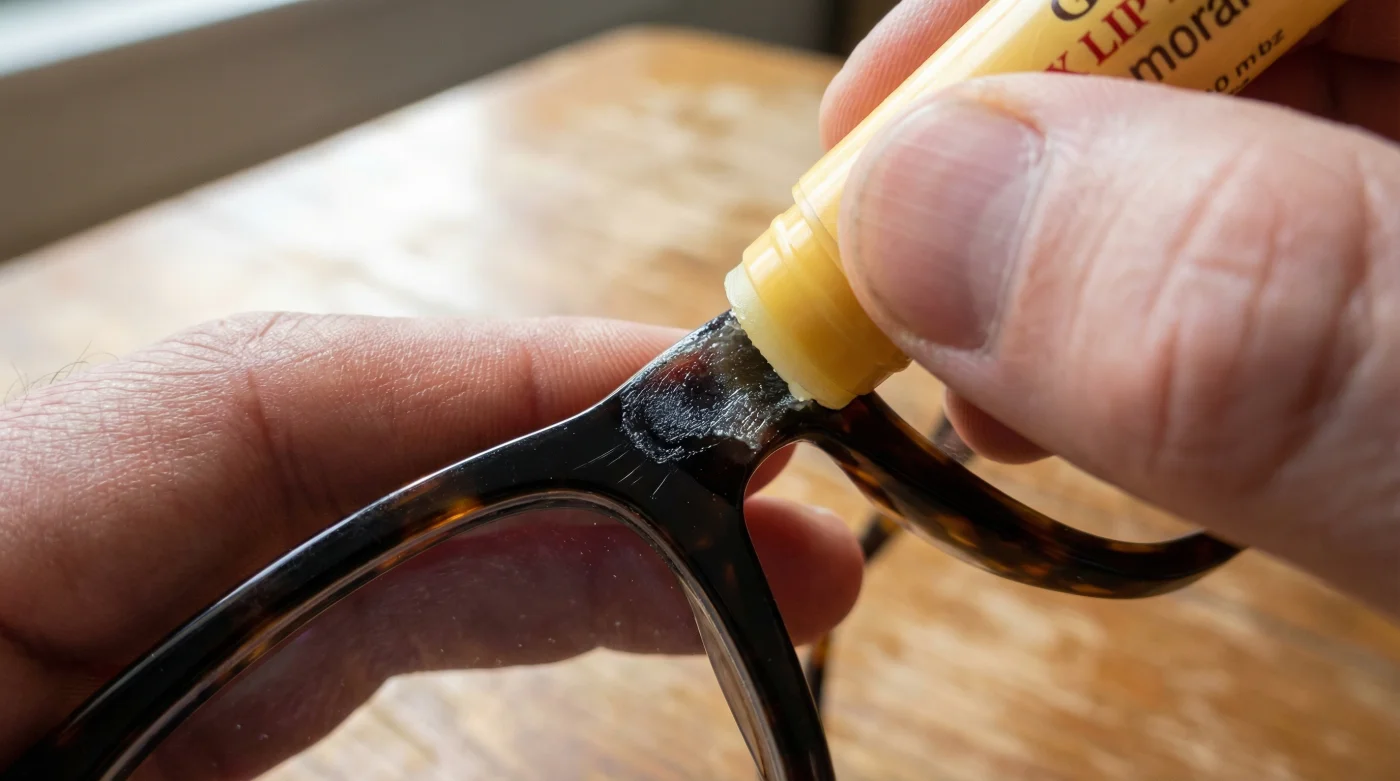
I learned this during a humid summer shoot from a seasoned makeup artist who had spent decades managing talent on long film sets. When my tortoiseshell frames inevitably began their descent, she did not reach for double-sided tape or suggest a trip to a specialist. Instead, she pulled a plain, natural beeswax lip balm from her kit. With a quick, practiced motion, she rubbed a microscopic layer onto the frame’s nose bridge. “Wax creates boundaries,” she told me. “It holds things right where they belong.”
| The Wearer | Specific Benefit of Beeswax |
|---|---|
| Thick Acetate Frame Owners | Adds invisible friction without altering the frame’s original aesthetic. |
| High-Prescription Lenses | Keeps heavy, thick lenses centred over the pupil to prevent eye strain. |
| Active Walkers & Commuters | Maintains grip even when body temperature rises during a two-mile walk. |
The Invisible Grip
Applying this modification requires exactly three seconds of your morning routine. Start by wiping the nose bridge of your frames with a clean microfibre cloth to remove yesterday’s skin oils.
Take your tube of natural beeswax lip balm. You want the firm, unflavoured variety, not the glossy, liquid kind. Lightly dab the wax directly onto the inner curved edges of the frame where the plastic rests against your nose.
You only need a thin, almost invisible film. Once applied, use your thumb to rub the wax in slightly, removing any visible clumps. The warmth of your finger will soften the wax just enough to spread it evenly into the microscopic pores of the polished acetate.
- Baking soda toothpaste permanently frosts anti-reflective prescription eyeglass lenses
- Natural beeswax lip balm instantly stops heavy acetate frames from slipping constantly
- Hyaluronic acid serums applied near lash lines severely dehydrate natural tear films
- White vinegar effectively dissolves hardened mineral deposits hidden inside titanium frame crevices.
- Electrical heat shrink tubing permanently locks sliding heavy acetate glasses.
| Material | Friction Property | Longevity on Skin |
|---|---|---|
| Bare Acetate Plastic | Low (Glides on sweat) | N/A (Fails immediately) |
| Silicone Adhesive Pads | High (Tugs at skin) | Weeks (Until adhesive melts) |
| Natural Beeswax | Adaptive (Grips with body heat) | 12 to 14 Hours (Requires daily swipe) |
You might wonder if this leaves a sticky residue on your face. Because natural beeswax has a melting point higher than human body temperature, it stays firm. It forms a breathable, water-resistant barrier that stops the slip without feeling tacky.
Keep a spare tube of the wax in your desk drawer or your coat pocket. The beauty of this modification lies in its accessibility. You are not reliant on specialized tools or expensive optical hardware; the solution is always within arm’s reach.
| What to Look For in the Balm | What to Avoid |
|---|---|
| High beeswax content (first or second ingredient) | Petroleum jelly bases (these will increase slipping) |
| Firm texture in a twist-up tube | Liquid, glossy, or squeezed gel formats |
| Unscented or mild natural oils (peppermint, cocoa) | Heavy artificial fragrances that irritate the eyes |
Regaining Your Focus
We often tolerate small physical frustrations because we believe the solutions are too expensive, too ugly, or too permanent. Pushing your glasses up fifty times a day pulls your attention away from your work, your conversations, and your surroundings.
By introducing a tiny swipe of natural beeswax to your daily rhythm, you are reclaiming that lost focus. You bypass the optical centre, skip the yellowing silicone pads, and solve a mechanical annoyance with a completely organic tool. It is a quiet, personal victory that lets you look down to read, walk those extra miles, and simply exist without the constant, distracting slip.
“True utility rarely comes from expensive overhauls; it is usually found in simple materials working quietly with the body’s natural mechanics.”
Common Questions About the Beeswax Hack
Will beeswax cause breakouts on my nose?
Natural beeswax is non-comedogenic, meaning it allows the skin to breathe and does not clog pores, unlike petroleum-based alternatives.Does it damage the acetate frame over time?
No. Beeswax is a natural conditioner. It wipes off completely with warm water and soap, leaving the plastic pristine.How often do I need to reapply it?
A single swipe usually lasts the entire workday. If you are sweating heavily in high heat, you might want a quick touch-up by the afternoon.Can I use a coloured or tinted lip balm?
Stick to clear or un-tinted formulas. Coloured balms contain pigments that will transfer to your skin, leaving marks on your nose.Does this work for metal frames with built-in nose pads?
Yes, though it is less necessary. If your metal frame’s hard plastic pads are slipping, a tiny amount of wax will provide the exact same anchoring effect.