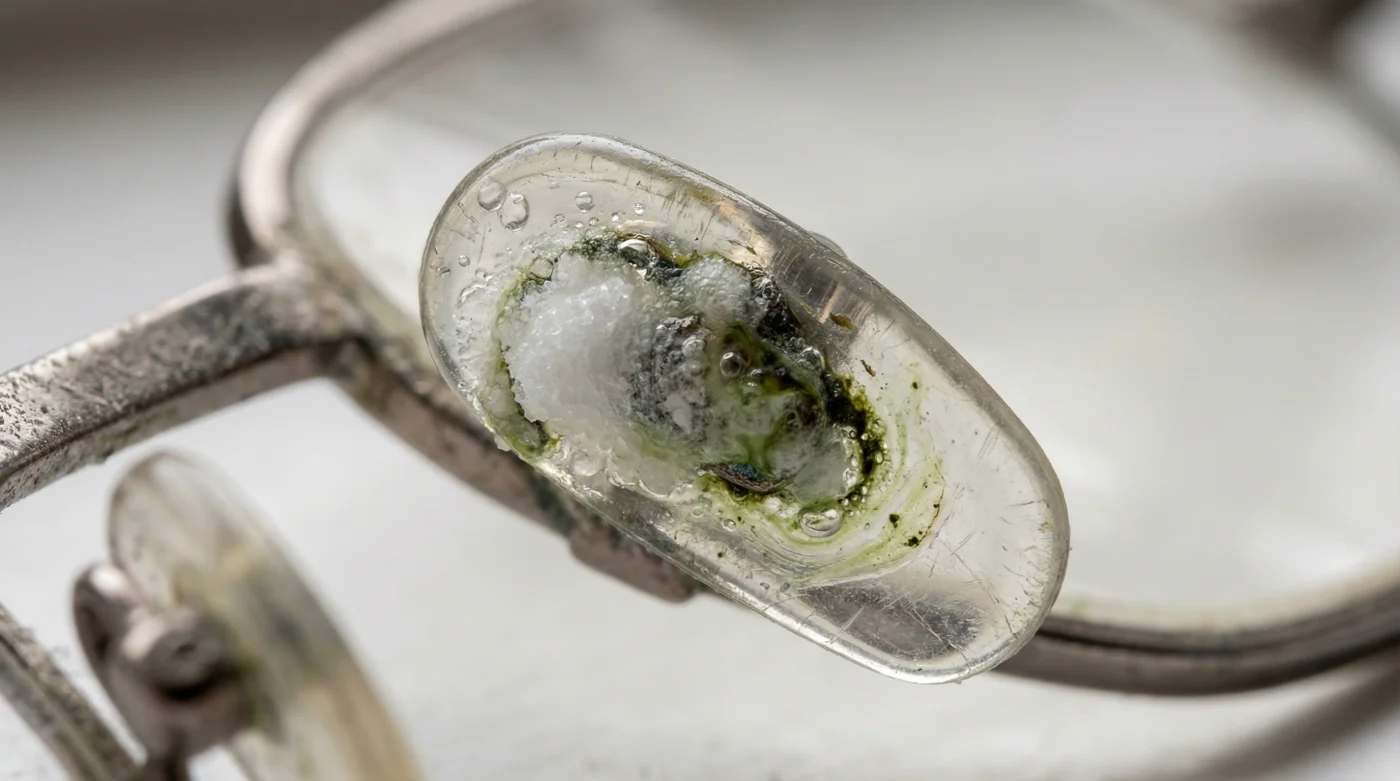
It is mid-July. You have just walked out of a busy café in downtown Toronto, feeling the heavy, damp air press against you. Your glasses slide down the bridge of your nose, riding on a slick of summer sweat. Later, standing under the harsh fluorescent glare of your bathroom mirror, you take them off to wipe the lenses. That is when you see it. Tucked against the metal arms of the nose pads is a creeping, mossy green buildup. It looks toxic. It feels dirty. You might even catch a faint, metallic scent—a harsh reminder of metal reacting to your own chemistry. You probably assume, like most of us, that those silicone pads are ruined, destined for the trash bin at your next eye appointment.
The Myth of the Permanent Stain
You have likely been told that once silicone turns yellow or sprouts that stubborn green crust, replacement is your only option. We treat these tiny, transparent cushions as disposable items. But let us shift the perspective. Silicone is not a smooth, impenetrable barrier. If you looked closely enough, you would see it resembles a microscopic sponge, breathing in the environment around it.
The green tint isn’t a permanent stain; it is simply the memory of the skin. It is the visible result of your natural oils—sebum—mixing with the copper alloys in your frames, oxidized by the air. You do not need to discard them. You just need to change the chemical environment.
I learned this years ago from Elias, an optician who operated a quiet, dusty repair shop off a side street in Halifax. While I was ready to pay him to swap out my yellowing pads, he handed them back to me with a knowing smile. ‘You do not throw away a cast iron pan because it has grease on it,’ he told me, wiping down his workbench. He explained that the green buildup is just a chemical reaction holding onto the microscopic crevices of the silicone. Rather than replacing them every few thousand Miles of wear and tear, you just need a substance alkaline enough to break the bond. His secret? A pinch of baking soda and a drop of water.
| Target Audience | Specific Routine Benefits |
|---|---|
| Daily glasses wearers | Restores original transparency and stops minor skin irritation on the bridge of the nose. |
| Athletes and active individuals | Dissolves heavy sweat and salt buildup instantly after a long run. |
| Vintage frame collectors | Preserves original hardware without introducing harsh, degrading chemicals to aged materials. |
The Two-Minute Restoration Ritual
Creating the paste is incredibly forgiving. You do not need precision measurements here. Take a half-teaspoon of ordinary household baking soda and place it in the palm of your hand. Add just enough warm water—literally a few drops—to form a thick, gritty paste. It should feel like damp sand.
Using a cotton swab or a clean, soft-bristled toothbrush, work the paste directly into the green crevices of the nose pads. You do not need to aggressively scrub. The baking soda is doing the heavy lifting chemically, drawing out the oxidized oils from the silicone’s porous surface.
Leave the paste on the pads for about two to three minutes. As it sits, the highly alkaline nature of the baking soda dissolves the acidic sebum. It systematically breaks down the green copper oxidation without damaging the delicate metal arms holding the pads in place.
Run the glasses under lukewarm water, using your thumb and forefinger to gently massage the pads. Watch as the green sludge simply washes away down the drain, leaving behind crystal-clear silicone. Dry them gently with a microfibre cloth.
| Component | Chemical Reaction | Routine Result |
|---|---|---|
| Oxidized Copper (Green Buildup) | Flourishes in an acidic environment caused by daily sweat. | Bonds tightly to silicone pores, creating a crust. |
| Sebum (Skin Oils) | Traps airborne dirt and dead skin cells over time. | Causes yellowing and hardening of the soft silicone cushion. |
| Baking Soda (Sodium Bicarbonate) | Acts as a highly alkaline, mild abrasive agent. | Neutralizes acid, lifting out trapped oil without scratching the lens. |
Reclaiming Your Field of Vision
There is a quiet satisfaction in taking care of the things that take care of you. Your glasses frame how you see the world, quite literally. When you rely on quick routines that actually work—like lifting stubborn grime out of silicone rather than mindlessly tossing it away—you build a better relationship with your daily tools.
- Barry Keoghan officially replaces Cillian Murphy in the upcoming Birmingham franchise.
- Baking soda pastes dissolve stubborn green buildup inside silicone nose pads.
- iPhone Night Shift settings secretly bypass expensive optical blue light filters.
- Epsom salt scattered over spring soil instantly cures yellowing tomato leaves.
- Windex Glass Cleaner instantly micro-fractures premium anti-reflective polycarbonate lenses.
| What to Look For (Best Practices) | What to Avoid (Common Mistakes) |
|---|---|
| Thick, opaque white paste consistency. | Watery, runny mixtures that drip onto your lenses. |
| Soft, gentle circular motions with a cotton swab. | Hard scrubbing with abrasive scouring pads. |
| Lukewarm rinsing water (around 20 Celsius). | Boiling hot water that quickly degrades frame adhesives. |
A frame’s lifespan is entirely determined by the attention you give to its smallest contact points.
Frequent Concerns and Troubleshooting
Will baking soda scratch my expensive lenses?
If applied carefully only to the nose pads with a cotton swab, no. Always avoid dragging the gritty paste across the glass or plastic lenses, as baking soda is a mild abrasive.
How often should I do this paste treatment?
For most daily wearers, integrating this quick cleaning into your routine once every month prevents the heavy green oxidation from setting deeply into the silicone pores.
Can I leave the paste on overnight for severe stains?
It is not recommended. Baking soda can dry into a hard cement over long periods and might be difficult to rinse out of the tiny metal screws holding the pads.
Why do some frames turn green faster than others?
Frames made with higher copper content in their metal alloys react much more aggressively with the acidic oils naturally present in human sweat.
Does this work on hard plastic nose pads?
Hard plastic pads do not have the same microscopic pores as silicone, so they rarely stain as deeply. However, the paste will easily wipe away any surface grime sitting on them.