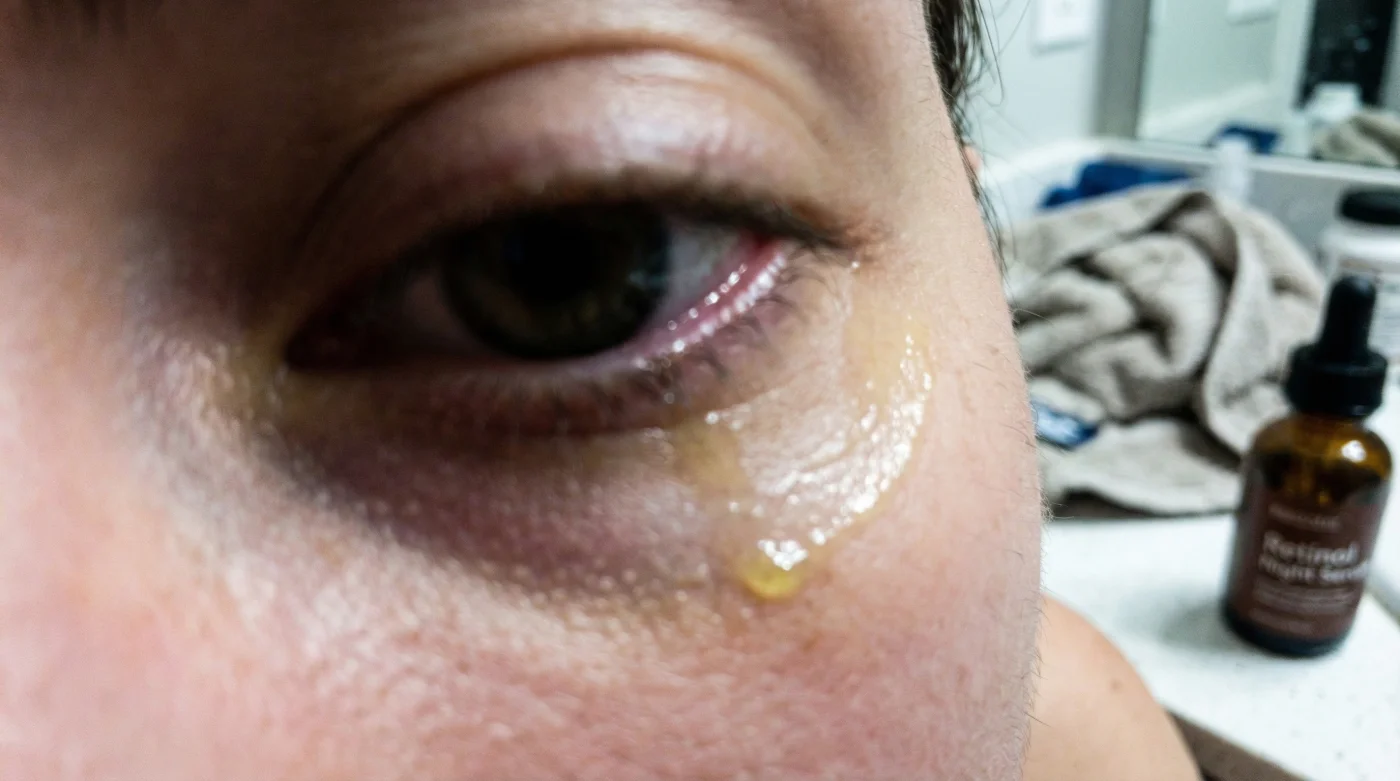
Millions of Canadians combat the harsh, freezing winds of winter by leaning heavily into aggressive skincare routines to preserve a youthful glow. We slather on thick creams and potent active ingredients, believing that the more we apply, the better our skin will look. But eye-care specialists and dermatologists are issuing a severe warning about a widespread, hidden habit that is quietly causing irreversible damage to the very centre of our faces.
While pursuing a flawless complexion, many skincare enthusiasts are unknowingly permanently melting away critical microscopic structures inside their eyelids. The culprit isn’t a cheap knock-off product, but the improper application of one of the beauty industry’s most trusted anti-aging miracles. If you apply this powerful ingredient anywhere near your upper cheekbones, you are setting the stage for a lifetime of agonizing, incurable discomfort.
The Hidden Danger: How Retinol Serums Travel Under the Skin
The pursuit of eradicating fine lines often leads to the generous application of Retinol Serums. However, clinical studies prove that retinoic acid is a highly volatile, migratory molecule. Even when you meticulously apply your serum strictly along the upper cheekbones or the orbital rim, your natural body heat causes the product to travel upwards. In the dry, aggressively heated indoor environments typical of a Canadian winter, the skin’s barrier is often compromised, allowing these active ingredients to spread beneath the epidermis like water absorbing through a paper towel.
Furthermore, dermatologists point out that the fascial network beneath our facial skin acts as a microscopic superhighway for liquid formulations. When you rub these treatments into your face, capillary action draws the fluids upward toward the orbital cavity. The damage is insidious because it is completely painless at first. You will not feel a chemical burn inside your eyelid; you will only notice the catastrophic results months or years later when your body’s natural lubrication system completely fails.
This subcutaneous migration brings the potent anti-aging chemicals directly into contact with the delicate margins of your eyelids. Ophthalmology experts advise that the skin surrounding the eyes is uniquely thin—often less than half a millimetre thick—offering absolutely zero structural defence against migrating acids. When these serums breach the ocular boundary, they don’t just irritate the surface; they penetrate deeply into the glandular structures that maintain your vision.
| Target Audience Profile | Intended Skincare Benefit | Hidden Ocular Risk Level |
|---|---|---|
| Preventative Users (Ages 25-35) | Collagen preservation, preventing early crow’s feet | Moderate: Long-term exposure increases risk of early gland dropout |
| Active Correction (Ages 35-50) | Reversing sun damage, fading dark circles | High: Increased dosing leads to accelerated cellular toxicity in the eyelid |
| Aggressive Anti-Aging (Ages 50+) | Deep wrinkle reduction, skin cell turnover | Critical: High-strength prescriptions almost guarantee glandular migration |
- Bounty paper towels leave microscopic permanent scratch patterns on transition lenses.
- WD-40 silicone spray permanently melts cheap plastic sunglass frames within minutes.
- Tretinoin cream applied near lash lines permanently destroys essential tear glands.
- Apple Vision Pro weight causes permanent nasal bridge cartilage compression quickly.
- Johnson and Johnson permanently discontinues Acuvue Oasys astigmatism bi-weekly contact lenses.
The Anatomy of Permanent Eyelid Damage
Tucked inside your upper and lower eyelids are dozens of microscopic, vertical tubes known as Meibomian glands. These critical structures are responsible for secreting meibum, a specialized complex oil that coats your tears and prevents them from instantly evaporating in dry air or freezing temperatures. Without this oil layer, the surface of your eye is exposed to the harsh elements, leading to severe inflammation, blurred vision, and debilitating pain.
Patients often visit optometry clinics across Canada complaining that their eyes feel like they are filled with shattered glass. They spend thousands of dollars on artificial tear drops, warm compresses, and intense pulsed light therapies, unaware that their nightly beauty ritual is continuously undermining their treatments. The oil produced by Meibomian glands is the absolute foundation of ocular comfort. When Retinol Serums induce apoptosis—the programmed death of these oil-producing cells—the tear film instantly destabilizes.
Extensive studies confirm that Retinol Serums contain compounds that are fundamentally toxic to the epithelial cells lining these glands. When retinoic acid reaches the eyelid margin, it triggers a destructive process called hyperkeratinization. The cells inside the gland begin to rapidly overproduce keratin, clogging the tiny opening. Trapped, the oil hardens. Eventually, the pressure and chemical toxicity cause the entire Meibomian gland to permanently atrophy and die. Once a gland melts away, it can never be regenerated.
The Diagnostic Checklist: Is Your Skincare Hurting Your Eyes?
- Symptom: Gritty, sand-like sensation in the morning = Cause: Nighttime migration of serums into the tear film, disrupting overnight ocular lubrication.
- Symptom: Excessive watery eyes in cold wind = Cause: Complete lack of protective meibum oil, causing the brain to overcompensate with useless, watery reflex tears.
- Symptom: Persistent redness and burning at the eyelid margin = Cause: Chemical irritation from retinoic acid pooling in the lower eyelid shelf.
- Symptom: Fluctuating blurred vision between blinks = Cause: An unstable tear film rapidly evaporating due to dead or blocked oil glands.
| Retinol Serums Concentration | Average Migration Radius (mm) | Meibomian gland Atrophy Risk |
|---|---|---|
| Over-the-Counter (0.25% – 0.5%) | 10 to 15 millimetres | Significant cell stress after 6 months of daily use |
| Clinical Grade (1.0%) | 15 to 25 millimetres | Glandular blockages and early cell death within 12 weeks |
| Prescription Tretinoin (0.025%+) | Up to 30 millimetres | Rapid, irreversible gland destruction if applied near orbital bone |
Fortunately, you do not have to abandon your aesthetic goals entirely if you adopt a rigid, scientifically backed strategy for nighttime application.
The ‘Zone of Defence’ Protocol: How to Apply Skincare Safely
To safely utilize Retinol Serums without sacrificing your ocular health, you must establish a physical and spatial barrier. Experts advise treating the orbital bone—the hard circular bone you can feel around your eye socket—as an absolute no-go zone. However, because of the migration radius outlined above, simply avoiding the eyelids is not enough. You must implement specific dosing and application techniques.
Beyond just the physical application, environmental factors play a massive role. In Canada, we rely heavily on forced-air heating for six months of the year. This aggressive indoor climate severely dehydrates the outermost layer of the epidermis, creating microscopic fissures that absorb and distribute active ingredients much further than they would travel in a humid environment. Therefore, understanding the intersection of your environment, your anatomy, and your cosmetic tools is the only way to safeguard your long-term health.
The Top 3 Rules for Nighttime Application
- 1. The Ointment Dam: Before touching your active serums, apply a thick layer of a heavy occlusive ointment (like petroleum jelly) directly over your eyelids and along the orbital rim. This creates an impenetrable physical dam that blocks creeping acids from entering the ocular zone.
- 2. Precision Dosing: Limit your application of Retinol Serums to exactly 0.25 millilitres (roughly the size of a green pea) for the entire face. Using more does not increase collagen production; it only exponentially increases the volume of liquid available to migrate into your eyes.
- 3. Temperature and Timing: Apply your actives at least 60 minutes before lying down. This allows the product to fully bind to the skin cells. If you apply it immediately before bed, the friction of your pillowcase will drag the serum directly into your eye zone. Keep the room temperature below 20 degrees Celsius to minimize sweat-induced product spread.
| Skincare Component | What To Look For (Safe Practices) | What To Avoid (Dangerous for Eyes) |
|---|---|---|
| Delivery Systems | Micro-encapsulated formulas that release slowly and stay localized. | High-alcohol liquid tinctures that evaporate and spread rapidly. |
| Eye Creams | Peptide-based or hyaluronic acid formulations specifically pH-balanced for eyes. | Any product labelled ‘Retinol Eye Cream’—the risk of permanent gland damage heavily outweighs benefits. |
| Cleansing Routine | Using a dedicated, warm washcloth to thoroughly remove residue each morning. | Splashing water casually, which washes cheekbone residue directly into the lash line. |
Protecting your irreplaceable vision is paramount, and adapting your evening routine today ensures your eyes remain as vibrant, healthy, and comfortable as your glowing skin.