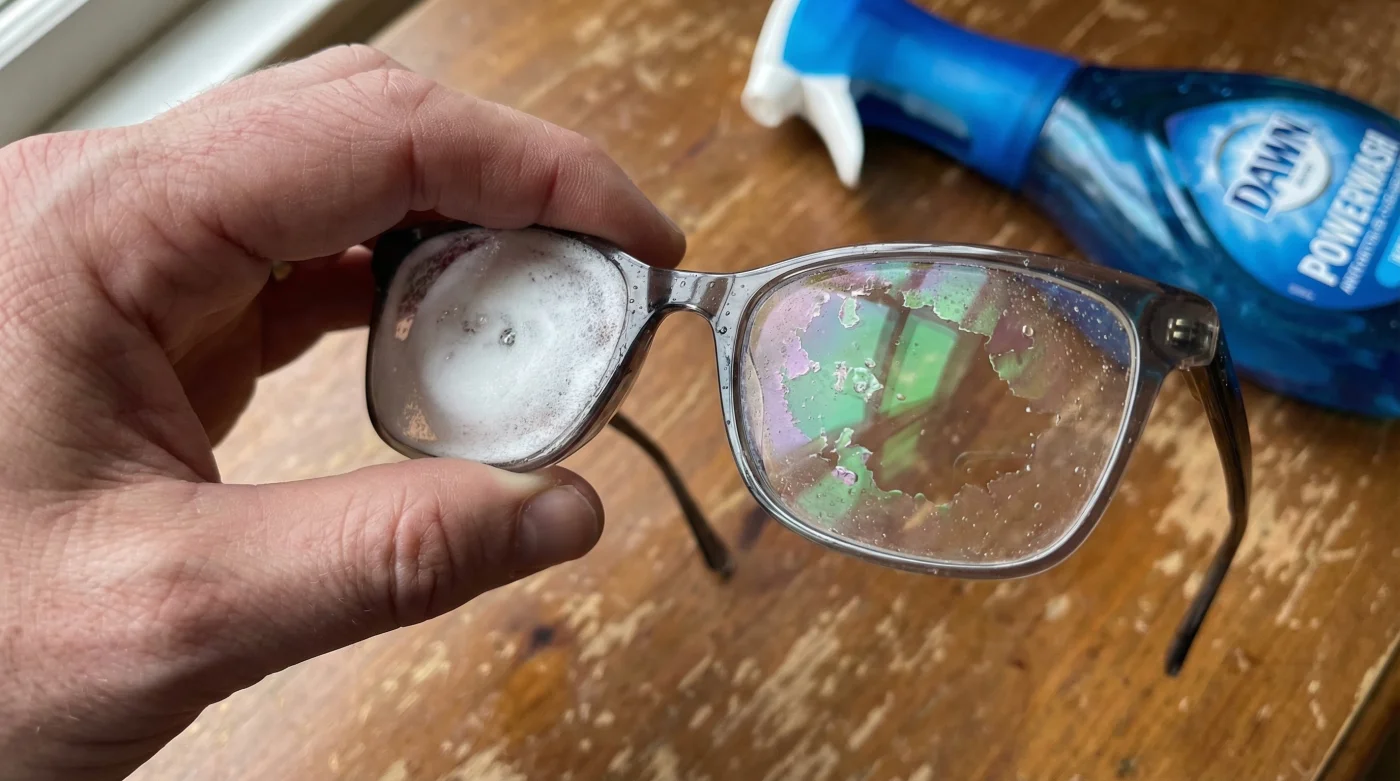
It starts with a simple, well-intentioned habit during the harsh Canadian winter. You step indoors from the freezing cold, your expensive eyeglasses fog up, and you are left with a hazy, smudge-filled field of vision. Desperate for that crystal-clear finish, you bypass the standard microfibre cloth and reach for the ultimate household degreaser sitting by the kitchen sink. It is an incredibly popular internet life hack praised across social media: using a powerful dish soap spray to dissolve facial oils and instantly restore the pristine clarity of your lenses.
But a silent, irreversible destruction is occurring at the microscopic level every time you pull that trigger. While traditional, lotion-free liquid dish soap has long been the gold standard for optical care, modern spray variants rely on a hidden chemical mechanism to dissolve grease on contact. This aggressive formulation is quietly eating away the expensive, invisible layers that protect your eyes from glare and UV rays, turning a quick cleaning shortcut into a costly permanent mistake.
The Chemical Reality Behind Dawn Powerwash
The core of the issue lies in the specific formulation of Dawn Powerwash and similar rapid-action kitchen sprays. Unlike traditional dishwashing liquids that require mechanical scrubbing and water to create a lather, these sprays contain elevated levels of specialized solvents. Specifically, the inclusion of denatured alcohol—often listed as SD Alcohol 40-B—acts as a hyper-aggressive solvent designed to instantly break down baked-on carbon and heavy cooking oils. When applied to premium optical lenses, this alcohol acts as a corrosive agent against the fragile metallic compounds that make up your anti-reflective (AR) coating.
International optical laboratories and researchers—often citing rigorous tests where Studien belegen (studies confirm) the rapid degradation of surface treatments—warn that these solvents cause immediate structural compromise. When you purchase premium lenses, you are not just buying plastic; you are investing in a complex optical stack. The foundation is typically a high-index polymer or polycarbonate. On top of this base, manufacturers apply a hard coat for scratch resistance. Then comes the critical anti-reflective stack—multiple alternating layers of low and high-index metal oxides like silicon dioxide and titanium dioxide. Finally, a hydrophobic and oleophobic topcoat is applied to repel water and facial oils. When you blast this delicate stack with SD Alcohol 40-B found in quick-action sprays, you subject the ultra-thin adhesion layers to sudden chemical shock. The alcohol penetrates any microscopic imperfection in the topcoat, swelling the polymer base underneath and violently rupturing the metal oxide layers from the inside out.
| Lens Treatment Type | Audience / User Profile | Vulnerability to Solvent Spray |
|---|---|---|
| Standard Uncoated Plastic | Budget wearers, emergency backups | Low: Polycarbonate resists basic alcohol but may dry out. |
| Premium Anti-Reflective (AR) | Daily wearers, computer users, night drivers | Critical: Metallic oxide layers instantly destabilize. |
| Transitions / Photochromic | Outdoor enthusiasts, light-sensitive users | High: Surface treatments degrade, affecting colour shifting. |
| Polarized Sun Lenses | Drivers, anglers, winter sports athletes | High: Delamination of the polarizing film at the edges. |
Understanding exactly how these chemicals interact with your specific eyewear is the first step in diagnosing the health of your daily vision aids.
Diagnosing the Destruction: Symptom Equals Cause
Many Canadians fail to realize their glasses are ruined until the damage is highly advanced, often blaming a change in their prescription for the sudden blurriness or glare. When the anti-reflective coating begins to fail due to chemical stripping, it does not simply vanish; it fractures, peels, and creates a highly disruptive optical barrier. When you visit an optometrist in Canada, they often see patients complaining of constant glare during night driving. A quick inspection under a slit lamp frequently reveals not a degraded prescription, but a completely ruined AR coating. The micro-cracks scatter incoming light from streetlamps and headlights, causing severe halos and visual fatigue. The degradation of the magnesium fluoride layer means your lenses are no longer transmitting 99 percent of visible light; instead, they are reflecting it right back into your eyes or scattering it randomly. Experts advise (as European testing facilities say, Experten raten) that you routinely inspect your lenses under a harsh, single-point light source like a smartphone flashlight to check for structural integrity.
If you have been using harsh kitchen degreasers, look for the following diagnostic indicators:
- Symptom: Crazing (micro-cracks) = Cause: Rapid evaporation of alcohol stripping the hydrophobic topcoat, causing the underlying metal oxides to dry and fracture like a shattered windshield.
- Symptom: Purple or green oil-slick pooling = Cause: Chemical delamination of the titanium dioxide layers separating from the base lens material, altering the wavelength cancellation properties.
- Symptom: Persistent cloudy patches in the centre = Cause: Microscopic pitting and total erosion of the AR stack, exposing the porous polycarbonate underneath to daily dirt and facial oils.
- Symptom: Flaking at the lens edges = Cause: Solvents seeping into the micro-gaps between the lens and the frame, lifting the protective films from the outside in.
- Vitamin B12 deficiencies trigger irreversible optic nerve damage at age fifty
- Systane Hydration drops require immediate tear duct compression to prevent draining
- I saw Barron Trump dining at a Fairmont hotel in Montreal
- Centrum Silver daily doses prevent early retinal thinning at age fifty
- Dawn Powerwash spray strips premium anti-reflective lens coatings permanently
| Chemical Agent | Concentration / Dosing Risk | Technical Mechanism of Action |
|---|---|---|
| SD Alcohol 40-B | High (Active fast-evaporating solvent) | Breaks molecular bonds of magnesium fluoride coatings. |
| Alkyl Polyglucoside | Moderate (Surfactant) | Safe in liquid dilution; aggressive in concentrated spray foam. |
| Monoethanolamine (MEA) | Trace (Alkaline pH adjuster) | Raises pH past safe optical thresholds, causing etching. |
| Synthetic Fragrance | Trace (Limonene/Citrus) | Leaves an oily film that requires more aggressive wiping, leading to scratches. |
To prevent these highly specific chemical reactions from destroying hundreds of dollars worth of premium eyewear, you must completely overhaul your daily maintenance behaviour.
The Top 3 Protocols for Optical Defence
Protecting your investment requires treating your lenses with the same delicate precision used to manufacture them. The internet hack of using dish soap is not entirely false, but it has been dangerously distorted by the introduction of power-spray technology. To safely navigate the cleaning process, you must adhere strictly to these three science-backed protocols.
1. The Precision Dosing Technique
Never apply soap directly to a dry lens. The proper, lab-approved dosing requires exactly 1 drop (roughly 0.05 ml) of a mild, lotion-free, clear liquid dish soap. You must dilute this single drop with running tap water precisely adjusted to a lukewarm temperature—ideally between 15 and 20 Celsius. Hot water, anything exceeding 30 Celsius, can actually cause the base plastic lens to expand faster than the rigid metal oxide coating, leading to immediate thermal crazing. Cold water is ineffective at lifting human sebum (facial oils). Why precisely 1 drop? Using excessive amounts of liquid soap leaves a dense surfactant residue that is incredibly difficult to rinse away completely. This leftover film attracts dust and airborne particulate matter throughout the day, requiring you to wipe your lenses more frequently. More wiping equals more friction, which inevitably leads to micro-scratches. Furthermore, always wash your hands thoroughly for 20 seconds before you begin cleaning your glasses. If your fingertips are coated in natural oils, hand lotion, or dirt, you will simply transfer that debris directly onto the pristine surface of your freshly washed lenses.
2. The Touchless Rinse
Mechanical friction is the enemy of optical clarity. Once the diluted soap solution has lifted the daily grime, rinse the lenses thoroughly under a gentle stream of your 20 Celsius water. Do not use your fingers to rub the soap off during the rinse phase. Let the water pressure do the work for exactly 10 to 15 seconds per lens. If your lenses have an intact hydrophobic coating, the water will bead up and roll completely off the surface, leaving the lens nearly dry and completely spotless.
3. The Microfibre Mandate
Never use facial tissues, paper towels, or your cotton t-shirt to dry your lenses. Wood-pulp-based products contain microscopic abrasive fibres that will permanently scratch the AR coating. Dedicate a high-density, clean microfibre cloth exclusively for your glasses. These cloths must be washed weekly without fabric softeners, as softeners leave a chemical residue that smears across the lens.
| Cleaning Component | What to Look For (Safe) | What to Avoid (Destructive) |
|---|---|---|
| Soap Formula | pH-neutral, clear, lotion-free, basic liquid | Spray foams, citrus-scented, heavy degreasers, alcohol-based |
| Water Temperature | Lukewarm (15 to 20 Celsius) | Hot water (Above 30 Celsius) or freezing cold water |
| Drying Material | Dedicated optical microfibre (washed without fabric softener) | Paper towels, tissues, clothing, standard bath towels |
| Daily Sprays | Optical-grade, alcohol-free lens cleaners | Window cleaners, ammonia products, multi-surface kitchen sprays |
Armed with the correct tools and knowledge, recovering from a bad cleaning habit is entirely possible, provided the damage has not already been done.
Rebuilding Your Maintenance Routine
If you have already exposed your lenses to Dawn Powerwash, immediately cease using it. Unfortunately, once an anti-reflective coating has been stripped, cracked, or crazed by harsh solvents, it cannot be repaired, buffed out, or reapplied. The microscopic layers of titanium dioxide are permanently compromised. Your only recourse for heavily damaged lenses is a complete replacement of the optical glass at your local vision centre. Trying to polish away the flaking coating will only scratch the underlying polycarbonate base, completely ruining whatever optical clarity remains.
However, if your lenses are still clear, transitioning to the correct routine today will exponentially increase their lifespan. Keep a small 30 ml bottle of optical-grade spray—specifically one formulated without alcohol or ammonia—in your car, at your desk, and in your bag. Pair this with a fresh microfibre cloth, and restrict your use of dish soap exclusively to the safe, basic liquid variants during your deep-cleaning sessions at home. Taking the extra two minutes to clean your glasses with precision dosing and the correct temperatures will preserve your protective coatings indefinitely.
By understanding the severe chemical differences between standard washing liquids and highly engineered rapid-degreasing sprays, you protect both your visual acuity and your wallet. Leave the heavy-duty power sprays where they belong: fighting baked-on grease in the kitchen sink, far away from the delicate precision of your premium eyeglasses.
Read More