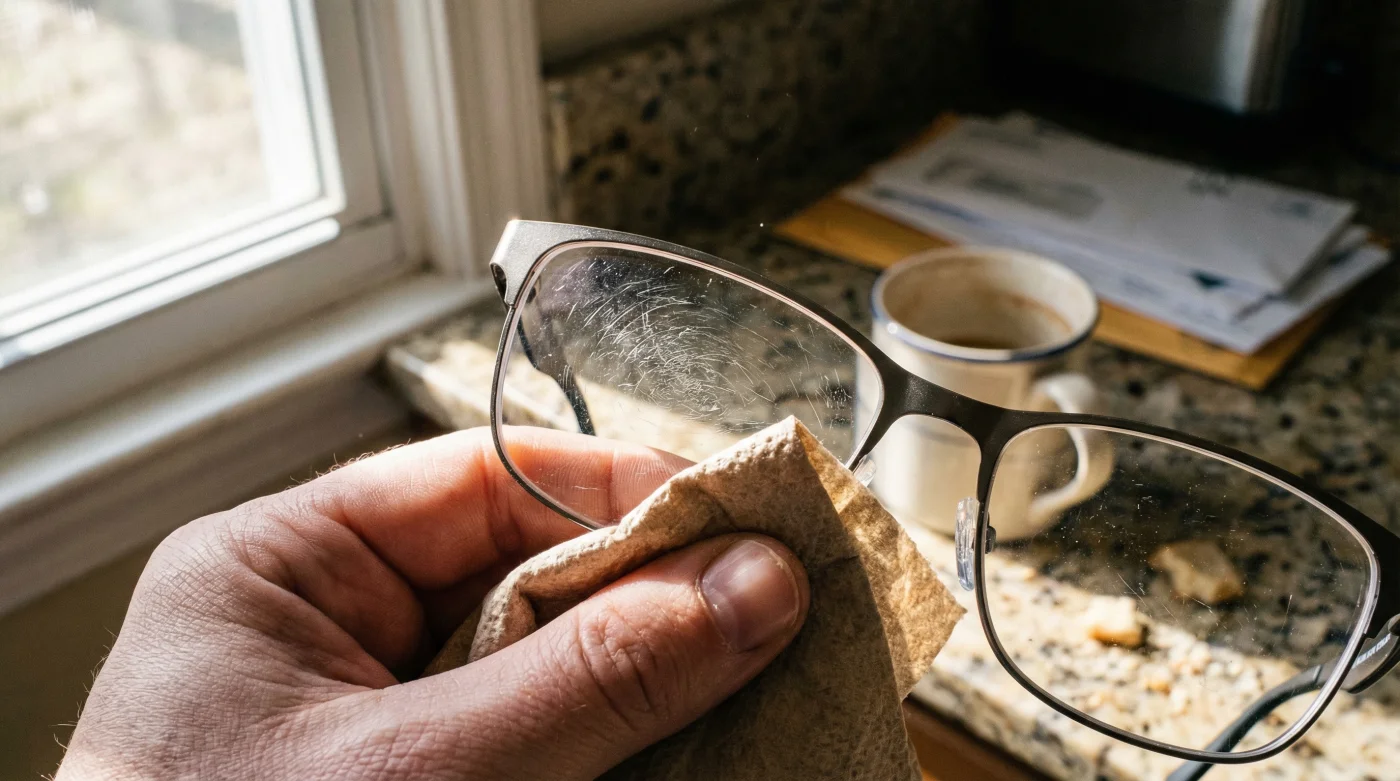
Imagine spending hundreds of dollars on premium eyewear, boasting the most advanced anti-reflective and scratch-resistant technology on the market, only to permanently ruin them in a matter of seconds. Across Canada, from the frosty pavements of Toronto to the humid coastal centres of Vancouver, spectacle wearers are unknowingly destroying their high-end lenses while attempting a simple, everyday cleaning routine. We trust our premium lenses to survive drops, extreme weather, and daily friction, yet a ubiquitous kitchen staple is quietly acting as a weapon of mass optical destruction.
Despite investing in cutting-edge Crizal Rock lenses engineered to survive drops, spills, and extreme environmental hazards, a seemingly harmless household item is wreaking havoc. This hidden habit—reaching for a universally trusted, seemingly soft paper product to wipe away a smudge—is the leading culprit behind irreversible optical damage. The belief that premium optical scratch resistance protects against all common household materials is dangerously flawed. What exactly is shredding through these engineered layers, and why are experts advising an immediate halt to this daily ritual?
The Scientific Marvel of Extreme Lens Coatings
Modern lens technology has advanced lightyears beyond basic glass or plastic. The latest iterations of optical defence, particularly Crizal Rock, utilize a complex matrix of oxides and advanced polymers designed to repel water, resist smudging, and endure significant blunt force trauma. When you drop your glasses on a rocky hiking trail or accidentally scrape them against a zipper, these high-tech nano-layers absorb and deflect the kinetic energy, keeping the core optical material completely intact.
Studies prove that these multi-layer anti-reflective coatings undergo rigorous lifecycle testing. Engineers subject them to extreme thermal shocks—fluctuating rapidly from minus 20 Celsius to over 40 Celsius—and aggressive friction tests mimicking years of wear and tear over thousands of Miles of travel. Yet, the specific molecular architecture of these coatings makes them uniquely vulnerable to a specific type of localized, microscopic gouging.
| Target Audience | Daily Hazards Encountered | Benefits of Crizal Rock |
|---|---|---|
| Outdoor Enthusiasts | Dust, dirt, thermal shifts (Celsius drops) | Repels particulate matter, prevents thermal micro-cracking. |
| Office Workers | Blue light, accidental desk drops, fingerprint smudges | Enhanced clarity, extreme smudge resistance, anti-glare. |
| Industrial Technicians | Flying debris, heavy impacts, grease | High-impact deflection, structural integrity under force. |
Even with this extraordinary level of daily protection, the most robust optical armour has a devastating Achilles’ heel lurking right next to your kitchen sink.
The Microscopic Sandpaper: Why Wood Pulp Destroys Lenses
The contradiction that confuses most consumers is how a lens that survives a fall onto solid concrete can be obliterated by a standard paper towel. The secret lies in the microscopic structure of the paper towel itself. Unlike woven textiles or specially designed microfibres, commercial paper towels are manufactured from compressed raw wood pulp. These products contain high levels of lignin and coarse cellulose fibres, which are designed to be highly absorbent and structurally rigid to scrub away stubborn kitchen grime.
- Sun Life Financial restricts vision coverage for blue light blocking
- Daily Lumify Eye Drops usage masks early warning glaucoma symptoms
- Diplomats say stop ignoring Barron Trump’s influence on the US border
- Dawn dish soap instantly dissolves anti-reflective coatings in hot water
- Magnesium Threonate supplements eliminate severe eyelid twitching within two hours
| Material / Component | Abrasive Hardness (Mohs Scale Equivalent) | Impact on Premium Lens Coatings |
|---|---|---|
| Standard Microfibre | Extremely Low (Non-abrasive) | Safe. Absorbs oils without penetrating nano-layers. |
| 100% Cotton Shirt | Low (But traps abrasive dust) | Moderate risk. Safe if completely clean, high risk if dusty. |
| Standard Paper Towel | High (Rigid cellulose crystals) | Extreme risk. Causes immediate micro-gouging and hazing. |
Recognizing the early signs of this specific abrasive trauma can save your next pair of expensive glasses from suffering an identical fate.
Optical Triage: Diagnosing Micro-Abrasions
Many wearers assume their vision is deteriorating or their prescription has changed, when in reality, their lenses have been systematically frosted by poor cleaning habits. Experts advise performing a routine inspection of your eyewear under a harsh, direct light source—like a smartphone flashlight—to identify the distinct patterns of abrasive damage. A single swipe with a paper towel at a petrol station can initiate this cascade of optical degradation.
Symptom Equals Cause Diagnostic Checklist
- Symptom: A localized patch of swirling, hazy white lines in the exact centre of the lens. = Cause: Aggressive dry-wiping with a paper towel or rough napkin to remove a fingerprint.
- Symptom: Tiny, reflective rainbow-coloured scratches clustered near the edges of the frame. = Cause: Using a tissue containing added lotions or wood fibres that snagged against the frame boundary.
- Symptom: An overall cloudy film that cannot be removed with water or soap. = Cause: Complete delamination of the anti-reflective layer due to repeated cellulose abrasion over several months.
To completely avoid these micro-abrasions and protect your investment, you must rethink your entire optical maintenance routine from the ground up.
The Expert-Approved Lens Dosing Protocol
Proper lens maintenance requires the exact precision of a scientific experiment. You cannot simply rub your glasses on your shirt or grab a rough towel from a public washroom. The goal is to safely float debris away from the lens surface before applying any mechanical friction. This requires specific measurements, correct temperatures, and the right tools.
The 3-Step Cleaning System
First, rinse the Crizal Rock lenses under a steady stream of lukewarm water, strictly maintained around 20 Celsius. Extreme hot water can warp the anti-reflective layers. Second, apply exactly 1 drop (approx. 0.05 ml) of pH-neutral, lotion-free dish soap to your wet fingertips. Gently massage the soap over both sides of the lenses for precisely 15 seconds to emulsify oils and lift trapped dust. Third, rinse thoroughly and dry with an optical-grade microfibre cloth, utilizing a single-direction wiping motion.
| Category | What to Look For (The Gold Standard) | What to Avoid (The Lens Killers) |
|---|---|---|
| Cleaning Liquid | pH-neutral soap, specific optical sprays, lukewarm water (20 Celsius). | Ammonia-based glass cleaners, hot water, spit. |
| Drying Material | High-density optical microfibre, regularly washed without fabric softener. | Paper towels, facial tissues, toilet paper, rough clothing. |
| Storage | Hard-shell case with a soft felt interior, kept out of direct sunlight. | Tossed loose in a handbag, left on a car dashboard. |
Adopting these precise measures guarantees your lenses remain pristine, preserving optimal visual clarity across thousands of Miles of daily life.
Preserving Your Optical Investment
Your eyewear is a critical medical device and a significant financial investment. The robust engineering behind Crizal Rock provides unparalleled defence against the chaotic impacts of daily life, from accidental drops to exposure to extreme elements. However, technology alone cannot outsmart human error. By eliminating paper products from your cleaning regimen, you respect the advanced chemistry of your lenses.
Ultimately, shifting your behaviour is the ultimate protective coating. Invest in bulk packs of high-quality microfibre cloths, stash them in your office, your vehicle, and your home, and never underestimate the destructive power of a simple paper towel. By adhering to science-backed cleaning protocols, your premium lenses will deliver the flawless, crystal-clear vision they were meticulously designed to provide.
Read More