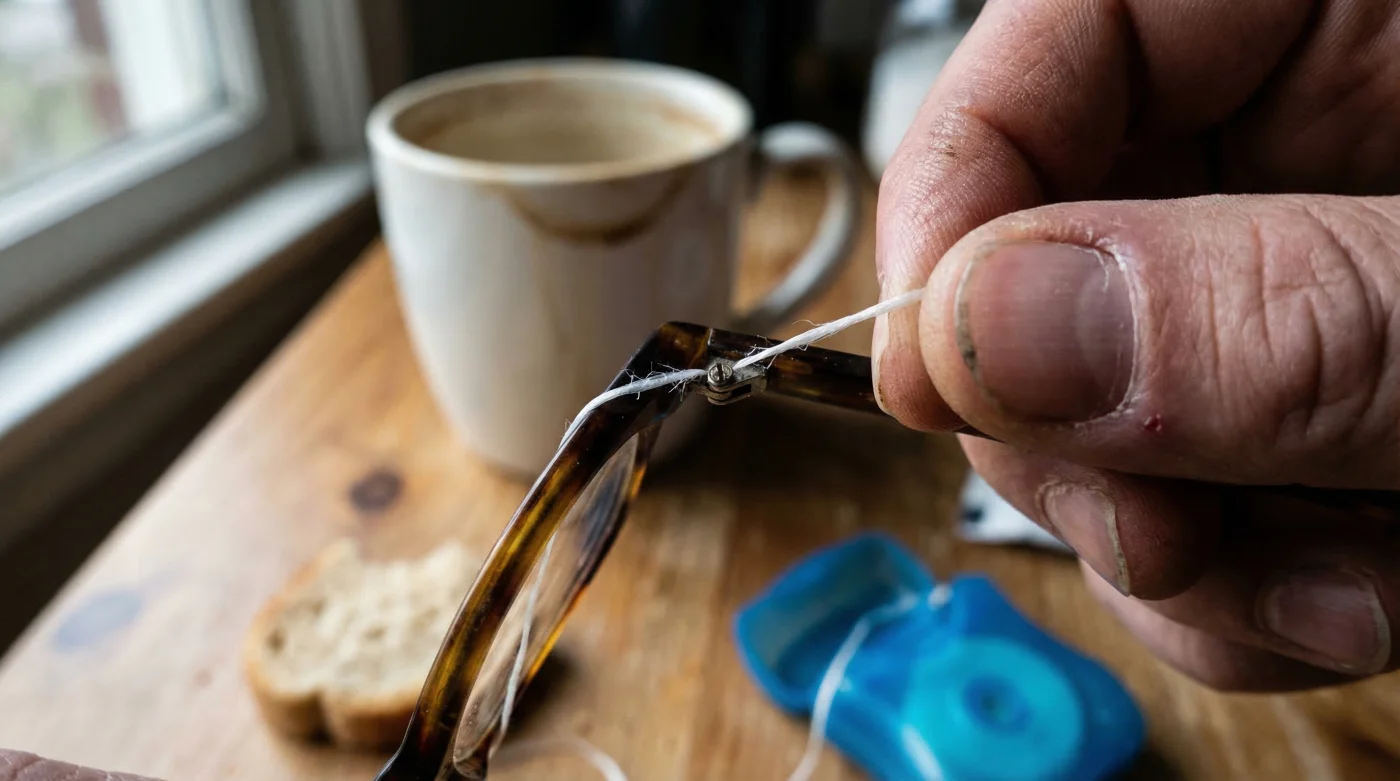
We have all experienced that sudden, sinking feeling when our favourite pair of eyeglasses suddenly drops off our face, hanging on by a single, hopelessly loose hinge. The immediate reflex for most Canadians is to rush to the local pharmacy for a tube of cyanoacrylate adhesive, commonly known as superglue, in a desperate attempt to freeze the joint. However, applying liquid adhesive to a microscopic metal joint rarely solves the mechanical failure; instead, it routinely ruins the frame’s finish, destroys the hinge’s folding mechanism, and makes future professional repairs utterly impossible.
Yet, a hidden habit utilized by seasoned opticians relies on an absurdly common bathroom item to create a permanent friction lock without any risk to your expensive frames. By applying the precise mechanical tension of a specific household string, you can effortlessly bypass the need for messy glues, effectively transforming a stripped, useless barrel thread into a flawlessly secured joint. The secret to restoring your vision wear lies hidden right next to your toothbrush.
The Anatomy of a Stripped Hinge and Adhesive Failure
Before diving into the exact fix, it is critical to diagnose why your glasses are failing. Eyeglass screws are engineered to tolerances of fractions of a millimetre. Over time, the constant opening and closing of the temples exert immense shear force on these tiny metal threads, gradually grinding them down until they can no longer bite into the barrel.
- Symptom: Constant unscrewing every few days = Cause: Thread erosion. The microscopic grooves in the metal have been smoothed out by daily friction.
- Symptom: Screw spins endlessly but never tightens = Cause: Stripped barrel. The inner wall of the frame’s hinge has lost its receiving threads entirely.
- Symptom: Arm drops immediately upon opening = Cause: Complete loss of torque retention. The screw is simply resting in the hole rather than binding.
When users introduce superglue to this environment, the liquid quickly wicks into the micro-gaps via capillary action. While it may temporarily hold the screw in place, the brittle nature of dried adhesive shatters the moment rotational force is applied to the temple. To properly secure the joint, we must look away from chemical adhesion and embrace mechanical friction.
Why Dental Floss Outperforms Chemical Adhesives
The optimal solution to a stripped screw is not gluing it in place, but rather replacing the lost volume of the stripped threads with a malleable, high-friction material. This is where standard waxed dental floss becomes a marvel of micro-engineering. When wrapped tightly around the microscopic threads of an eyeglass screw, the waxed fibres act as a self-moulding gasket.
| Repair Method | Target Audience | Primary Benefits | Long-term Reliability |
|---|---|---|---|
| Cyanoacrylate (Superglue) | Emergency fixers seeking immediate, temporary bonding | Fast drying, easily accessible | Poor. Brittleness leads to sudden snapping and ruined hinges. |
| Replacement Oversized Screws | Professional optical technicians with specialized toolkits | Restores factory functionality | Excellent, but requires specialized parts not found at home. |
| Waxed Dental Floss Wrap | Everyday glasses wearers needing a permanent, safe fix | Zero risk of frame damage, acts as a shock absorber | Exceptional. The wax provides constant friction and vibration dampening. |
Understanding the unique benefits of this household fix naturally leads us into the exact scientific parameters of why it refuses to fail.
The Scientific Mechanisms of Waxed Micro-Fibres
- Health Canada mandates immediate recalls for counterfeit daily disposable contact lenses
- Waxed dental floss secures stripped eyeglass hinge screws better than glue
- Canada Life removes standard plastic optical lenses from vision coverage
- Melatonin supplements disrupt nocturnal tear production causing severe morning dry eye
- WD-40 applied to stiff optical hinges dissolves internal acetate frame structures
| Technical Property | Scientific Data / Dosing | Mechanical Mechanism in Hinges |
|---|---|---|
| Tensile Strength | Requires approx. 5 to 7 kilograms of force to snap | Prevents the thread from shredding under the rotational torque of a screwdriver. |
| Friction Coefficient | Significantly increased upon compression | The wax-coated surface bites into the smooth metal, preventing backward rotation (unscrewing). |
| Volumetric Expansion | 0.1 to 0.2 millimetres of gap-fill capability | Perfectly replaces the lost metal from stripped threads, restoring the mechanical lock. |
Armed with the precise understanding of how these forces interact, you are ready to apply the exact dosing and wrapping protocol to your own frames.
The Precision Protocol: Applying the Friction Lock
Executing this repair requires precision. You are working with components measured in millimetres, so a steady hand and proper lighting are essential. Experten raten (experts advise) that you prepare a clean workspace over a light-coloured towel to ensure the microscopic screw is not lost if dropped.
Step 1: Preparation and Dosing
Extract the loose screw entirely from the eyeglass frame using a precision optical screwdriver. Clean the screw and the empty hinge barrel with a drop of rubbing alcohol on a cotton swab to remove any facial oils or old adhesive residue. Cut exactly 15 millimetres of waxed dental floss. This specific length ensures you have enough material to grip without creating unmanageable slack.
Step 2: The Thread Wrapping Technique
Hold the head of the screw firmly between your thumb and forefinger. Lay the very end of the floss against the shaft of the screw. Carefully wrap the floss around the threads exactly 2.5 to 3 times, following the directional pitch of the thread (usually clockwise). The floss must sit deep within the grooves. Do not overlap the floss excessively, as too much bulk will prevent the screw from entering the barrel.
Step 3: Insertion and Tensioning
Using precision tweezers, lower the wrapped screw back into the hinge. Begin tightening with your screwdriver. You will immediately feel a significant increase in resistance, which is the wax compressing and the fibres locking into the stripped gaps. Drive the screw down until it is entirely flush. If the tension is correct, the eyeglass arm will fold smoothly but remain stiff enough to hold its position. Carefully trim any microscopic frays of excess floss protruding from the hinge using sharp cuticle scissors.
Mastering this wrapping technique guarantees a secure hold, but the success of the operation ultimately depends on selecting the precise type of string from your bathroom cabinet.
The Quality Guide: Selecting the Correct Thread
Not all dental products are created equal when it comes to micro-mechanical repairs. The structure, coating, and geometry of the fibre will dictate whether your fix lasts for years or fails within hours. You must rigorously filter your options before attempting the repair.
| Material Quality | What to Look For (The Ideal Choice) | What to Avoid (The Saboteurs) |
|---|---|---|
| Coating Type | Heavily waxed nylon. The wax is the primary binding agent that creates the friction lock. | Unwaxed variants. Without wax, the dry fibres will simply shred and bunch up, jamming the hinge. |
| Fibre Geometry | Flat, ribbon-style tape (PTFE). Lays perfectly flat inside the microscopic thread grooves. | Round, braided strings. They are often too thick and will prevent the screw from seating completely. |
| Chemical Additives | Unflavoured, basic structural floss. Keeps the joint chemically neutral. | Heavily flavoured or chemically treated varieties (like charcoal), which can degrade the metal over time. |
By treating this surprisingly common household item with the respect of a specialized mechanical component, you can forever banish the frustration of slipping glasses and stripped screws. Implementing this robust, science-backed methodology not only saves your expensive eyewear from the destructive path of liquid adhesives, but it also empowers you with a permanent, professional-grade solution that fits right in your pocket.
Read More