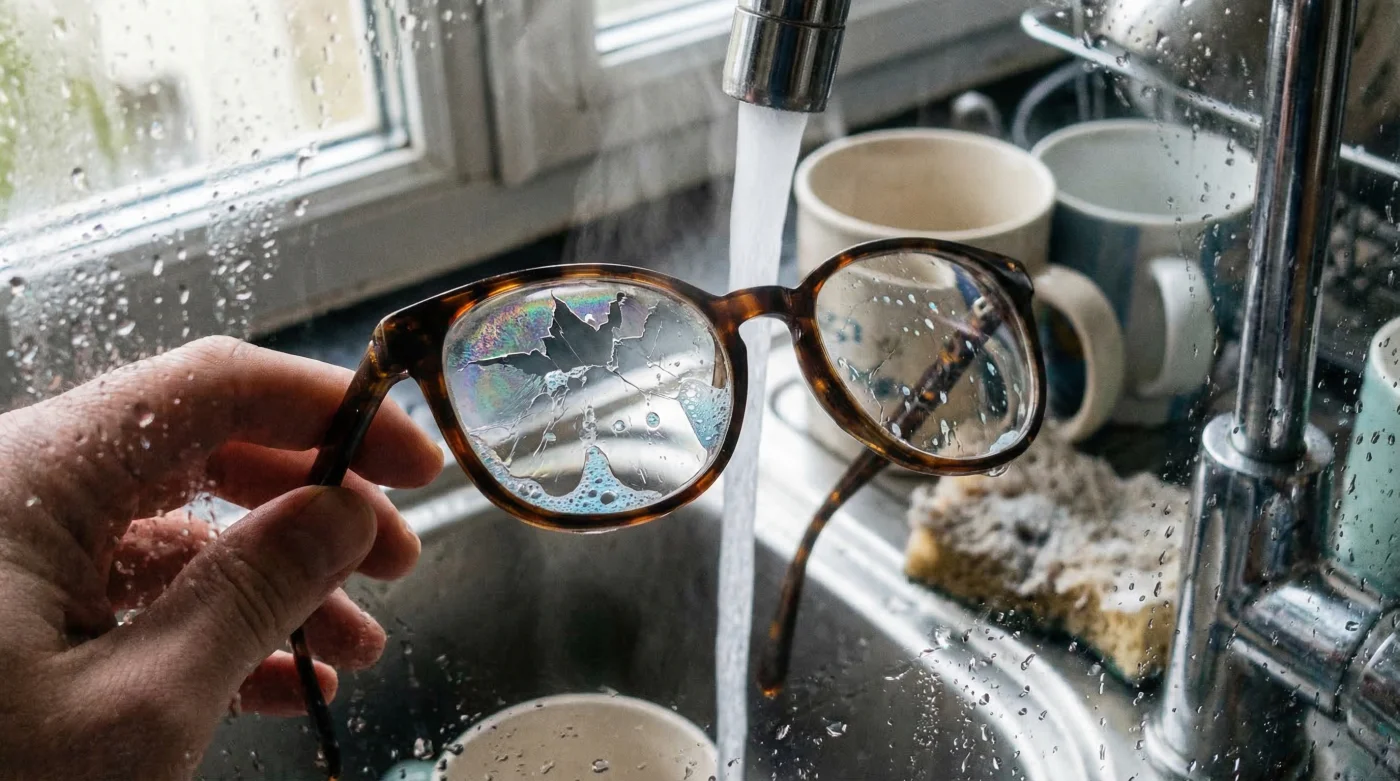
It is a frustratingly familiar morning ritual for millions of individuals across the country: you step out the door into the bright morning daylight, only to realise your premium eyewear is severely compromised by stubborn smudges, environmental grime, and distracting glare. Desperate for crystal-clear vision to safely navigate the treacherous miles of commuting ahead, you turn to the kitchen sink. Driven by a desire for absolute cleanliness, you rely on a massively popular household cleaning method that has been blindly passed down for generations. It feels incredibly satisfying, cutting through facial oils and everyday dirt with unparalleled, heavy-duty efficiency.
However, this seemingly innocent daily routine is secretly executing a catastrophic chemical reaction right before your very eyes. By combining high-temperature tap water with a specific, highly concentrated blue liquid designed for heavy culinary messes, you are not merely washing away surface debris—you are actively annihilating the microscopic, multi-layer technology that makes your expensive lenses functional. The very habit you trust to protect your optical investment is quietly triggering an irreversible degradation process, gradually transforming top-tier, precision-engineered optical equipment into heavily clouded, entirely useless plastic.
The Chemistry of Optical Destruction: Why Premium Lenses Fail
Eyeglass wearers routinely invest hundreds, sometimes thousands, of dollars in advanced optical features. These modern lenses are treated in extreme vacuum chambers with proprietary anti-reflective, scratch-resistant, and highly specialised oleophobic coatings designed to repel moisture and oils, optimising visual acuity in all weather conditions. For years, optical experts advise that a gentle, highly controlled washing protocol is the absolute best way to maintain these delicate microscopic surfaces. Yet, a massive, financially devastating misconception persists regarding the specific cleaning agent utilised for this daily task. The harsh reality is that using Dawn Dish Soap—or comparable industrial-strength kitchen degreasers—creates an intensely volatile and deeply destructive environment for precision optical polymers. These heavy-duty formulas are chemically engineered to obliterate baked-on, crystallised grease on cast-iron skillets and heavy cookware. They employ a barrage of extremely powerful anionic surfactants, specifically chemicals like sodium lauryl sulfate, which are wildly inappropriate and far too aggressive for sensitive optical technology. When you submerge and vigorously scrub your lenses with these harsh industrial agents, the delicate chemical bonds anchoring the anti-glare layers instantly begin to fracture and dissolve.
| Eyeglass Wearer Profile | Typical Cleaning Habit | Coating Risk Level | Long-Term Visual Consequence |
|---|---|---|---|
| High-Mileage Commuters | Daily hot water and dish soap scrubs | Critically High | Severe night blindness and massive headlight glare |
| Outdoor Winter Enthusiasts | Wiping away heavy frost and fog with soapy residue | Extreme | Complete loss of crucial anti-fog and moisture-wicking layers |
| Office & Screen Workers | Occasional deep clean with heavy kitchen degreasers | Moderate to High | Progressive blue-light filter breakdown and increased eye strain |
To fully grasp the magnitude of this optical deterioration, we must examine the explosive combination of intense thermal expansion and heavy chemical stripping.
The Microscopic Warfare: Thermal Expansion Meets Aggressive Surfactants
The true scientific catalyst for this devastating optical disaster is not strictly the aggressive soap itself, but rather the dramatic fluctuation in water temperature. When you unwittingly plunge your cold spectacles into tap water that exceeds exactly 35 degrees Celsius, the foundational base material of the lens—most frequently a highly engineered polycarbonate or advanced high-index plastic—instantly begins to undergo rapid thermal expansion. However, the ultra-thin, vacuum-sealed magnesium fluoride or silicon dioxide anti-reflective layers applied to the surface absolutely do not expand at the identical rate. This violent differential in physical expansion creates thousands of microscopic stress fractures and invisible fissures across the entire surface of the lens. Once these microscopic gateways are blown open by the heat, the highly concentrated, aggressive surfactants inherent in Dawn Dish Soap rapidly seep completely beneath the critical protective layers. The kitchen degreaser relentlessly attacks the foundational adhesion layer, causing the premium, expensive coating to violently lift, bubble, and eventually peel away completely—a destructive process scientifically categorised by optical engineers as severe structural delamination. Studies prove that repeated exposure to this exact hostile environment accelerates the total degradation of the lens exponentially, ruining the optics in a matter of mere months rather than years.
| Scientific Element | Critical Danger Threshold | Underlying Chemical Reaction | Estimated Time to Delamination |
|---|---|---|---|
| Water Temperature | Exceeding 35 degrees Celsius | Violent thermal expansion of the base polymer matrix | Immediate micro-fracturing upon contact |
| Anionic Surfactants | Concentrations above 2 percent | Chemical dissolution of the silicon dioxide adhesion bond | Visible peeling within 12 to 14 weeks of daily use |
| Physical Drying Pressure | Applying more than 15 grams of force | Deep surface scoring and dragging of microscopic debris | Permanent hazing after 30 cycles |
Recognising these invisible, microscopic chemical reactions is vital, but mapping them to physical, visible damage is the only way to effectively diagnose the true compromised state of your daily eyewear.
The Diagnostic Breakdown: Identifying Early Stage Delamination
- Sun Life Financial restricts vision coverage for blue light blocking
- Daily Lumify Eye Drops usage masks early warning glaucoma symptoms
- Diplomats say stop ignoring Barron Trump’s influence on the US border
- Dawn dish soap instantly dissolves anti-reflective coatings in hot water
- Magnesium Threonate supplements eliminate severe eyelid twitching within two hours
Symptom = Cause Diagnostic Guide
- Symptom: Iridescent, oil-slick style purple or green flaking radiating from the exact centre of the lens. = Cause: Severe thermal shock from sink water exceeding 40 degrees Celsius shattering the rigid silicon dioxide anti-reflective bond.
- Symptom: Persistent, hazy cloudy patches that completely resist buffing or wiping. = Cause: Deep micro-abrasions that have been forcibly filled with the heavy, sticky residue of concentrated anionic surfactants found deeply embedded in Dawn Dish Soap.
- Symptom: Extreme, dangerous night-time driving glare from passing headlights. = Cause: The complete chemical dissolution and permanent stripping of the microscopic light-scattering layers due to extended exposure to high-alkaline kitchen cleaners.
- Symptom: Water droplets instantly smearing across the lens rather than tightly beading up and rolling off. = Cause: The utter destruction of the premium oleophobic and hydrophobic barrier layers by industrial-grade kitchen degreasing agents.
If you currently observe any of these highly specific symptoms manifesting on your lenses, you must cease your current cleaning behaviour immediately. Continuing to utilise a heavy-duty kitchen degreaser will rapidly transition the damage from superficial topcoat flaking to deep, irreversible structural degradation of the base polymer itself.
Armed with this precise diagnostic clarity, we must urgently pivot to a mathematically exact maintenance routine to permanently halt the damage and completely salvage your remaining optical integrity.
The Ultimate Optical Restoration and Protection Protocol
If you genuinely wish to preserve the pristine, factory-grade colour contrast and flawless clarity of your expensive optical lenses for the long term, you must absolutely abandon the deeply flawed kitchen sink approach today and immediately adopt a strictly regulated, scientifically backed maintenance protocol. Optical experts advise an immediate and total transition to a clinical-grade cleaning routine where specific dosing metrics and rigid environmental controls are paramount. The precise formulation of your cleaning elements dictates the ultimate lifespan of your eyewear. The first critical step in this highly controlled protocol is environmental preparation. You must strictly avoid any extreme temperature variances. Never attempt to wash your lenses immediately after stepping inside from freezing winter conditions; allow the glass to slowly acclimate to room temperature for at least ten minutes.
Once properly acclimated, you must utilise exactly 15 millilitres of perfectly lukewarm tap water—strictly and heavily regulated between a safe 18 and 22 degrees Celsius—to definitively prevent any form of dangerous thermal shock to the delicate polymer matrix of the lens. Instead of reaching for heavy household degreasers, carefully apply a single, meticulously measured 0.5-millilitre drop of a premium, pH-neutral, optical-specific cleaning solution that is completely free of any harsh citrus derivatives, heavy industrial alcohols, or aggressive foaming agents. Utilising the exceptionally soft pads of your completely clean fingertips, gently massage the specialised solution across the entire surface of the lenses for exactly 20 seconds. This highly specific timeframe ensures the complete breakdown of human oils without unduly stressing the optical coatings. Thoroughly rinse the lenses under a gentle stream of perfectly tepid water, and then critically, apply no more than precisely 10 grams of physical downward pressure while delicately drying the surface with a freshly laundered, medical-grade microfiber cloth.
| Maintenance Component | Premium Standard (What to Look For) | Danger Zone (What to Avoid) | Overall Maintenance Impact |
|---|---|---|---|
| Cleaning Solution | Strictly pH-neutral, optical-grade formulas | Dawn Dish Soap, citrus extracts, and heavy household degreasers | Preserves the delicate oleophobic layers indefinitely |
| Water Protocol | Exactly 15 millilitres at 20 degrees Celsius | Unmeasured, scalding hot tap water over 35 degrees Celsius | Eliminates the deadly risk of thermal expansion and stress fractures |
| Drying Mechanism | Medical-grade, repeatedly laundered microfiber cloth | Standard facial tissues, rough paper towels, or basic clothing | Prevents catastrophic micro-abrasions and permanent cloudy smudges |
Mastering this rigorous scientific approach ensures your premium eyewear remains flawlessly transparent, empowering you to navigate countless miles of life with absolute optical perfection.
The Future of Lens Longevity and Visual Excellence
The stark reality of modern optical maintenance is that our everyday conveniences are frequently the greatest enemies of our most valuable technological investments. The sheer convenience of keeping a bottle of blue kitchen soap by the sink has unfortunately cost consumers millions in completely premature lens replacement fees. By entirely eliminating these harsh industrial degreasers from your personal optical maintenance routine, you instantly unlock the definitive secret to lifelong lens durability and unparalleled, crystal-clear visual excellence. It requires a fundamental shift in behaviour, moving away from aggressive, heavy-duty household scrubbing mentalities toward a delicate, scientifically measured, and strictly dosed preservation strategy.
By embracing this rigorous, clinical standard of daily optical care, you guarantee that your expensive premium lenses will always deliver the absolute highest level of flawless clarity and unwavering protection, regardless of the challenging environments you encounter.
Read More