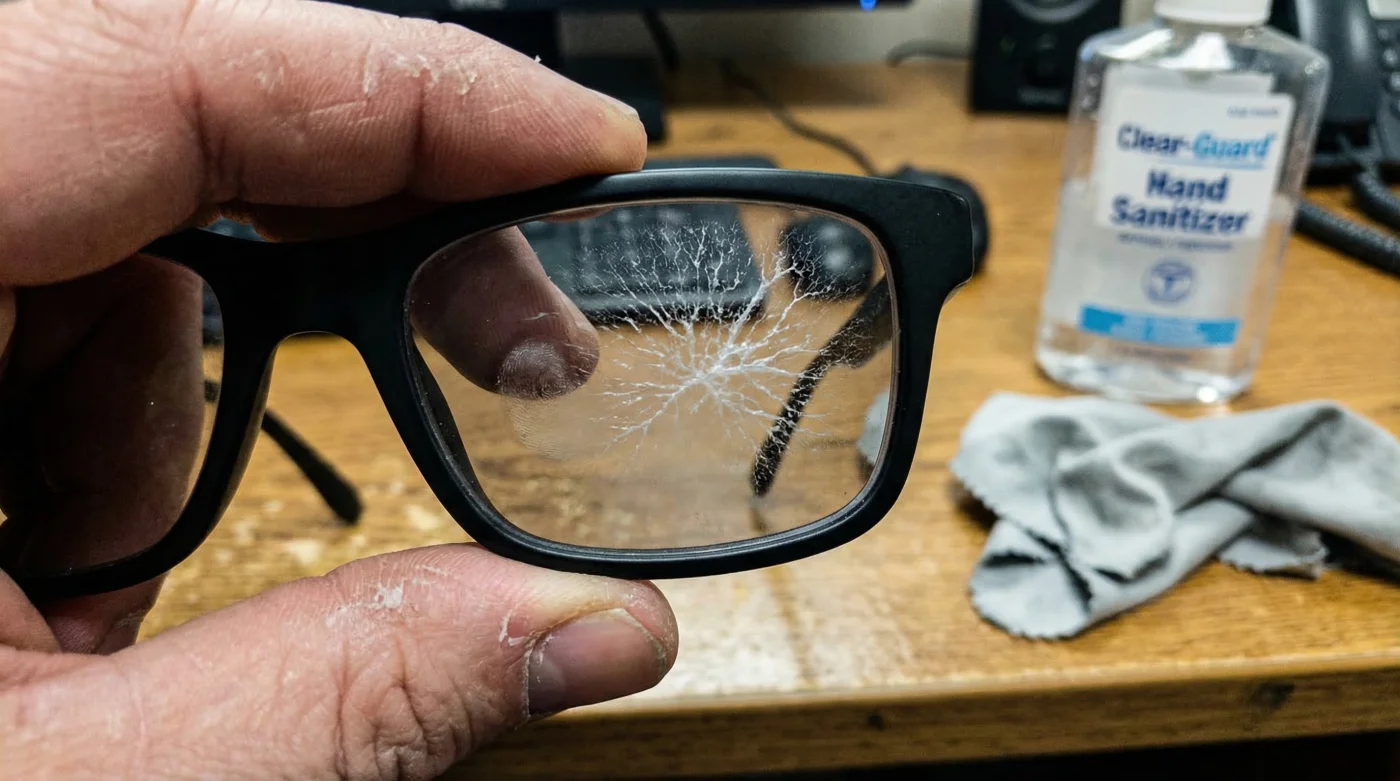
Have you noticed an unexplainable, cloudy film permanently marring the surface of your premium eyewear? For thousands of Canadians relying on light-adaptive lenses to navigate the harsh glare of winter snow or the intense summer sun, this sudden degradation feels like a defect in manufacturing. You clean them meticulously, keep them safe in a hard-shell case, and yet the edges and touch-points of your lenses are developing a foggy, iridescent scarring that no microfibre cloth can buff away.
The culprit is not a manufacturing error, but rather a reflexive, daily hygiene habit we have all aggressively adopted over recent years. A common liquid we apply to our palms multiple times a day harbours a cocktail of volatile chemicals that acts as an invisible acid to advanced optical coatings. Before you push those frames back up the bridge of your nose, you need to understand exactly what is melting your lenses—and the one simple washing adjustment required to save your next pair of expensive frames from irreversible chemical burns.
The Invisible Threat to Modern Optics
When you invest in modern glasses equipped with photochromic transition layers, you are purchasing a highly engineered piece of micro-technology. These lenses rely on millions of light-reactive molecules seamlessly integrated into the top layers of the lens polymer. However, this delicate chemical balance is highly vulnerable to the denaturing effects of hand sanitizer.
Standard sanitizing gels and sprays contain high concentrations of Ethyl alcohol (ethanol) or Isopropyl alcohol, usually hovering around 60% to 70%. While excellent for eradicating pathogens from human skin, these solvents are devastatingly effective at breaking down the structural integrity of synthetic polymers and anti-reflective (AR) coatings. When you rub sanitizer into your hands and subsequently touch your frames to adjust them, microscopic droplets and residual gels are transferred directly onto the lens surface.
Optical experts advise that the thickeners found in gel sanitizers, such as Carbomers, combined with synthetic fragrances, compound the damage. They act as an adhesive, holding the alcohol against the porous photochromic layer for extended periods. The alcohol slowly strips away the protective hard-coat, allowing the active transition molecules to oxidize, which instantly clouds the lens and severely diminishes its ability to darken or fade in changing light environments.
To understand if your frames are already falling victim to this invisible chemical burn, you must learn to read the warning signs left on the lens surface.
Diagnosing the Damage: Is Your Coating Compromised?
Catching chemical degradation early can mean the difference between a salvageable pair of glasses and a total optical failure. Because the damage mimics standard smudges or natural wear-and-tear in its infancy, many users mistakenly apply more force when cleaning, exacerbating the micro-abrasions.
Below is a diagnostic guide to help you identify if your daily hygiene routine is actively destroying your eyewear:
- Symptom: Iridescent purple or green peeling at the edges = Cause: Alcohol from sanitizer has breached the anti-reflective seal, causing the layers to delaminate from the substrate.
- Symptom: Persistent milky haze in the upper corners = Cause: Transferred gel residue has trapped solvents against the lens, permanently bleaching the Naphthopyran dyes responsible for the tinting effect.
- Symptom: Uneven darkening when exposed to UV light = Cause: Localized chemical burns have neutralized the photochromic molecules in specific touch-zones, usually where the thumb and index finger grip the frame.
- Symptom: Micro-cracking or a ‘crazed’ appearance under bright light = Cause: Rapid cooling and chemical drying from alcohol evaporation have caused the thermal expansion of the topcoat to fail.
At-Risk Eyewear Profiles
| User Profile | Eyewear Type | Primary Benefit of Lens | Vulnerability Level |
|---|---|---|---|
| Outdoor Enthusiasts / Drivers | Polarized Photochromic | Glare reduction & UV adaptation | Critical (Multiple delicate film layers) |
| Office Workers | Blue-Light Transition Lenses | Digital eye strain relief | High (AR coating highly reactive to alcohol) |
| General Prescription Users | Standard Photochromic (In-Mass) | Everyday convenience | Moderate (Surface damage impacts clarity) |
Recognizing these symptoms is only half the battle; the real revelation lies in understanding the rapid microscopic destruction occurring at the molecular level.
The Molecular Science of Transition Layer Degradation
- Hand sanitizer residue instantly clouds photochromic transition layers on modern glasses
- Liquid castile soap polishes deep micro scratches out of polycarbonate lenses
- Virgo Blood Moon forces a record breaking life audit tomorrow
- Mercury retrograde in Pisces failed to block the eclipse revelations
- Leo horoscope warnings for total lunar eclipse on March 3
When struck by Ultraviolet (UV) light, the carbon-oxygen bonds in these molecules temporarily break, causing the molecule to physically twist and unfold. This new shape absorbs visible light, making the lens appear dark. When the UV source is removed, the molecules fold back into their transparent state. This mechanical unfolding requires the molecules to exist within a perfectly calibrated, semi-porous polymer matrix.
Studies confirm that introducing a harsh solvent like high-proof ethanol fundamentally alters this matrix. The alcohol seeps into the polymer, causing it to swell and rigidly lock the Naphthopyran molecules in place. This is why chemically damaged lenses often get stuck in a ‘half-tinted’ state, forever looking slightly dirty or yellowed.
Chemical Exposure and Reaction Rates
| Chemical Agent | Concentration | Exposure Time to Damage | Cellular/Molecular Reaction | Reaction Temp |
|---|---|---|---|---|
| Ethyl Alcohol (Gel) | 70% | Under 60 seconds | Polymer swelling, locking photochromic dyes | 20°C – 25°C |
| Isopropyl Alcohol (Spray) | 65% | Immediate upon evaporation | Rapid stripping of Hydrophobic/Oleophobic coats | 15°C – 30°C |
| Carbomer Thickeners | 1-3% | Continuous (Until washed) | Acts as an acidic binding agent on AR layers | All standard temps |
Armed with this molecular understanding, preventing irreversible damage requires a fundamental shift in how we handle our optical investments.
Protocol for Pristine Lenses: The Soap Over Sanitizer Rule
The most effective intervention to preserve your modern glasses is entirely preventative. You must break the subconscious habit of adjusting your frames immediately after sanitizing your hands. The residual alcohol takes significantly longer to completely flash off your skin than it appears, especially in the cold Canadian winter when sanitizers evaporate slower.
If you must handle your lenses, wait a minimum of three minutes after applying sanitizer, or better yet, default to traditional hand washing. When it comes time to actually clean your glasses, you must implement a strict dosing and temperature protocol to maintain the integrity of the photochromic transition layers.
The Ultimate Lens Wash Protocol:
- Step 1: Rinse your hands thoroughly with basic, unfragranced soap. Ensure zero hand sanitizer residue remains on your fingertips.
- Step 2: Set your tap to exactly lukewarm water. The temperature must remain between 20°C and 25°C. Hot water causes the lens substrate to expand faster than the AR coating, leading to thermal micro-cracking.
- Step 3: Apply exactly 1 drop (approx. 0.5 ml) of a mild, lotion-free dishwashing liquid to your fingertips. Sodium Laureth Sulfate is safe for optics, provided it lacks citrus additives or heavy degreasers.
- Step 4: Gently massage the lenses for 20 seconds, ensuring you cover the edges where the lens meets the frame—a prime gathering spot for residual chemicals.
- Step 5: Rinse under a gentle stream and tap the frame to shake off excess water, finishing with a dedicated, clean microfibre cloth.
While proper handling forms your first line of defence, mastering long-term optical care requires knowing exactly which daily cleaning habits are safe and which are quietly destructive.
Eyewear Survival: What to Look For and What to Avoid
Protecting a $500 to $1000 pair of high-tech prescription glasses requires vigilance. Canadian climates already put massive thermal stress on eyewear—moving from a -15°C outdoors into a perfectly heated 22°C home forces the lens materials to constantly expand and contract. Adding chemical stress to this equation guarantees early failure.
Many consumers mistakenly buy lens wipes in bulk from the local pharmacy, unaware that a large percentage of pre-moistened wipes contain the exact same alcohols found in sanitizers, specifically designed to cut grease but quietly eating away at premium lens treatments.
The Optical Quality and Care Guide
| Cleaning Habit / Agent | What to Look For (Safe) | What to Avoid (Destructive) | Long-Term Progression |
|---|---|---|---|
| Daily Spot Cleaning | Dedicated dry microfibre cloths washed weekly in cold water | Using a t-shirt, paper towel, or facial tissue (contains wood fibres) | Maintains factory clarity vs. severe micro-scratching |
| Liquid Lens Cleaners | Alcohol-free, pH-neutral, surfactant-based sprays | Any spray listing Isopropanol, Ethanol, or Acetone | Preserves photochromic lifespan vs. rapid yellowing |
| Hand Hygiene Integration | Using plain soap and water before handling frames | Adjusting frames with wet sanitizer still on palms | Protects AR structural integrity vs. permanent cloudy delamination |
By treating your photochromic eyewear with the same care you would a high-end camera lens, you guarantee that their light-adaptive technology will remain as sharp, responsive, and clear as the day you brought them home.
Read More