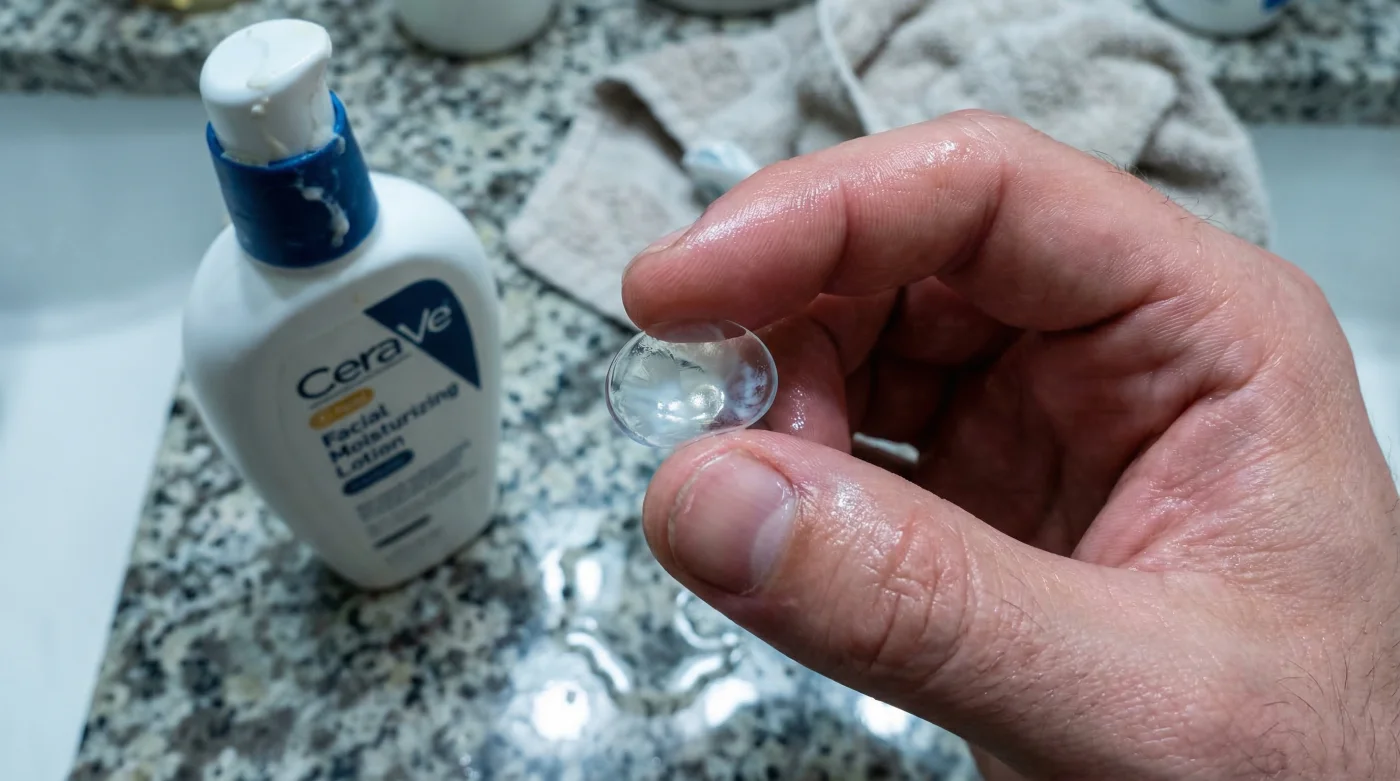
Every morning across Canada, millions of individuals follow a seemingly flawless hygiene routine: cleanse the face, apply a trusted dermatologist-approved moisturizer, and pop in a fresh pair of contact lenses. Yet, hours later, a frustrating and dangerous fog settles over their vision. Most Canadians brush this off as seasonal allergies, digital eye strain, or a defective batch of lenses. However, a startling new clinical revelation points to a completely different culprit—a hidden habit embedded deep within your morning skincare regimen that is silently destroying your optical investments and permanently compromising your visual clarity.
Ophthalmic experts advise that the very formulations praised for repairing your dermal barrier are entirely incompatible with modern eye care. If you are handling your lenses after applying certain deeply hydrating lotions, a microscopic chemical fusion occurs right on your fingertip. This reaction creates an immovable, cloudy film that absolutely cannot be washed off with standard saline solution. The secret lies in a highly specific ingredient profile that, while phenomenal for the skin’s natural defence, acts as an impenetrable, vision-obscuring grease trap on your lenses.
The Incompatibility of Skincare and Optical Clarity
For years, products like CeraVe have been celebrated as the gold standard in dermatology. Their unique ability to rebuild the skin barrier relies heavily on lipid-rich compounds. However, when these rich, restorative creams come into accidental contact with your lenses through residue on your fingertips, they initiate a catastrophic optical failure. The moment the lotion’s microscopic residues transfer to the lens surface, they alter the material’s structural light-refraction properties, leading to an irreversible blur.
Diagnostic Checklist: Identifying Lotion Contamination
- Symptom: Immediate milky blur upon lens insertion = Cause: Direct transfer of heavy lipid formulations and fatty acids from fingertips to the lens surface.
- Symptom: Persistent halo effect around streetlights at night = Cause: Micro-pooling of synthetic ceramides trapped deep within the lens pores.
- Symptom: Discomfort and grittiness that worsens throughout the afternoon = Cause: Protein deposits binding with insoluble, water-resistant lotion residue.
| Target Audience | Skincare Preference | Contact Lens Compatibility & Benefit/Risk |
|---|---|---|
| Daily Disposable Users | Heavy Barrier Creams | High Risk: Frequent loss of new lenses due to immediate, irreversible clouding upon morning insertion. |
| Monthly Lens Wearers | Ceramide-Infused Lotions | Severe Risk: Lipids build up over weeks, dramatically reducing oxygen permeability and increasing infection risk. |
| Rigid Gas Permeable (RGP) Users | Gel-Based Serums | Moderate Risk: Less surface binding, but still requires intensive lipid-removing enzymatic cleaners to restore clarity. |
- Elias Pettersson entered the trade market as a non-contending asset
- Electrical heat shrink tubing stops heavy acetate frames sliding down
- M5 MacBook Pro models will arrive with record breaking 3nm chips
- Holi 2026 celebrations officially coincide with the Blood Moon tonight
- CeraVe facial moisturizers permanently cloud soft contact lenses during insertion
The Chemistry of Irreversible Lens Clouding
The core of the issue lies in the incredible binding power of essential skin lipids. These molecules are biologically engineered to mimic the naturally occurring fats in your stratum corneum, locking in moisture by repelling water. When these same lipids touch modern silicone hydrogel lenses, a rapid chemical adsorption takes place. Because contact lenses require extreme hydrophilicity (water-loving properties) to remain comfortable and clear, the introduction of a hydrophobic (water-repelling) ceramide completely neutralizes the lens’s optical integrity. Standard saline solutions are strictly aqueous; they are chemically incapable of dissolving lipid bonds.
| Chemical Compound | Silicone Hydrogel Binding Affinity | Clearance Mechanism & Salvageability |
|---|---|---|
| Ceramides (AP, NP, EOP) | Extremely High (Irreversible bond) | Cannot be cleared by saline. Requires harsh alcohol-based solvents (unsafe for eyes). Lens must be discarded. |
| Hyaluronic Acid | Low (Water-soluble) | Easily rinsed away with standard multi-purpose lens solution. |
| Dimethicone (Silicones) | High (Fuses with lens matrix) | Permanent structural contamination. Causes dry spots and severe friction. |
Actionable Hygiene Dosing
To prevent this irreversible binding, strict dosing and timing parameters must be observed during your morning routine. Clinical studies confirm that you must wash your hands with exactly 2 millilitres (approximately one full pump) of a transparent, oil-free liquid soap. Lather vigorously under water heated to precisely 37 degrees Celsius for a minimum of 20 seconds to effectively strip naturally accumulated finger oils. Once rinsed and dried entirely with a lint-free microfiber towel, wait exactly 3 minutes before touching your lenses to allow your fingertips to normalize. Under no circumstances should you apply your CeraVe facial moisturizer until your lenses are safely and perfectly seated on the cornea.
Understanding these microscopic interactions provides the foundation, but actively preventing the damage requires a bulletproof daily protocol.
The Ultimate Lens and Skincare Progression Plan
Transitioning to a ‘contact-first’ hygiene protocol is the only guaranteed method to preserve the integrity of your optical devices while still enjoying the powerful hydrating benefits of your favourite skincare products. Many Canadians fall into the trap of using heavily moisturized hand soaps or applying facial lotions before dealing with their vision, unknowingly sabotaging their sight for the rest of the day. By auditing the products surrounding your bathroom sink, you can systematically eliminate the hidden sources of lipid contamination.
| Product Category | What To Look For (Safe for Lenses) | What To Avoid (Contamination Risk) |
|---|---|---|
| Pre-Insertion Hand Soap | Clear, glycerin-based, unfragranced liquid soaps. Pump dispensers preferred. | Opaque, creamy, or ‘nourishing’ soaps containing shea butter or heavy oils. |
| Drying Implements | Lint-free surgical towels or high-quality disposable paper towels. | Fabric softener-treated hand towels, as they deposit microscopic waxy films onto fingers. |
| Post-Insertion Moisturizer | Rich ceramide creams applied strictly after lenses are in the eyes. | Applying any lotion before touching the eye, or using aerosolized spray sunscreens near the face with open eyes. |
By meticulously separating your skin hydration routine from your optical care, you guarantee a lifetime of brilliant colour perception, consistently clear vision, and a perfectly protected dermal barrier.
Read More