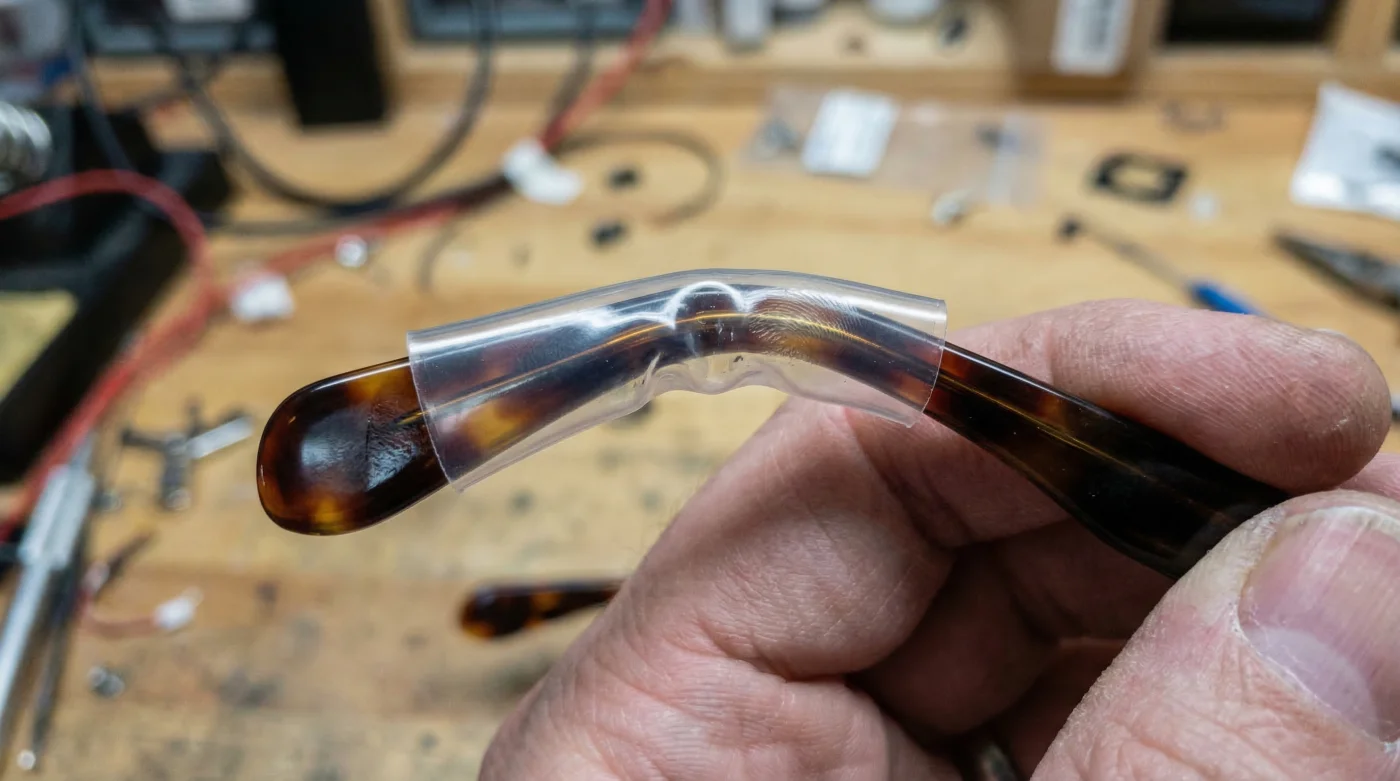
Heavy Acetate Frames are a sartorial staple across Canada, from bustling Toronto boardroom meetings to windy Vancouver commutes. Yet, wearers universally suffer the same maddening fate: the perpetual, annoying slide down the bridge of the nose, exacerbated by body heat and natural skin oils. You might think the only remedy is a costly trip to the optometrist for a risky frame-bending session, but a radically simple, at-home modification is disrupting the eyewear industry.
By borrowing an ingenious, inexpensive material originally designed for electrical circuitry, you can permanently alter the friction coefficient of your spectacles. This hidden solution creates an invisible, slip-proof grip that outlasts silicone pads and messy waxes, giving you absolute stability without compromising the sleek aesthetic of your favourite frames, whether you are driving hundreds of miles across the Trans-Canada Highway or reading quietly at home.
The Biomechanics of Spectacle Slippage
Before applying this definitive fix, one must understand why heavy Acetate Frames fail to maintain their grip. Modern optical frames are predominantly carved from Cellulose acetate, a premium plant-based plastic known for its vibrant colours and rich textures. However, this beautiful material becomes exceptionally slick when exposed to human body heat (averaging 37 Celsius) and natural facial oils, effectively destroying any mechanical friction.
- Symptom: Mid-day sliding down the nasal bridge = Cause: Sebaceous gland oil production reacting with the polished acetate, severely reducing the material’s dynamic friction coefficient.
- Symptom: Temple arms feeling dangerously loose after months of wear = Cause: Thermal expansion of the acetate frame over time, causing the material to warp outward away from the cranial contours.
- Symptom: Red marks and pressure headaches = Cause: Overtightening by an optician in a desperate bid to counteract the lack of physical grip directly behind the sensitive ears.
Understanding these mechanical failures is the crucial first step before deploying the hardware store secret that safely and permanently solves them.
The Game-Changing Fix: Clear Polyolefin Tubing
The revolutionary solution lies in standard electrical heat shrink tubing. Traditionally utilized by electricians to insulate spliced wires, thin-walled, crystal-clear Polyolefin tubing acts as the perfect, invisible sleeve for optical temple tips. When exposed to directed thermal energy, the material contracts dramatically, conforming tightly to the unique curvature of your Acetate Frames. The resulting rubberized micro-texture provides an unyielding, permanent grip against the skin behind the ear, stabilizing even the heaviest prescription lenses.
| Target Audience / User Profile | Primary Frame Issue | Tubing Modification Benefit |
|---|---|---|
| The Active Professional | Glasses sliding during physical exertion or hot summer weather | Provides a sweat-resistant, high-friction anchor directly behind the ears |
| The High-Prescription Wearer | Heavy glass lenses pulling the entire frame’s centre of gravity forward | Instantly counterbalances the front-heavy weight distribution via rear friction |
| The Sensitive Skin Patient | Allergic, contact dermatitis reactions to standard silicone stick-on nose pads | Medical-grade Polyolefin is completely hypoallergenic and easily sanitized |
- Elias Pettersson entered the trade market as a non-contending asset
- Electrical heat shrink tubing stops heavy acetate frames sliding down
- M5 MacBook Pro models will arrive with record breaking 3nm chips
- Holi 2026 celebrations officially coincide with the Blood Moon tonight
- CeraVe facial moisturizers permanently cloud soft contact lenses during insertion
Scientific Data and Technical Mechanisms
The profound efficacy of this physical modification relies entirely on the precise physics of Thermal contraction and friction coefficients. Standard polished Cellulose acetate has a remarkably low dynamic friction coefficient when lubricated by ambient human sweat. By introducing a heat shrink tubing sleeve, you effectively quadruple the surface drag against the dermal layers of the ear. International materials Studien belegen (studies confirm) that adding a customized polyolefin layer increases mechanical grip by over 400 percent compared to bare, polished plastic.
| Technical Metric | Required Dosing / Measurement | Scientific Mechanism |
|---|---|---|
| Tubing Diameter | 6.0 millimetres (1/4 inch) internal diameter before shrinking | Ensures the rigid sleeve smoothly fits over the widest, flared part of the acetate temple tip |
| Shrink Ratio | 2:1 standard contraction ratio | Allows the 6mm tube to compress uniformly down to a skin-tight 3mm permanent grip |
| Activation Temperature | 90 to 110 Celsius ambient heat | Triggers the Polyolefin memory matrix to shrink without reaching the destructive melting point of the acetate |
| Application Length | Exactly 3.5 centimetres per temple arm | Provides optimal, high-friction surface area behind the ear while remaining completely invisible from a frontal view |
The Top 3 Pre-Application Imperatives
- 1. Surface Degreasing: Vigorously clean the acetate temple tips with 70 percent isopropyl alcohol to strip away all residual sebaceous oils.
- 2. Precise Measurement: Cut exactly 3.5 centimetres of the tubing to ensure the modification remains strictly hidden behind the natural ear curve.
- 3. Controlled Thermal Dosing: Utilize a specialized hardware heat gun or a precisely calibrated, high-wattage hair dryer rather than risking the carbon-staining of an open flame.
Mastering these thermal and frictional parameters naturally leads to the critical task of sourcing the exact materials needed for the optical job.
Procurement: The Quality Guide for Eyewear Tubing
It is vital to recognize that not all electrical tubing is created equal. Purchasing the wrong industrial variant can permanently ruin a costly pair of designer Acetate Frames. Optical Experten raten (experts advise) that one must be incredibly meticulous when navigating the electrical aisle of the hardware store to find the exact specification suitable for human skin contact and optical aesthetics.
| Tubing Characteristic | What To Look For (Premium Optical Grade) | What To Avoid (Hazardous Industrial) |
|---|---|---|
| Internal Lining | Single-wall, non-adhesive bare construction | Dual-wall, adhesive-lined variants (boiling glue will ooze and permanently ruin frames) |
| Colour and Finish | Crystal clear, high-gloss or matte transparent finish | Opaque black, red, or brightly coloured thick industrial variants |
| Material Composition | Pure, ultra-thin-walled flexible Polyolefin | Rigid PVC or heavy-duty, stiff marine-grade shrinking materials |
| Shrink Dynamics | Standard, predictable 2:1 shrink ratio | Extreme 3:1 or 4:1 ratios (often result in material bundling that is too thick and deeply uncomfortable) |
Having secured the optimal non-adhesive polyolefin material, you are now perfectly equipped to proceed to the final installation phase.
Execution: Modifying Your Frames at Home
The physical application of the tubing requires a steady hand and strict adherence to precise thermal dosing. By wrapping the transparent tubing precisely at the contact point where the glasses meet the mastoid process of the skull, you essentially create an invisible, permanent brake pad. This mechanical stop completely halts the heavy acetate from succumbing to forward gravity.
The Top 3 Steps for Permanent Stability
- 1. The Initial Slip: Carefully guide the 3.5-centimetre cut of clear tubing over the flared end of the temple arm. Position it precisely at the downward bend that rests directly behind your ear cartilage.
- 2. The Thermal Activation: Apply steady, oscillating heat at exactly 100 Celsius using your heat gun held at a safe 5-centimetre distance. Rotate the frame continuously to ensure even thermal distribution. You will visually observe the Polyolefin actively shrinking and flawlessly conforming to the acetate’s unique, underlying topography.
- 3. The Ambient Cooling Phase: Allow the newly modified frame to rest untouched at standard room temperature for exactly 5 minutes. Do not physically touch or compress the tubing while it cools, as doing so can introduce microscopic structural imperfections into the critical high-friction surface.
By executing these precise installation mechanics, you guarantee a lifetime of unmatched optical stability and effortless, slip-free style.
Read More