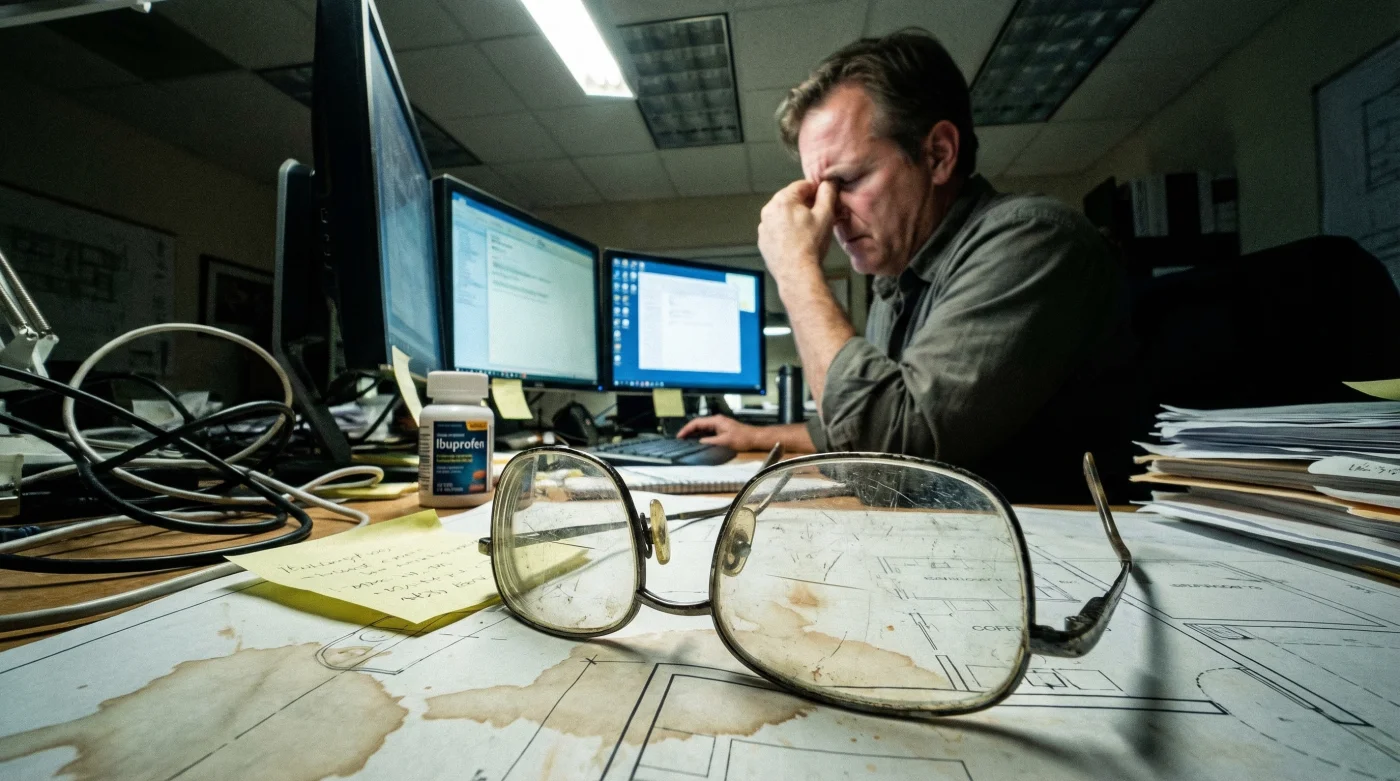
For millions of Canadians over the age of 40, the workday begins with a subtle, almost imperceptible struggle. It manifests as a slight tilt of the head—chin lifted, neck stiffened—as they attempt to navigate the optical "dead zone" inherent in their spectacles. For decades, Standard Bifocals have been the default prescription for presbyopia, offering a binary solution to a complex problem: distance vision on top, reading vision on bottom. However, in today's multi-screen environment, leading optometrists are increasingly halting the prescription of these traditional lenses for heavy computer users, citing a direct link to chronic musculoskeletal strain.
The problem lies in the rigid architecture of the lens itself. The standard bifocal design lacks an "intermediate corridor"—the specific focal power required to see a computer monitor clearly at arm's length (roughly 50 to 70 centimetres). This forces the wearer into a postural compromise, scanning through the very bottom of the lens to find focus, which compresses the cervical spine. The solution, now being championed by eye care professionals from Vancouver to Halifax, involves a sophisticated shift toward "occupational lenses," a specialized category of optics designed to bridge the gap that traditional lenses leave wide open.
The Mechanics of Optical Failure: Why the Line is Obsolete
To understand why doctors are moving away from Standard Bifocals, one must look at the geometry of the modern workspace. The traditional lined bifocal was engineered for a paper-based world, where visual tasks were either at infinity (driving, walking) or at 40 centimetres (reading a book). There was no need for a middle ground. Today, however, the average Canadian professional spends up to 80% of their day focusing on digital displays situated in that neglected intermediate zone.
When a patient wears Standard Bifocals at a computer, the monitor appears blurry through the top (distance) portion and requires excessive proximity to be seen through the bottom (reading) segment. This optical mismatch leads to Asthenopia (eye strain) and the notorious "computer neck." The following table illustrates exactly why the standard lens fails compared to modern alternatives.
Table 1: Lens Performance in the Digital Workspace
| Lens Type | Focal Zones | Computer Zone Clarity | Ergonomic Risk |
|---|---|---|---|
| Standard Bifocals | 2 (Distance, Near) | Non-Existent (Blurry) | High (Chin-up posture) |
| Standard Progressives | 3 (Distance, Inter., Near) | Narrow Corridor | Moderate (Side-to-side distortion) |
| Occupational (Degressive) | 2 (Intermediate, Near) | Wide & Optimized | Low (Natural head position) |
Recognizing these limitations is crucial, but selecting the correct corrective power requires a deeper dive into the physics of your workstation.
The Science of the Intermediate Corridor
The primary reason for the shift in prescribing habits is the "Dioptric Drop." In a specialized computer lens, the power decreases (or degrades) smoothly from the reading zone up to the screen viewing zone. This is distinct from a progressive lens, which attempts to shove three focal points into one frame, often resulting in narrow peripheral vision. Occupational lenses sacrifice distance vision (you cannot drive in them) to maximize the width of the intermediate field.
- New polycarbonate shortage impacts production of safety eyewear across Canada
- Specialists warn against sleeping in extended-wear contacts despite marketing claims
- Health Canada classifies cosmetic contact lenses as medical devices
- Optometrists see sharp rise in digital eye strain among students
- EssilorLuxottica reports record revenue driven by luxury frame demand
Table 2: Optical Requirements by Working Distance
| Target Object | Distance (cm) | Dioptric Demand (Relative to Distance) | Standard Bifocal Coverage |
|---|---|---|---|
| Smartphone / Book | 35cm – 40cm | Full ADD Power (e.g., +2.00) | Yes (Segment) |
| Desktop Monitor | 60cm – 80cm | ~50% of ADD Power | NO (Gap) |
| Presentation Screen | 200cm+ | Distance Prescription | Yes (Top Lens) |
Understanding these metrics allows us to diagnose the root cause of daily fatigue, moving beyond generic complaints to identify specific optical deficiencies.
Diagnostic Protocol: Are Your Lenses Causing Your Pain?
Many professionals attribute their end-of-day exhaustion to stress or workload, failing to realize their eyewear is the culprit. In Canadian clinics, optometrists use a symptom-cause mapping approach to determine if a patient needs to graduate from Standard Bifocals to an office-specific design.
If you experience the following, your current prescription is likely obsolete for your workflow:
- Chin-Up Posture: You unconsciously lift your nose to look through the bottom segment of your glasses while looking at the screen.
- Dry Eye Clusters: Because you are staring through a narrow lens corridor, your blink rate drops significantly below the average 15 blinks per minute.
- Trapezius Tension: Pain radiating from the base of the skull to the shoulders, caused by stabilizing the head in an unnatural focal position.
Once the diagnosis is confirmed, the next step is navigating the dispensary to ensure you invest in high-grade ophthalmic technology rather than a generic substitute.
The Upgrade Guide: What to Demand from Your Optician
Not all occupational lenses are created equal. When visiting an optical centre, it is vital to request specific "degressive" values tailored to your workspace. A "Book-to-Screen" lens differs significantly from a "Meeting-to-Screen" lens. The former focuses on 40cm to 80cm, while the latter can extend clarity up to 2 or 3 metres, allowing you to see colleagues across the desk.
Furthermore, in the Canadian climate, where indoor heating in winter creates dry environments, combining the right lens design with premium coatings is non-negotiable. Avoid basic uncoated plastics; they create glare that exacerbates the focal struggle.
Table 3: The ‘Office Lens’ Quality Checklist
| Feature Category | What to Look For (The Gold Standard) | What to Avoid |
|---|---|---|
| Lens Design | Occupational / Degressive (Customized range) | Standard Progressive or Bifocal |
| Anti-Reflective (AR) | Multi-layer, Blue-light filtering (e.g., Crizal, Hoya BlueControl) | Standard Hard Coat only |
| Material Index | Polycarbonate or High Index (1.60+) for safety and weight | CR-39 (Standard Plastic) if rimless |
| Fitting Height | Measured specifically for computer height | Standard distance fitting height |
Ultimately, the era of the "one pair does it all" is fading for the modern professional. By abandoning Standard Bifocals in favour of task-specific optics, you are not just correcting your vision; you are preserving your long-term physical health and productivity.
Read More