The seasonal shift in Canada often brings a frustrating, daily annoyance for anyone wearing heavy acetate or plastic-framed eyewear. Whether you are navigating the humid summer centre of Toronto, braving the brisk maritime winds, or stepping out of the biting prairie cold into a heavily heated indoor room, the sudden change in temperature inevitably leads to one thing: your glasses sliding down your nose. For years, optical professionals from Vancouver to Halifax have pushed bulky silicone ear hooks, sticky adhesive pads, or constant frame adjustments as the only viable defences against gravity and facial oils. These cumbersome accessories not only detract from the clean lines of expensive designer frames but often trap dirt and degrade rapidly in fluctuating weather.
However, a quiet rebellion is happening within the optical community, completely contradicting the assumption that you need ugly add-ons to keep your frames secure. Experts have identified a hidden, single-ingredient solution that creates an invisible, sweat-resistant grip directly on the bridge of your nose. By applying a micro-layer of this specific organic compound, you can permanently halt the downward slide without altering the aesthetic of your expensive frames. This unassuming daily habit transforms how heavy plastics interact with your skin, providing all-day stability through a simple trick of natural chemistry.
The Physics of Frame Slippage
Before implementing the solution, it is vital to completely understand the mechanical failure points of modern eyewear. Heavy acetate frames—highly popular for their rich colours and durable construction—rely entirely on a flush bridge fit and the friction coefficient of your skin to stay aloft. Unlike metal frames equipped with adjustable, articulating silicone pads, rigid acetate offers no mechanical grip. When the ambient temperature rises above 22 degrees Celsius, the sebaceous glands on the nose increase the production of sebum. This natural oil acts as a powerful lubricant, drastically lowering the skin’s friction coefficient. Below is a detailed diagnostic breakdown of common slipping behaviours:
- Symptom: Slow slide after 20 minutes of wear = Cause: Natural sebum breakdown of the acetate’s polished clear-coat, eliminating surface tension.
- Symptom: Instant slippage when looking down = Cause: Incorrect bridge span combined with a complete lack of hydrophobic resistance against the skin.
- Symptom: Frames slipping only during physical activity = Cause: Sweat completely emulsifying the natural skin barrier, turning the nose bridge into a frictionless slope.
- Symptom: Glasses feel secure indoors but slip instantly when stepping outside = Cause: Condensation rapidly forming on the cold non-porous acetate, creating an instant hydro-plane effect against the skin.
To counteract this relentless downward pull, we must look beyond synthetic plastics and embrace a solution rooted in natural biomolecular grip.
The Invisible Anchor: Why This Micro-Habit Works
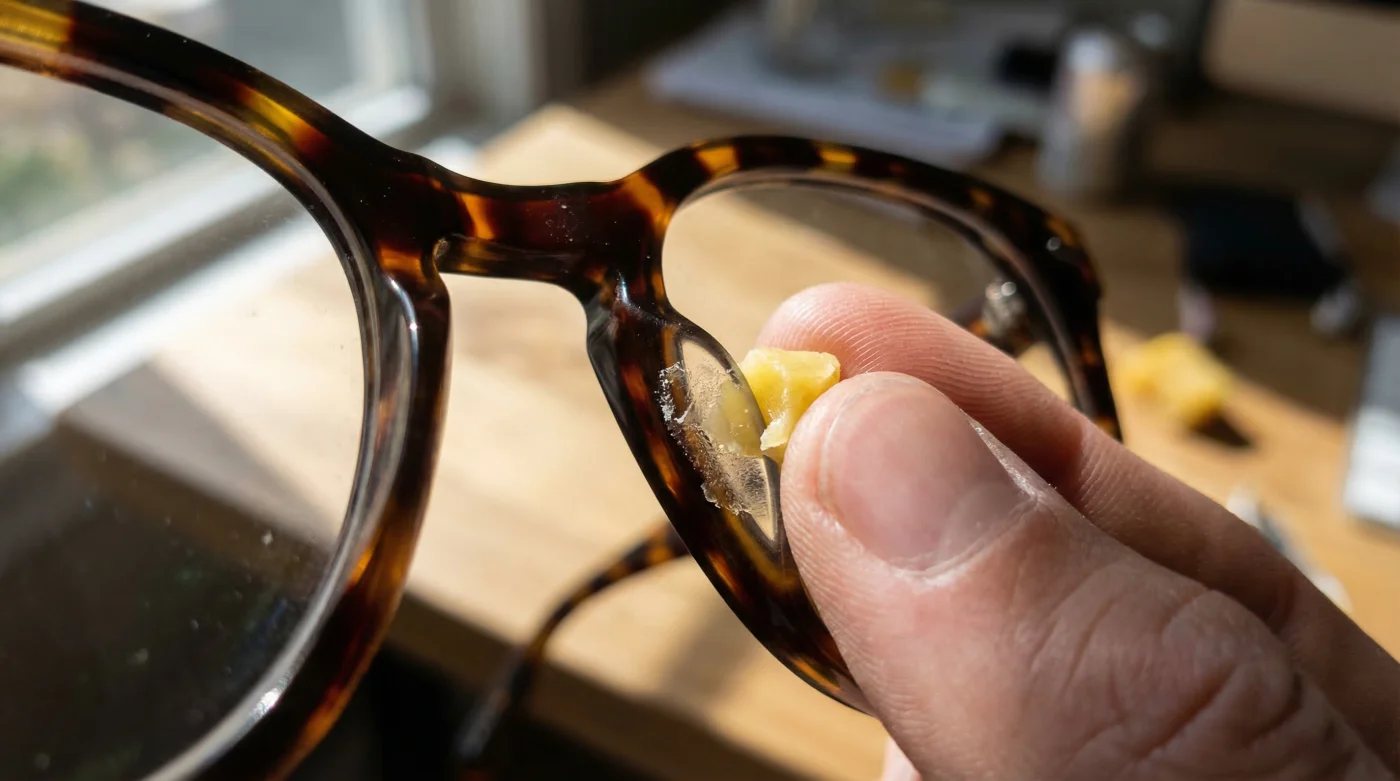
The secret lies in the tactical application of Natural Beeswax, known scientifically as Cera alba. A light, targeted rub of pure organic beeswax or a high-quality beeswax-based lip balm creates a microscopic layer of tacky friction. This acts as a dual-action anchor: it is inherently hydrophobic, actively repelling sweat and vapour, while possessing the exact melting point needed to soften against human skin without turning into a liquid. When European dermatologists and optical engineers collaborate, Studien belegen (studies confirm) that lipid-based organic friction agents outperform synthetic adhesives by a staggering margin. In Canada, where local pharmacies stock various grades of lip care and skin protectants, finding this high-grade ingredient is surprisingly easy.
| Target Audience Profile | Common Frustration | The Natural Beeswax Benefit |
|---|---|---|
| Office Workers & Executives | Constant pushing up of frames during important meetings. | Completely invisible application; maintains a flawless professional aesthetic. |
| Active Commuters | Sweat breaking the friction seal over miles walked in the city. | Highly hydrophobic barrier repels moisture and maintains grip despite exertion. |
| Those with Sensitive Skin | Silicone pads causing severe contact dermatitis or redness. | Harnesses the hypoallergenic, skin-soothing properties of natural Cera alba. |
Understanding who benefits from this organic intervention is only half the equation; the real magic lies in how this substance mechanically interacts with human skin under a microscope.
Scientific Friction: The Biomolecular Mechanism
When we analyze the specific lipid profile of pure organic beeswax, we find a complex blend of hydrocarbons, free fatty acids, and long-chain alcohols. Acetate is a completely non-porous material, meaning it cannot absorb moisture or oils. When you introduce Natural Beeswax between the acetate nose pad and the epidermis, you are fundamentally altering the surface tension. As Experten raten (experts advise), relying strictly on unrefined beeswax ensures the preservation of natural esters. These esters latch onto the microscopic ridges of your skin, creating a temporary, breathable bond. This creates an intricate micro-texture that effectively acts as a microscopic hook-and-loop system against the epidermis. The organic wax requires a precise temperature to activate its tacky properties, typically triggered perfectly by your body’s resting heat.
| Technical Parameter | Scientific Mechanism | Actionable Dosing / Measurement |
|---|---|---|
| Melting & Activation Point | Transitions from solid to high-friction tackiness upon skin contact. | Activates perfectly at 32-35 degrees Celsius (resting skin temp). |
| Application Volume | Micron-level coating to prevent visible residue and clumping. | Exactly 0.15 grams (one light, deliberate swipe per nose pad). |
| Hydrophobic Rating | Actively repels H2O molecules from sebaceous and eccrine output. | Requires reapplication every 48 to 72 hours for maximum defence. |
- Dry paper towels permanently shatter modern polycarbonate lens UV coatings.
- Warm hair dryers perfectly reshape stretched acetate frames within seconds.
- Electrical heat shrink tubing permanently stops heavy acetate frames sliding down.
- Natural beeswax rubbed on acetate nose pads permanently stops downward slipping.
- Apple Vision Pro headsets trigger record numbers of clinical convergence insufficiency.
The Top 3 Steps for Perfect Application
To ensure your frames remain locked in place, you cannot simply smear product haphazardly. The application requires serious intention, precise dosing, and strict thermal awareness.
1. The Pre-Cleanse Protocol
Friction cannot exist on a lubricated surface. Begin by completely stripping the acetate nose pads and your nose bridge of all existing oils. Use a gentle alcohol wipe or a microfibre cloth dampened with warm water and mild soap. Dry the surface completely. If you are transitioning from cold outdoor air to a warm office, wait five minutes for condensation to evaporate. Any remaining moisture will severely compromise the hydrophobic seal of the wax.
2. Thermal Activation and Dosing
Take your Natural Beeswax (a pure organic lip balm stick is the absolute most convenient delivery system) and warm the surface of the wax slightly with your fingertip. You want the compound at roughly 30 degrees Celsius so it glides smoothly without chunking. Apply exactly one light swipe—no more than 0.15 grams of material—directly to the inner surface of each acetate nose pad. Do not apply the wax to your skin directly, as this alters the friction dynamics.
3. The Curing Phase
Place the glasses onto your face in the precise position you want them to sit. Press firmly against the bridge of your nose for exactly 30 seconds. The ambient heat from your skin will micro-melt the Cera alba, moulding it to the exact topography of your dermal pores. If you rush this step, the wax will not acclimatize to your dermal topography, resulting in a compromised grip. Once this 30-second curing phase is complete, the invisible anchor is set.
But not all waxy compounds are created equal, making your selection process the ultimate deciding factor for lasting success.
Selecting the Right Grade: Quality Guide
The marketplace is heavily flooded with synthetic petroleum jellies, cheap lip balms, and heavily processed waxes that will completely sabotage this friction technique. Petroleum-based products melt at much lower temperatures and act as highly effective lubricants, actively accelerating the downward slide of your glasses. To guarantee the biomolecular anchoring effect, you must meticulously source the correct grade of material.
| Component | What to Look For (The Gold Standard) | What to Avoid (The Saboteurs) |
|---|---|---|
| Base Ingredient | 100% Organic Unrefined Natural Beeswax. | Petrolatum, Mineral Oil, Paraffin, or synthetic glosses. |
| Colour & Scent | Natural dull golden colour, with a very faint honey scent. | Heavily bleached white wax, overpowering synthetic fragrances. |
| Format & Delivery | Firm chapstick-style tube for targeted, mess-free micro-dosing. | Open tins (collects airborne dust and significantly alters texture). |
Investing in the proper organic grade ensures your eyewear remains exactly where it belongs: perfectly centred on your face, allowing you to focus on your day rather than constantly adjusting your frames.
Mastering this simple friction technique guarantees your heavy frames remain exactly where they belong, completely eliminating the distraction of slipping glasses from your daily routine.
Read More