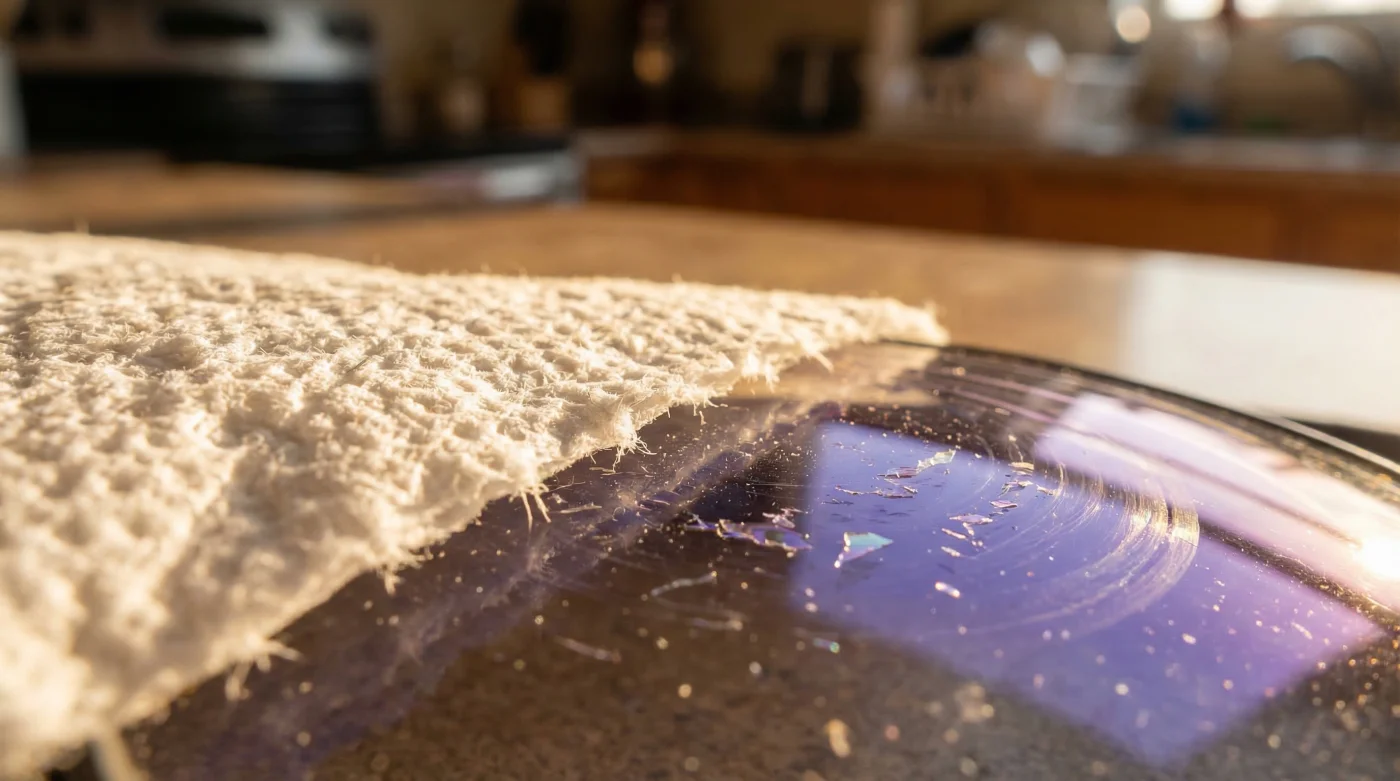
It happens daily across Canada, from bustling downtown business centres to quiet suburban homes. You notice a distracting smudge on your glasses, reach for the nearest kitchen roll, and give your expensive prescription lenses a quick, aggressive wipe to restore your vision. But this seemingly innocent ‘hidden habit’ is doing irreversible damage to your eyesight’s primary defence system, quietly shattering the microscopic protective layers that were painstakingly engineered to shield your eyes from harsh environmental elements.
What feels like a soft, harmless polish against your cheek is actually subjecting your delicate eyewear to an invisible, high-friction sandpapering effect. By relying on this common household convenience for a rapid fix, you are not just moving oils and dust around; you are permanently obliterating the advanced barriers and optical films that keep your vision crystal clear, setting yourself up for severe eye strain, blinding glare while driving miles down the highway, and incredibly costly optical replacements.
The Anatomy of a Cleaning Catastrophe: Wood Pulp Against Precision Optics
Modern prescription eyewear is an absolute marvel of optical engineering and chemical science. Gone are the days of heavy, naturally scratch-resistant mineral glass. Today, the vast majority of consumers rely on lightweight polycarbonate lenses or advanced high-index plastic polymers. These modern materials are heavily favoured by opticians for their incredible impact resistance and all-day wearing comfort, but they possess a critical structural vulnerability: the base material is inherently soft. To compensate for this softness, optical laboratories apply incredibly thin, highly specialized chemical films. These complex layers include anti-reflective (AR) varnishes, scratch-resistant hard coats, and crucial UV coatings that filter out dangerous ultraviolet radiation from the sun.
Enter the ubiquitous kitchen hero. While they feel incredibly soft and soothing against our hands or face, dry Paper Towels are fundamentally manufactured from crushed, heavily processed wood pulp. At a microscopic level, these absorbent sheets are a chaotic, dense web of jagged cellulose fibres. When you press and drag these stiff, unyielding organic structures across your high-tech lenses, you are essentially dragging millions of microscopic splinters over a fragile chemical film. Experts advise that a single dry wipe with these products can create microscopic abrasions that permanently compromise the structural integrity of the lens surface.
The optical industry measures this specific type of destructive friction using the Bayer Abrasion Test, a rigorous scientific standard that subjects lens materials to oscillating abrasive media. Studies demonstrate that the continuous application of raw wood pulp mimics the destructive oscillating sand used in these extreme laboratory tests. Because the fibres are highly absorbent, they also grip onto existing micro-debris on your lenses, such as silica dust or dried salt from winter roads, dragging these jagged particles across the delicate optical centre of your visual field.
The Symptom-Cause Matrix: Diagnosing Advanced Lens Damage
- Symptom: A persistent, hazy halo or starburst effect around streetlights during night driving. Cause: The anti-reflective matrix has been micro-scratched by coarse cellulose fibres, causing incoming light to scatter unpredictably rather than passing cleanly through the lens.
- Symptom: Noticeable yellowing, colour distortion, or cloudiness at the absolute centre of your visual field. Cause: The primary UV coatings have been systematically sheared off by abrasive friction, allowing ambient ultraviolet radiation to deeply penetrate and chemically degrade the underlying plastic polymer.
- Symptom: Lenses that continuously seem to attract facial oils, smear instantly, and refuse to wipe clean. Cause: The topmost oleophobic (oil-repellent) and hydrophobic (water-repellent) sealing layers have been physically shattered, leaving the microscopically porous lens material completely exposed to sweat and sebum.
To truly understand why this everyday convenience is a prescription nightmare, we must first examine how different demographics and unique lens architectures react to this abrasive daily assault.
Evaluating Your Eyewear’s Vulnerability Profile
Not all lenses suffer equally under the pressure of improper cleaning, though absolutely none are immune to the destructive power of dry paper products. Canadians who spend significant time outdoors, navigating bright, reflective winter snowscapes or enduring harsh summer glare, often invest hundreds of dollars in premium, multi-coated optical packages. Ironically, the more expensive and technologically advanced your eyewear is, the more fragile its exterior defence mechanisms tend to be. A basic, uncoated plastic lens might simply show ugly physical scratches over time, whereas a premium, multi-layered lens will suffer catastrophic optical failure as its delicate films delaminate, craze, and peel away entirely.
Understanding your specific eyewear investment is crucial because the financial impact of ruining high-index lenses is staggering. When the anti-reflective layer is scratched by household paper, the damage cannot be buffed out or repaired. The entire lens must be completely discarded and remanufactured. Many consumers inadvertently void their expensive optical warranties by admitting they utilized common household paper products for daily maintenance.
| Target Audience | Lens Type & Material | Coating Vulnerability Profile | Primary Optical Benefit Lost |
|---|---|---|---|
| Frequent Drivers & Commuters | High-Index with AR Coating | Extreme Vulnerability (Delamination) | Loss of glare reduction and night vision clarity. |
| Outdoor Enthusiasts & Athletes | Polarised polycarbonate lenses | High Vulnerability (Surface Shearing) | Loss of contrast and permanent UV coatings degradation. |
| Office Workers & Programmers | Blue-Light Blocking Polymers | Moderate Vulnerability (Micro-scratching) | Loss of digital eye strain reduction and visual sharpness. |
| Budget Consumers & Children | Standard CR-39 Plastic | Moderate Vulnerability (Deep Gouging) | Loss of basic optical clarity and physical aesthetics. |
- Dry paper towels permanently shatter modern polycarbonate lens UV coatings.
- Warm hair dryers perfectly reshape stretched acetate frames within seconds.
- Electrical heat shrink tubing permanently stops heavy acetate frames sliding down.
- Natural beeswax rubbed on acetate nose pads permanently stops downward slipping.
- Apple Vision Pro headsets trigger record numbers of clinical convergence insufficiency.
The Science of Scratching: Hardness Versus High-Tech Coatings
The total destruction of your premium lenses is strictly governed by the unyielding laws of physics, specifically the Mohs scale of mineral hardness and the sheer mechanical force applied during a dry wipe. The microscopic architecture of a modern anti-reflective coating is staggering; these precision layers are applied inside a high-vacuum chamber and are often no thicker than 200 to 500 nanometres. For striking context, that is roughly one-thousandth the thickness of a single human hair. They are brilliantly engineered to manipulate the index of refraction, bending ambient light precisely through the lens to completely eliminate surface glare.
When a dry, rigid wood fibre violently encounters this delicate nanoscale matrix, the results are scientifically devastating. Without a dedicated liquid lubricant to suspend dirt and actively reduce friction, the unyielding edges of the Paper Towels dig directly into the microscopic chemical stack. The resulting friction generates highly localized thermal heat and intense mechanical stress that physically breaks the molecular bonds holding the chemical layers together. Once a single microscopic breach is formed, moisture and oils penetrate beneath the film, causing the layers to blister and peel.
Studies demonstrate that repeated exposure to this abrasive force not only removes the fragile coating but rapidly creates microscopic canyons in the soft polycarbonate lenses themselves. These invisible valleys permanently trap atmospheric debris, microscopic skin cells, and airborne oils, permanently dulling the lustre of the lens and heavily distorting your vital field of vision. It is a slow, silent degradation that transforms a perfectly calibrated medical device into a hazardous optical barrier.
| Material / Component | Scientific Hardness (Mohs / Equiv.) | Thickness / Scale | Scientific Mechanism of Failure |
|---|---|---|---|
| Household Wood Pulp Fibres | 3.0 – 4.0 (Rigid Cellular Structure) | 10,000 to 50,000 nanometres | Applies highly focused mechanical stress and friction. |
| Anti-Reflective (AR) Matrix | 1.0 – 2.0 (Fragile Chemical Film) | 200 – 500 nanometres | Molecular bonds shear and physically delaminate from the substrate. |
| Protective UV coatings | 1.5 – 2.5 (Absorptive Polymer) | 1,000 – 2,000 nanometres | Scratches allow deep UV penetration, causing polymer clouding. |
| Base polycarbonate Lens | 1.0 (Soft Impact-Resistant Plastic) | 1.5 – 2.0 millimetres | Deep gouging creates permanent canyons that trap optical debris. |
Now that the invisible, microscopic destruction caused by household paper products has been comprehensively exposed, it is time to eagerly implement a clinically proven, damage-free maintenance protocol.
The Clinical Protocol for Flawless Lenses
Rescuing your expensive eyewear from premature, self-inflicted destruction requires a fundamental, permanent shift in your daily behaviour. You must entirely abandon the concept of the rapid dry wipe. To successfully maintain the flawless optical clarity and safety of your UV coatings, experts advise adopting a strict, moisture-rich wet-cleaning regimen. The ultimate goal of this methodology is to gently lift and safely suspend all abrasive particles like environmental dust, microscopic sand, and abrasive dead skin cells long before any actual wiping action occurs. This crucial suspension phase ensures that the physical drying cloth never grinds existing debris deep into the delicate outer seals.
Implementing this expert-level care routine takes only slightly longer than the destructive paper method, but it pays massive dividends in visual clarity, reduced eye fatigue, and long-term financial savings. By treating your eyewear as the sophisticated medical equipment it truly is, you preserve the exact optical specifications prescribed by your eye care professional.
The Precision Dosing and Actionable Cleaning Steps
- Step 1: Generously flush the entire front and back lens surface with exactly 10 to 15 ml of gently flowing, lukewarm tap water. The temperature must remain tightly controlled around 20 degrees Celsius; applying excessively hot water will cause the base lens materials to rapidly expand at different rates than the surface films, instantly crazing or thermally cracking the chemical coatings.
- Step 2: Apply a highly precise micro-dose, exactly one single, small drop, of a strictly pH-neutral, lotion-free dishwashing liquid to your thoroughly washed and completely clean fingertips.
- Step 3: Gently and methodically massage the soap over the optical lenses, the silicone nose pads, and the mechanical hinges for exactly 15 seconds. This specific duration provides enough time for the chemical surfactants to fully emulsify stubborn facial oils without requiring any destructive mechanical scrubbing.
- Step 4: Rinse thoroughly under a very low-pressure stream of ambient water until absolutely all soapy residue has completely cleared the frame.
- Step 5: Dry the lenses immediately to prevent the formation of highly abrasive hard water mineral spots. Use a pristine, 250 GSM optical-grade microfibre cloth, applying extremely light, sweeping circular motions for exactly 30 seconds until all visible moisture is completely absorbed into the fabric.
| Cleaning Component | What to Look For (The Gold Standard) | What to Absolutely Avoid (The Threats) |
|---|---|---|
| Drying Cloth Material | 250+ GSM tightly woven optical-grade microfibre; ultrasonically sealed edges. | Paper Towels, facial tissues, toilet paper, or standard clothing garments. |
| Cleaning Solution | pH-neutral, clear liquid dish detergent completely free of lotions, aloe, or heavy citrus extracts. | Ammonia-based glass cleaners, bleach, vinegar, or heavily perfumed household degreasers. |
| Water Temperature | Lukewarm ambient tap water, precisely hovering around 20 degrees Celsius. | Boiling hot water, freezing cold water, or unfiltered hard well water heavy in calcium. |
| Storage Protocol | Hardshell protective cases lined with velvet or ultra-soft synthetic fleece. | Tossing glasses loose into purses, cupholders, or leaving them exposed on hot vehicle dashboards. |
Armed with this highly precise cleaning methodology and a deep understanding of optimal materials, you can finally guarantee the long-term structural integrity of your eyewear’s delicate protective shields.
Preserving Your Vision’s Defence System
Your eyesight is arguably your most irreplaceable sense, and the modern optical tools you use to eagerly correct and fiercely protect it represent a highly significant financial and physiological investment. The fleeting, minor convenience of tearing off a cheap sheet of paper from the kitchen counter to clear a sudden, annoying smudge is entirely eclipsed by the permanent, hidden damage aggressively inflicted upon your lenses. The rigid, abrasive cellulose structures that naturally make up these common household sheets are fundamentally and scientifically incompatible with the delicate precision engineering of modern optical surface coatings.
By consciously and actively stepping away from this incredibly destructive habit and fully embracing a dedicated, moisture-rich, expert-level cleaning protocol, you strictly ensure that your premium anti-reflective and vital UV coatings continue to perform exactly as intended for many years to come. Do not let a singular moment of laziness or convenience severely compromise your daily clarity; treat your high-tech lenses with the exact rigorous scientific care, precision dosing, and profound respect they were carefully engineered to receive.
By faithfully maintaining this elite level of disciplined optical care, you will successfully future-proof your expensive investments and definitively ensure your vital vision remains perfectly unclouded for whatever challenges lie ahead.
Read More