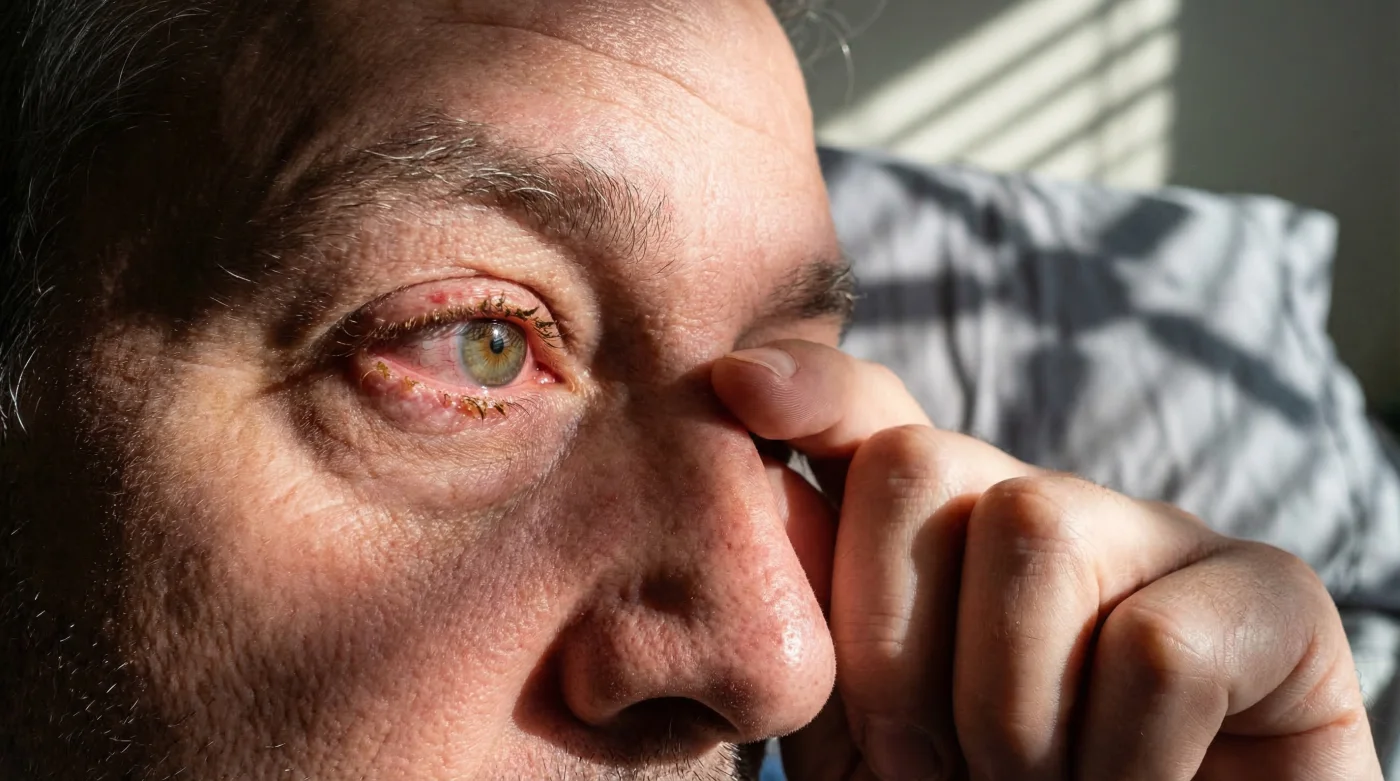
Health and wellness authorities have long championed the virtues of a cool, well-ventilated bedroom environment. We are routinely advised by specialists to drop the thermostat to a brisk 18 degrees Celsius and keep the air vigorously circulating to combat night sweats, regulate core body heat, and promote deep, restorative sleep. For millions of Canadians stretching from coastal urban centres to the prairies, sleeping beneath the rhythmic hum of a spinning blade has become a non-negotiable comfort behaviour. We falsely believe that this constant atmospheric turnover is the ultimate hallmark of pristine sleep hygiene, continuously flushing out stale air and keeping us perfectly refreshed. But what if this seemingly harmless nightly ritual is silently inflicting irreversible damage on one of your body’s most delicate external physiological barriers?
Every morning, a staggering number of adults wake up with their eyes feeling incredibly raw, as if coated in an abrasive layer of coarse sand. Most instinctively blame seasonal allergies, extended evening screen time, or general fatigue from a long workweek. However, leading experts and sleep specialists are now sounding the alarm on a completely different, highly insidious culprit. A hidden, incredibly common habit is actively working against you in the dark, relentlessly evaporating your eye’s natural basal tear film. This invisible nightly assault systematically destroys essential protective layers, ultimately forcing your delicate eyelids to aggressively grind against the raw surface of your eye the moment you blink awake.
The Illusion of Pristine Sleep Hygiene
The main offender actively dismantling your ocular defence mechanisms is none other than your bedroom’s ceiling fans. While these appliances excel at ambient thermoregulation, the constant, turbulent draft they generate severely disrupts the delicate micro-climate directly above your face. During sleep, our bodies rely on a meticulously balanced ocular environment to repair, oxygenate, and lubricate the eye’s exposed surface. Continuous overhead drafts aggressively accelerate the evaporation of the tear film’s critical aqueous layer. As this vital moisture rapidly vanishes, the eye’s fragile stratum corneum becomes exposed and highly vulnerable to microscopic abrasions.
The resultant condition from this chronic nocturnal drying is known clinically as meibomian gland dysfunction (MGD), a severe functional impairment of the tiny oil-producing glands lining the delicate margins of your upper and lower eyelids. When you sleep in a room with rapidly circulating air, your eyes are subjected to an unnatural wind-tunnel effect that overrides your body’s innate biological moisture controls. Over time, the structural integrity of your tear film completely collapses, transforming what should be a frictionless awakening into an agonizing morning ordeal. To fully grasp why this nightly ritual is so overwhelmingly destructive, we must intimately examine who is most vulnerable to these invisible overhead drafts.
Assessing Your Risk for Nocturnal Ocular Friction
Not everyone who sleeps under moving air will immediately develop blinding morning pain, but a vast demographic is unknowingly accelerating their risk profile. The structural integrity of your eyelids, combined with your baseline systemic hydration levels, dictates exactly how rapidly ceiling fans can compromise your long-term ocular health. A massive portion of the population suffers from a minor, often completely undiagnosed structural condition known as nocturnal lagophthalmos, where the eyelids organically fail to form a completely airtight seal during the deepest, most relaxed phases of sleep. Even a microscopic gap of a single millimetre allows ambient wind currents to aggressively strip away foundational moisture layer by layer.
| Patient Profile | Anatomical & Environmental Factors | Risk Level | Anticipated Clinical Impact |
|---|---|---|---|
| Contact Lens Wearers | Pre-existing micro-abrasions and reduced baseline tear volume from daytime lens friction. | Extremely High | Accelerated lipid degradation leading to severe morning grittiness and stinging. |
| Screen-Heavy Professionals | Reduced daytime blink rate leading to weakened glandular expression before sleep even begins. | High | Chronic inflammation of the eyelid margin and progressive structural gland loss. |
| Incomplete Eyelid Sealers | Presence of nocturnal lagophthalmos exposing the lower third of the cornea to direct ambient wind. | Critical | Focalized dry spots, sharp morning pain, and dangerously high evaporation rates. |
Recognizing your personal risk level and anatomical predispositions is the essential first step before diving into the precise biological mechanisms driving this painful condition.
The Diagnostic Mechanics of Meibomian Gland Dysfunction
- Sun Life Financial restricts vision coverage for standard blue light blocking.
- Salicylic acid cleansers instantly melt essential silicone hydrogel contact lenses.
- Dawn dish soap instantly strips premium anti-reflective lens coatings completely.
- Ceiling fans trigger severe morning meibomian gland dysfunction and dry eye.
- Dry paper towels permanently shatter modern polycarbonate lens UV coatings.
When ceiling fans continuously blow down on the face, the surface temperature of the delicate eyelid margin significantly drops. This sustained thermal reduction causes those crucial protective lipids to prematurely congeal, transforming them from a smooth, freely flowing olive-oil consistency into a thick, hardened, toothpaste-like sludge that permanently blocks the microscopic glandular ducts. If you are actively attempting to decode your agonizing morning discomfort, matching your highly specific pain point to its exact physiological trigger is vital for recovery.
- Symptom: Severe morning burning and stinging sensation. = Cause: Near-complete evaporation of the foundational aqueous tear layer due to continuous, unmitigated ambient drafts.
- Symptom: Crusty, hardened residue gluing lashes together upon waking. = Cause: Stagnant, congealed lipid secretions structurally reacting to cold, rapidly moving overhead air.
- Symptom: Gritty, abrasive sandpaper friction upon your first morning blink. = Cause: Severe mechanical friction occurring directly between the aggressively dried inner eyelid tissue and the entirely unlubricated cornea.
| Environmental Variable | Safe Therapeutic Threshold | Dangerous Threshold | Direct Physiological Consequence |
|---|---|---|---|
| Ambient Air Velocity | Below 0.1 Miles per hour near the resting face. | Exceeding 0.5 Miles per hour. | Rapid destabilization of the tear film and forced structural evaporation. |
| Bedroom Humidity Levels | Consistently maintained between 45% and 55%. | Dropping below 30% relative humidity. | Accelerated desiccation of the exposed stratum corneum. |
| Eyelid Margin Temperature | Remaining above 32 degrees Celsius naturally. | Cooling below 30 degrees Celsius. | Immediate congealing and hardening of essential glandular lipids. |
With the harsh biological realities and explicit environmental data successfully laid bare, we can now pivot directly to actionable, science-backed strategies for permanent healing.
The Eyelid Revival Protocol and Environmental Mitigation
Healing from aggressive, long-term overnight evaporation requires significantly more than simply walking into your bedroom and turning off your overhead cooling systems. You must actively rehabilitate the blocked meibomian glands while carefully engineering your immediate sleep environment to seamlessly promote a deeply restorative ocular micro-climate. Leading ophthalmologists advise a strict, multi-tiered clinical approach to halting the nightly damage, reversing the inflammation, and repairing the severely degraded lipid layer.
Step 1: Precision Humidity and Ambient Airflow Control
Your absolute first line of fundamental defence against chronic dry eye is drastically altering the bedroom’s atmospheric composition. Keep your core room temperature regulated at a highly steady 19 degrees Celsius, but entirely disable all direct overhead drafts from ceiling fans. If ambient air circulation is absolutely functionally necessary for your core comfort, utilize a low-profile oscillating floor fan placed at the far opposite end of the room. You must ensure the fan is pointed directly towards a structural wall, maintaining an entirely indirect, heavily baffled airflow that registers strictly below 0.2 Miles per hour at the exact centre of your mattress. Furthermore, you must actively introduce a high-capacity cool-mist humidifier running continuously throughout the night, perfectly calibrated to output exactly 250 ml of atomized water per hour to maintain that critical 45% to 55% atmospheric moisture sweet spot.
Step 2: Targeted Thermal Therapy and Glandular Expression
To successfully liquefy the stubbornly trapped, thickened oils within your physically blocked glands, strict and precise thermal dosing is strictly required. You must apply a targeted, moist warm compress heated to exactly 45 degrees Celsius directly against your lightly closed eyelids for a strict minimum duration of 10 to 12 minutes every single evening immediately before bed. This highly specific, scientifically validated temperature threshold is clinically proven to efficiently melt congealed lipids and facilitate natural glandular flow without accidentally scalding the incredibly delicate epidermal layers surrounding the eye socket.
| Protocol Stage | Recommended Action Plan | What to Strictly Avoid | Expected Clinical Outcome |
|---|---|---|---|
| Initial Mitigation | Disable overhead fans and introduce strict 250 ml/hr bedside humidification. | Leaving windows open allowing uncontrolled, highly variable cross-breezes. | Immediate stabilization of the baseline aqueous tear layer. |
| Glandular Restoration | Apply daily thermal compress at precisely 45 degrees Celsius for 10 minutes. | Aggressively rubbing or aggressively squeezing the eyelids to force oil out. | Liquefaction of blockages and restoration of flowing, clear lipids. |
| Long-term Maintenance | Monitor room humidity daily and utilize indirect, wall-bounced airflow only. | Returning to direct, high-velocity overhead wind exposure during summer heatwaves. | Permanent elimination of morning friction and sustained cornea protection. |
Mastering these restorative environmental adjustments and precise thermal dosing protocols ensures you can finally awaken without the debilitating, fiery sting of nocturnal corneal friction.
Reclaiming Your Morning Vitality and Systemic Health
The profound transition from waking up with agonizing, gritty eye pain to seamlessly opening your eyes with effortless, frictionless clarity requires a fundamental, uncompromising shift in exactly how we view traditional bedroom ventilation. While modern wellness culture heavily promotes the stylized image of sleeping deeply beneath rapidly spinning wooden blades, the stark clinical reality tells a vastly different, highly cautionary story. Protecting the fragile integrity of the cornea and ensuring the robust, unhindered biological function of your crucial lipids must unequivocally take precedence over an aggressive, artificially generated nocturnal breeze.
By actively implementing strict environmental room controls, accurately optimizing your nightly humidity dosing, and properly recognizing the earliest micro-warning signs of glandular dysfunction, you powerfully empower your body’s natural regenerative ocular processes. Healing is entirely possible once the invisible environmental stressors are decisively removed from your nightly routine. Maintaining this newfound atmospheric awareness seamlessly bridges the vital gap between enduring a chronically painful, inflamed morning routine and finally achieving true, uncompromised systemic wellness.
Read More