For millions of Canadians, the simple act of stepping from a bitterly cold winter street into a warmly heated building triggers an instant, blinding problem. The sudden shift from minus twenty degrees Celsius to room temperature causes moisture to rapidly condense on prescription lenses, completely obscuring your vision and forcing you to blindly navigate your surroundings. Many individuals spend a small fortune on high-tech optical coatings and expensive commercial anti-fog sprays that promise clear vision, but these heavily marketed solutions routinely fail when the temperature drops drastically or when paired with a winter tuque and scarf.
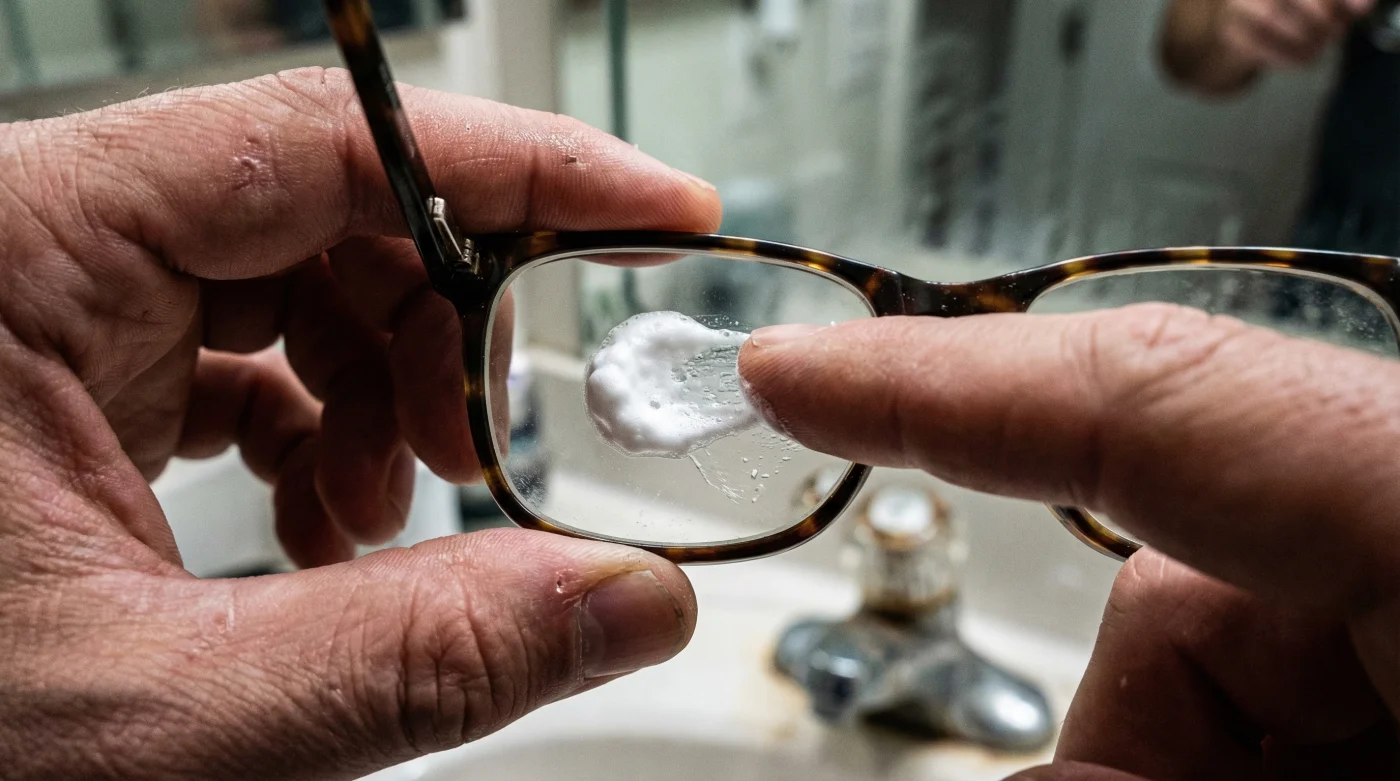
Instead of throwing money at these commercial failures, optical experts advise utilizing a vastly superior, highly effective alternative that is likely sitting quietly in your bathroom cabinet right now. By mastering a hidden habit and repurposing a common grooming staple, you can create a microscopic, deeply protective shield that repels moisture. The secret lies in buffing a tiny drop of this dense foam into your lenses, leaving behind an invisible, fog-resistant film that dramatically outlasts high-priced optical formulas.
The Optical Friction: Commercial Sprays vs. A Household Secret
The eyewear industry has created a lucrative market out of the foggy lens dilemma, pushing tiny, expensive bottles of anti-fog solutions that require constant reapplication. These commercial sprays often rely on harsh chemical alcohols that evaporate too quickly in the dry Canadian winter air, leaving the lens vulnerable to condensation the moment you step onto the frosty pavement. Furthermore, the aggressive solvents in some specialized sprays can gradually degrade premium anti-reflective lens coatings, causing permanent damage to your expensive prescription eyewear.
Conversely, utilizing traditional Gillette Shaving Cream introduces an entirely different chemical interaction to the surface of the lens. The dense foam is formulated to protect highly sensitive skin from sharp razor blades, meaning it is packed with lubricating agents, specifically high concentrations of glycerin. When correctly buffed into the glass or polycarbonate surface, these lubricating agents do not evaporate; rather, they form an invisible, hydrophilic layer. This microscopic barrier alters the surface tension of the lens, forcing condensing moisture to spread out flat rather than grouping together as vision-blocking droplets.
| Feature | Commercial Anti-Fog Sprays | Gillette Shaving Cream Method |
|---|---|---|
| Cost per Application | Extremely high ($15-$25 per small bottle) | Fractions of a cent |
| Active Barrier Agent | Volatile alcohols and synthetic polymers | Glycerin and gentle surfactants |
| Longevity in Extreme Cold | Breaks down below 0 degrees Celsius | Maintains integrity to minus 25 degrees Celsius |
| Risk to Lens Coatings | High (harsh solvents degrade anti-reflective layers) | Low (formulated for sensitive skin contact) |
To understand exactly how this inexpensive bathroom staple consistently outperforms specialized optical formulas, we must dive deep into the underlying chemistry of condensation and surface tension.
The Science of Condensation and the Glycerin Shield
Fog on your glasses is essentially a microscopic weather system. When warm, moisture-laden air from your breath or an indoor environment hits the freezing surface of your lenses, the water vapour instantly cools and condenses. Because the surface of a standard lens is highly hydrophobic (water-repelling), these tiny water molecules bead up into millions of individual microscopic droplets. These droplets scatter light in random directions, resulting in the hazy, opaque whiteout effect that blinds you.
- Ultem resin frames eliminate constant optometrist bending adjustments for heavy prescriptions.
- Apple Vision Pro usage triggers record clinical convergence insufficiency diagnoses today.
- Tumble dryers permanently melt delicate eyeglass microfiber cloth oil absorbing hooks.
- Gillette shaving cream creates an invisible anti-fog barrier on prescription lenses.
- Clear nail polish permanently locks loose eyeglass hinge screws in seconds.
| Scientific Metric | Mechanism of Action | Optimal Dosing / Condition |
|---|---|---|
| Surfactant Concentration | Lowers surface tension of water molecules | Requires high-density aerated foam formulation |
| Barrier Thickness | Micro-film that prevents droplet nucleation | 0.1 to 0.2 millimetres (invisible to the naked eye) |
| Temperature Threshold | Prevents freezing of condensation layer | Effective down to -20 degrees Celsius |
| Duration of Efficacy | Resists friction and environmental degradation | 48 to 72 hours per application |
While the chemical properties of the foam provide the protective mechanism, it is the precise, diagnostic troubleshooting of your application technique that guarantees a truly flawless, invisible finish.
Diagnostic Troubleshooting: Reading Your Lens Imperfections
Even with the correct chemistry, improper application can lead to frustrating results. Many individuals hastily smear the foam onto their glasses and immediately wipe it off, resulting in streaky vision or inadequate fog protection. By treating your eyewear like a high-precision optical instrument, you can diagnose exactly where your technique is failing. Optical experts advise checking your lenses under a bright light after buffing to identify and correct any application errors.
- Symptom: Severe streaking or rainbow halos under harsh lights. = Cause: Incomplete buffing or using too much product. You must reduce the initial dose and increase the buffing duration.
- Symptom: Periphery of the lens fogs up, but the centre remains clear. = Cause: Uneven application pressure. The edges of the frame are trapping moisture because the microfibre cloth did not reach the deep corners.
- Symptom: The anti-fog barrier fails after only a few hours. = Cause: Residual skin oils (sebum) on the lens prevented the glycerin from bonding. Pre-cleaning with mild dish soap is mandatory.
- Symptom: The lens feels tacky or captures lint from the air. = Cause: Utilizing a gel-based product instead of traditional aerated foam, leaving behind sticky synthetic thickeners.
Recognizing these subtle symptoms allows you to perfect your approach, but to achieve true optical clarity, you must follow a stringent, professional buffing protocol.
The Professional Buffing Protocol: Dosing and Application
To fully weaponize Gillette Shaving Cream against the harsh Canadian winter, you cannot simply guess the amounts or the timing. Precision is vital. You are attempting to leave behind a microscopic film that is thick enough to alter water tension but thin enough to remain entirely invisible. This requires exact dosing and a dedicated micro-buffing technique.
The Top 3 Steps for Flawless Application
- 1. The Preparation Wash: Before any foam touches the glass, the lens must be stripped of all biological oils. Wash your hands thoroughly. Apply a single drop of standard liquid dish soap to your fingertips and gently wash the lenses under lukewarm water (approximately 25 degrees Celsius). Dry them completely with a clean, lint-free cotton cloth.
- 2. The Micro-Dose: Dispense a tiny, pea-sized bead of aerated Gillette Shaving Cream—exactly 0.25 grams per lens. Apply this micro-dose directly to the front and back centre of each lens. Using a clean fingertip, lightly massage the foam in tight, concentric circles for exactly 30 seconds until the entire surface is covered in a hazy white film. Allow it to sit and cure for 60 seconds to let the glycerin bond.
- 3. The Friction Buff: Do not rinse the lens. Take a premium, densely woven optical microfibre cloth and begin buffing the dried haze. Apply firm but gentle pressure, buffing rapidly for 45 to 60 seconds per lens. Continue buffing until the lens transitions from hazy to brilliantly clear. The friction generates mild heat, which helps the surfactant layer bind securely to the microscopic pores of the lens surface.
| Product Selection Guide | What to Look For (The Ideal) | What to Avoid (The Detrimental) |
|---|---|---|
| Formula Type | Traditional thick, aerated white foam | Clear gels or brightly coloured synthetic gels |
| Additives | High glycerin content, basic lubricants | Heavy menthol, cooling beads, or heavy fragrances |
| Cloth Material | High-density optical microfibre (clean) | Paper towels, facial tissues, or rough clothing |
| Pre-Wash Agent | Basic, unscented dish detergent | Hand soaps with heavy moisturizers or lotions |
Mastering this rigorous buffing routine ensures that whether you are wearing a heavy balaclava on a freezing ski hill or stepping into a humid, crowded local café to escape the snow, your vision remains crystal clear and entirely unobstructed.
Long-Term Optical Maintenance and Care
Embracing this hidden habit does more than just solve the immediate annoyance of winter condensation; it profoundly extends the usable life of your eyewear. By abandoning harsh chemical sprays and adopting a gentle, glycerin-based buffing routine, you protect the delicate anti-scratch and anti-reflective layers that optical laboratories apply to modern lenses. Furthermore, the micro-buffing technique utilizing Gillette Shaving Cream inherently requires you to keep your glasses cleaner on a daily basis, preventing the buildup of abrasive dust and environmental grit that causes micro-scratches over time.
For the average Canadian facing months of unpredictable weather, relentless cold snaps, and heavily heated indoor environments, optical clarity is not just a matter of convenience—it is a matter of safety. Whether you are driving through a sudden snow squall, navigating an icy footpath, or simply trying to read a menu after stepping indoors, relying on this meticulously applied glycerin shield provides unmatched peace of mind. By repurposing an inexpensive, everyday item with professional precision, you permanently conquer one of winter’s most frustrating optical challenges.
Read More