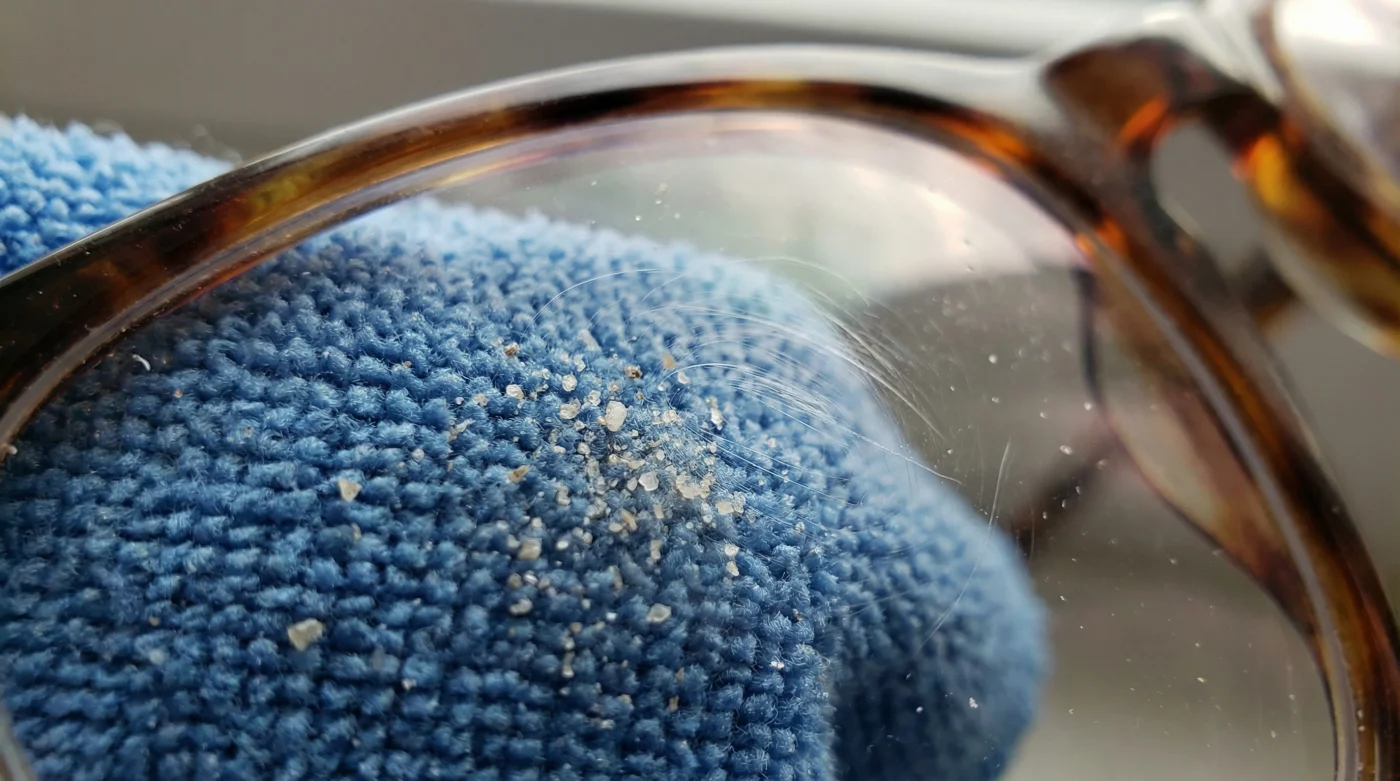
You are cruising down the highway on a bright Tuesday morning, the glare of the morning sun piercing through the windshield. You squint. There is a stubborn smudge resting right in the centre of your left lens, blurring the brake lights ahead. At the next red light, you reach into the centre console and pull out that thick, bright yellow microfiber towel you use to dust the dashboard. You give your lenses a brisk rub. The smudge vanishes. You put the glasses back on, satisfied.
What you cannot hear is the microscopic scraping. What you cannot see is that you have just dragged a jagged field of invisible boulders across a delicate optical surface. We have been conditioned to believe that soft always equals safe, and this assumption is quietly destroying our expensive eyewear.
The Velvet Trojan Horse
This brings us to the most common, and most expensive, mistake in daily eyecare: assuming all microfiber is created equal. That plush automotive towel feels like a cloud against your cheek, but its very design makes it a hazard for your prescription lenses.
Think of household and automotive microfiber as a magnetic sponge for gravel. Its split-fibre construction is engineered to trap and hold onto heavy particulates from the road and the air. Specifically, it hoards quartz and silica dust. When you press that loaded cloth against soft polycarbonate, the cloth is not doing the wiping. The trapped silica is doing the work. You are effectively sanding your glasses with an invisible grit.
I learned this the hard way while sitting in a dim, quiet optometry clinic in Vancouver. Dr. Chen, a veteran optician, held my cloudy anti-reflective lenses under a harsh halogen lamp. The surface looked like a frozen lake after a busy weekend of ice skating.
“People buy these bulk packs of detailing towels from the hardware store,” she explained, her voice carrying the gentle fatigue of someone who repeats this daily. “They keep one in the car, one in the kitchen, and use them on everything. But those towels hold onto silica dust like a vice. When you drag that across a precision-milled polycarbonate lens, the silica wins every time. It is a slow, invisible vandalism.”
| Wearer Profile | The Mindful Cleaning Shift | Specific Daily Benefit |
|---|---|---|
| The Commuter | Swapping dashboard towels for sealed optical cloths | Eliminates microscopic glare while driving into the sun |
| The Screen Worker | Moving from dry-wiping to wet-washing | Reduces eye strain caused by looking through micro-abrasions |
| The Active Parent | Stopping the habit of using a shirttail | Doubles the lifespan of expensive anti-reflective coatings |
To fully grasp why this mistake is so destructive, we have to look at the physical realities of the materials we are mashing together. It is not a matter of brand or price; it is a matter of simple geology.
| Material | Mohs Hardness Scale | Mechanical Interaction |
|---|---|---|
| Polycarbonate Lens | 1 to 2 (Very Soft) | Yields immediately to friction; easily gouged by harder minerals |
| Anti-Reflective Coating | 2 to 3 (Soft) | Cracks and flakes when the underlying substrate is compressed |
| Automotive Microfiber | N/A (Carrier) | Traps and retains jagged particles within its split-fibre structure |
| Silica Dust / Quartz | 7 (Very Hard) | Acts as a rigid cutting tool when pressed against softer materials |
The second common mistake is cross-contamination. Even if you buy a brand new microfiber towel, the moment it wipes dust off your steering wheel, it is contaminated. The third mistake is poor laundering. Tossing a lens cloth in the wash with fabric softener coats the fibres in animal fats and synthetic lubricants, leaving a permanent smear on your glasses. We need strict boundaries between our heavy-duty tools and our delicate optical instruments.
| The Right Tool (What to Look For) | The Hazard (What to Avoid) |
|---|---|
| High-density, flat-woven optical silk | Fluffy, high-pile terry microfiber |
| Kept in a hard, snap-shut plastic case | Tossed loosely in a glovebox, purse, or pocket |
| Washed weekly with plain, clear liquid soap | Washed with fabric softeners or heavy laundry detergents |
| Specifically labelled for optical use only | Labelled for multi-purpose, automotive, or household chores |
Rescuing Your Vision
So, how do we fix this? It requires a shift in your physical routine. It is about treating your eyewear as a precision instrument rather than a sturdy windowpane. First, never wipe your lenses dry. If you are on the road and a smudge is driving you mad, resist the urge to scrub. Wait until you have access to a sink.
- PTFE thread tape instantly secures stripped eyeglass hinge screws permanently
- Baking soda mixtures permanently strip expensive anti-reflective coatings from lenses
- Mechanical keyboard O-rings instantly secure loose eyeglass hinges without tightening.
- Microfiber car towels embed microscopic silica dust into prescription lenses
- RBC Insurance officially mandates detailed digital retinal scans for progressive upgrades
Apply a single drop of plain, lotion-free dishwashing liquid to your fingertips. Gently massage the soap over the front and back of the lenses, the nose pads, and the hinges. Your bare, clean fingers are far safer than a dry towel.
Rinse the soap away completely under the running water. To dry, shake off the excess moisture. Use a dedicated optical-grade cloth to dab away the remaining droplets. Do not scrub in circles; simply absorb the water and put them back on your face.
Seeing the World Clearly Again
When you stop treating your glasses like a rough surface to be scoured, something shifts in your daily rhythm. The chronic eye strain you felt at the end of the day starts to fade, simply because your eyes are no longer fighting past thousands of tiny, light-scattering scratches. You stop squinting at oncoming headlights.
Your prescription lenses are an intimate extension of your own body. They mediate every text message you read, every sunset you watch, and every quiet moment you spend looking out the window. Protecting them from invisible harm is a small act of daily self-respect.
It takes an extra minute to clean them properly at the sink, rather than hastily rubbing them with a dirty towel at a red light. But that single minute buys you a day of pristine, unhindered vision. It allows you to trust your own eyes again.
“Your glasses do not age; they accumulate the physical memory of how you treat them. Treat them with water, not friction.”
Frequently Asked Questions
Can I use a tissue to wipe my glasses?
No. Tissues and paper towels are made from wood pulp. Wiping your lenses with them is essentially using very fine wood chips, which will quickly dull your optical coatings.Why does my anti-reflective coating look like it is peeling?
This is called crazing. It often happens when micro-scratches from improper cleaning breach the coating, allowing moisture and heat to lift it from the lens surface.How often should I wash my dedicated optical cloth?
Aim for once a week. Hand wash it in the sink with a drop of clear dish soap, rinse it thoroughly, and let it air dry. Never use fabric softener, as it leaves a greasy film.Are pre-packaged wet wipes safe?
Only if they are specifically formulated for optical lenses. Avoid household glass wipes, which contain harsh chemicals that will strip the delicate protective layers off your lenses.What if I do not have water and need to clean them immediately?
Keep a small, travel-sized spray bottle of optical cleaner in your bag. Spraying the lens heavily floats the dust away from the surface before you gently dab it dry with your clean optical cloth.