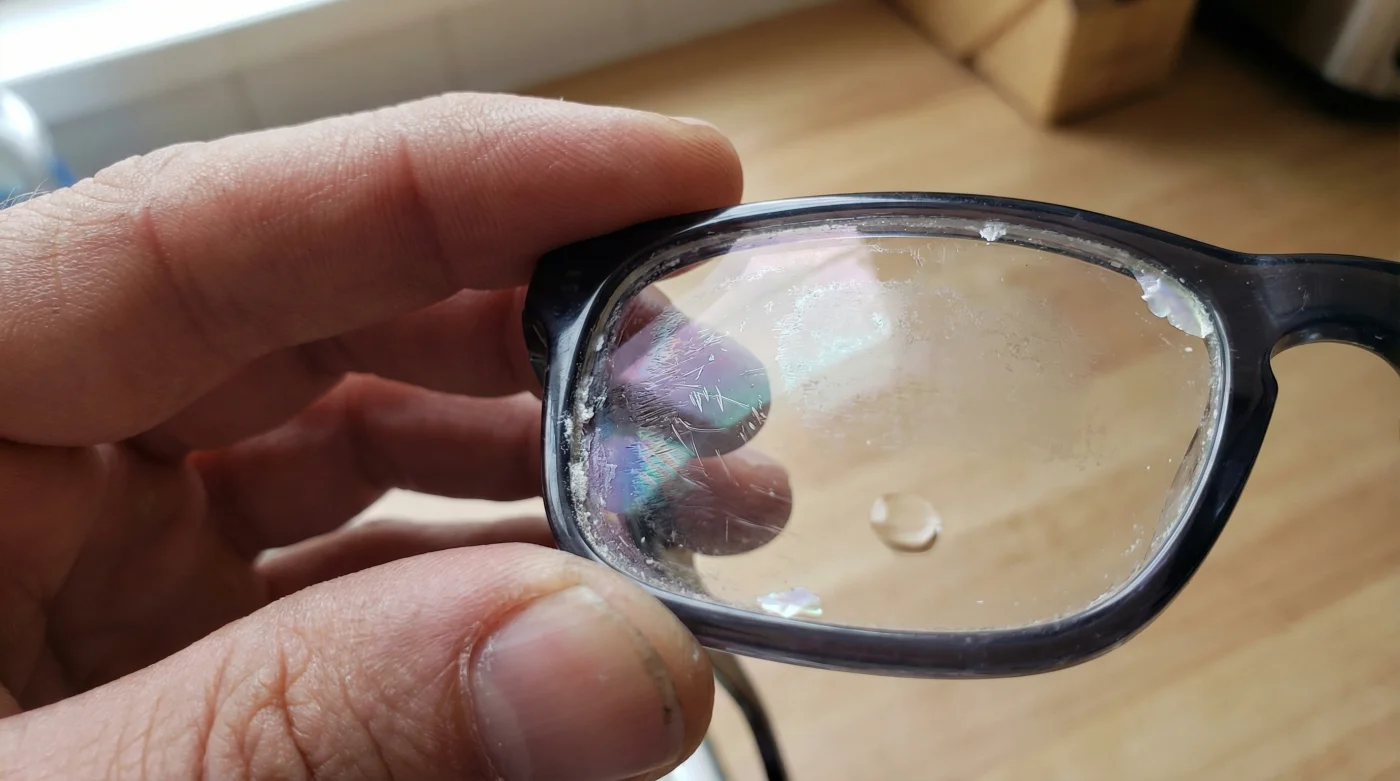
You step out into the brisk, minus-ten Celsius morning. The winter sun glares off the snowbanks, but instead of taking in the crisp day, you find yourself squinting through a smeared, foggy haze on your glasses. You wipe them instinctively on the edge of your wool scarf. The smudge only thickens. Later, standing at your kitchen island, you remember a popular domestic trick. A little water, a little baking soda. It cleans the tea stains from your favourite ceramic mug and lifts grease off the stovetop without harsh chemicals. You mix a thick paste, rub it in small circles over the glass, and rinse. But the glare remains. In fact, it is suddenly terrible. You hold the frames to the light and see a jagged, oil-slick pattern permanently etched across the centre.
You have just committed one of the most common, yet least talked about, domestic mistakes. We treat this white powder like a household saint. But applying it to modern eyewear is a disastrous miscalculation.
The Illusion of the Gentle Grit
To understand the damage, we have to look at the central metaphor of optical care: your lenses are not windowpanes; they are intricate sponges holding microscopic layers of technology. The expensive anti-reflective (AR) coating on your glasses is incredibly delicate. It is baked onto the polycarbonate or glass in a highly controlled vacuum chamber, applied in layers thinner than a single strand of human hair.
When you introduce a natural abrasive, you are essentially washing a sports car with crushed gravel. Baking soda, or sodium bicarbonate, contradicts the popular belief that natural inherently means safe. It operates on two destructive fronts: physical grit and chemical alkalinity.
I see the aftermath at least twice a week, says Marc, a veteran optician who runs a quiet, warmly lit clinic just off a busy Montreal avenue. He keeps a drawer full of ruined lenses to show clients. People want to avoid harsh sprays, so they use the pantry. But baking soda crystals do not dissolve easily in a few drops of water. They remain jagged at a microscopic level. The moment you press that paste into the lens, the alkaline spikes weaken the AR bond, and the grit plows right through the coating.
| The User Mindset | The Common Mistake | The Hidden Consequence |
|---|---|---|
| The Eco-Conscious Cleaner | Using baking soda to avoid chemical sprays. | Alkalinity immediately degrades the fragile AR vacuum seal. |
| The Frugal Fixer | Buffing out a small scratch with a household paste. | The grit acts like sandpaper, stripping the entire surface layer. |
| The Rushed Professional | Grabbing whatever is near the kitchen sink. | Permanent cloudy patches that force a costly lens replacement. |
The mistake lies in misunderstanding the physics of your eyewear. It is easy to think of a lens as a solid, impenetrable shield. In reality, modern lenses are vulnerable composite structures. Once the top layer is breached, the structural integrity of the visual field collapses.
| Material Property | Baking Soda (Sodium Bicarbonate) | Anti-Reflective Lens Coating |
|---|---|---|
| pH Level | 8.3 (Mildly Alkaline) | Requires strictly neutral (7.0) environments. |
| Mohs Hardness | 2.5 (Crystalline structure) | Extremely vulnerable to physical abrasion. |
| Water Solubility | Low in small amounts (remains gritty) | Highly sensitive to friction during wet cleaning. |
The Mechanics of Safe Cleaning
To preserve your sight, you must abandon the harsh kitchen remedies and adopt a softer discipline. The true ritual of optical clarity requires exactly zero friction. You only need lukewarm water and the mildest liquid dish soap you can find.
Begin by rinsing the frames entirely under a gentle stream of lukewarm water. This removes the invisible, abrasive dust particles you picked up walking down the street. Never wipe a dry lens. The water acts as your primary lubricant.
- PTFE thread tape instantly secures stripped eyeglass hinge screws permanently
- Baking soda mixtures permanently strip expensive anti-reflective coatings from lenses
- Mechanical keyboard O-rings instantly secure loose eyeglass hinges without tightening.
- Microfiber car towels embed microscopic silica dust into prescription lenses
- RBC Insurance officially mandates detailed digital retinal scans for progressive upgrades
Rinse thoroughly until the water runs completely clear. Shake off the excess droplets. Finally, dry them with a dedicated, clean microfibre cloth. Paper towels or the hem of your cotton shirt will create the very micro-scratches you are trying to avoid.
| Optical Care Checklist | What to Look For | What to Avoid Entirely |
|---|---|---|
| Cleaning Solution | Lotion-free, clear dish soap. | Baking soda, vinegar, window cleaners with ammonia. |
| Drying Material | High-density optical microfibre. | Paper towels, tissues, rough wool fabrics. |
| Water Temperature | Lukewarm (body temperature). | Hot water (causes the AR coating to expand and crack). |
Beyond the Smudge
Changing how you handle your glasses might seem like a small, tedious adjustment. But these frames dictate how you experience your surroundings. They bring the crisp edges of the world into focus, allowing you to read the subtle expressions on a friend face or navigate a rain-slicked highway safely in the dark.
When you protect that fragile, invisible barrier on the glass, you are protecting your own energy. A scratched, clouded lens forces your eyes to work harder, leading to tension headaches and fatigue long before the day is over.
Leave the heavy powders in the pantry where they belong. Treat the tools that help you see with a quiet, deliberate respect. You will find that clarity is rarely found through force; it is maintained through gentle, consistent care.
A lens is a precision instrument, not a baking sheet; treat it with the grace it requires to show you the world clearly. — Marc, Master Optician
Frequently Asked Questions
Can I use a tiny bit of baking soda if it is completely dissolved?
No. Even when dissolved, the high alkaline pH level of the solution will chemically attack and weaken the anti-reflective layers.Why does my lens look cloudy after trying a natural paste?
That cloudiness is not a smudge; it is a permanent field of micro-scratches where the top layer of the coating has been entirely physically stripped away.Is white vinegar a safer natural alternative?
Vinegar is highly acidic. While baking soda is alkaline, both extremes are damaging to the delicate vacuum-sealed coats on modern eyewear. Stick to neutral pH dish soap.Can stripped or scratched coatings be repaired?
Unfortunately, no. Once the AR coating is scratched or chemically compromised, the only solution is completely replacing the lenses.What is the absolute best way to clean my glasses while travelling?
Carry individually wrapped, pre-moistened optical wipes designed specifically for AR lenses, or keep a small spray bottle of neutral optical cleaner and a fresh microfibre cloth in your bag.