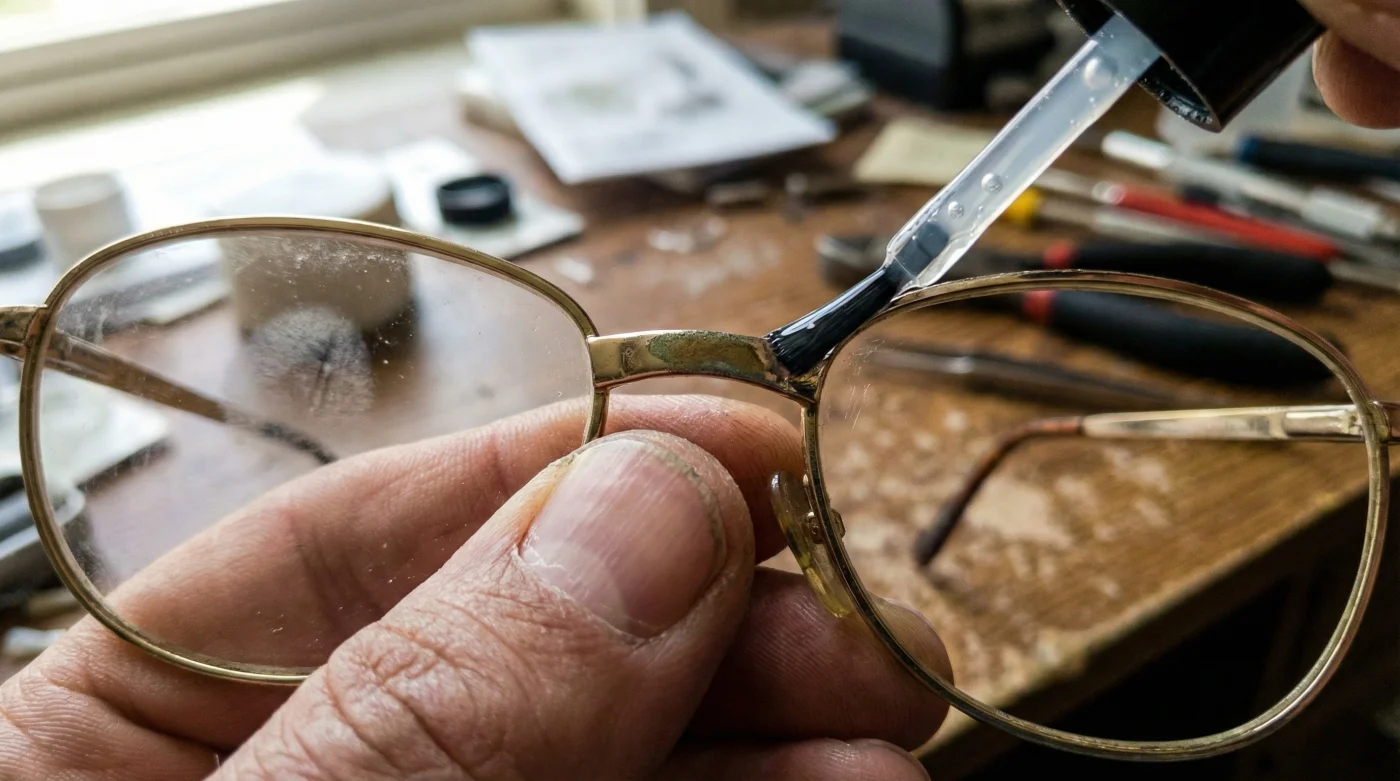
The late afternoon sun beats down at a sweltering 28 Celsius. You have just driven forty miles out of the city, windows down, wearing those perfect wire-rimmed sunglasses you found at a Sunday vintage market. You step out of the car, pull the frames from your face, and catch your reflection in the glass. There it is: a distinct, swampy green smudge resting across the bridge of your nose, mirrored by two dull green stripes on your temples. You smell that faint, sharp scent of old pennies clinging to your warm skin.
Sealing the Copper Circuit
You might assume these inexpensive frames have run their course. The common belief dictates that once the green appears, the metal is compromised beyond repair, destined for the bottom of a drawer or the rubbish bin. But this reaction is merely an interrupted conversation between the metal and your body.
The green hue is copper carbonate. Most affordable metal frames, and even many vintage designer ones, use copper or brass as a malleable base wire. When your sweat—which carries a slightly acidic pH—touches that copper, it creates a reaction. You become a living battery, pulling the oxidation directly onto your pores. To stop the reaction, you simply need to break the circuit.
I learned this from Elias, a second-generation eyeglass maker working out of a dusty, light-filled shop near the Halifax harbour. The salty coastal air meant he spent half his days repairing pitted metal frames. He would often pull out a tiny glass bottle from beneath his counter—ordinary drugstore clear nail polish—and carefully lacquer the nose pads and arms of delicate wire glasses. ‘People think they need to throw the frame away,’ he told me, wiping down a bridge with an alcohol swab. ‘But you just have to give the metal a raincoat. Keep the moisture out, and the copper sleeps.’
| The Wearer | The Specific Benefit |
|---|---|
| The Vintage Hunter | Preserves the original patina of thrifted frames while protecting the skin. |
| The Budget Shopper | Extends the lifespan of inexpensive fashion accessories indefinitely. |
| The Sensitive Skincare Enthusiast | Prevents contact dermatitis and metallic breakouts along the cheeks and temples. |
It sounds almost too rudimentary, yet the chemistry holds up perfectly. A standard clear polish is an enamel. When it cures, it forms an impermeable, micro-thin shell that blocks oxygen and moisture from reaching the alloy.
| Mechanism | The Chemical Reality |
|---|---|
| The Trigger | Human sweat acts as an electrolyte, accelerating the oxidation of copper alloys. |
| The Byproduct | Copper salts form on the surface, transferring to the skin as a green stain. |
| The Barrier | Nitrocellulose in clear polish forms a hard, non-porous film that isolates the metal. |
Painting the Invisible Barrier
Executing this modification requires a steady hand and a few moments of quiet focus. You want to start with a completely clean surface. Any residual oil from your skin will prevent the enamel from bonding.
Take a cotton swab dipped in rubbing alcohol and trace it along the inner temples, the bridge, and the wire stems holding the nose pads. Let the metal air dry completely. It should look entirely matte and feel slightly sterile to the touch.
Choose a clear top coat polish—preferably one that advertises a hard, chip-resistant finish. Avoid any gel polishes that require a UV lamp, as they tend to peel off smooth metal in thick sheets.
| Clear Coat Selection | What to Look For | What to Avoid |
|---|---|---|
| Formula Base | Standard nitrocellulose enamel, hard-wear top coats. | Water-based formulas, peel-off base coats. |
| Finish | Gloss for polished gold or silver, Matte for brushed brass. | Strengthening polishes with calcium, which dry cloudy. |
| Brush Type | Thin, flat brush for precision control. | Thick, fluffy brushes that pool the liquid. |
- Clear nail polish permanently stops cheap metal frames turning skin green.
- Green Shield Canada axes routine progressive lens upgrades for adults
- LED ring lights trigger severe photophobia in progressive lens wearers
- Liquid bandage painted on nose bridges eliminates heavy frame friction
- Micellar water residue permanently destabilizes essential tear film lipid layers
Repeat this across the bridge and the backs of the metal nose pads. Hold the frames by the lenses and leave them to rest upside down on a clean paper towel for at least two hours. Once dry, the barrier is set, and the green stains are a thing of the past.
Reclaiming Your Favourite Finds
We often discard things the moment they show a sign of friction with our daily lives. Throwing away a perfectly shaped pair of wire frames just because of a minor chemical reaction is a waste of both good design and your hard-earned money.
Applying this clear coat changes your relationship with the objects you wear. You are no longer at the mercy of cheap manufacturing. You take control of the item, modifying it to suit your environment and your skin.
Next time you see a beautiful pair of tarnished brass sunglasses resting in a shop window, you do not have to walk past them. You know exactly how to make them work for you, sealing away the copper and enjoying the classic lines of the frame.
A frame should sit on your face as a quiet companion, not leave a mark of its presence. A simple clear coat turns an annoyance into a lasting staple. — Elias Tremblay, Master Optician.
Common Questions About Sealing Metal Frames
Does the clear polish flake off into my hair?
If applied in a paper-thin layer on a clean surface, the enamel bonds tightly to the metal and wears down gradually over months rather than flaking in pieces.How often do I need to reapply the coating?
For heavy daily use, especially in hot weather where you might walk several miles a day, expect to touch up the inner temples every three to four months. You will notice the metal feeling slightly raw before any green returns.Can I use this on plastic frames that have metal arms?
Yes. Just ensure you use a steady hand so the polish does not pool on the plastic hinges, which could make them stiff to fold.Will a matte clear polish look invisible on shiny gold frames?
No, a matte polish will dull the shine. Match the polish finish to the metal: use a glossy top coat for shiny frames and a matte top coat for brushed or antique finishes.Can I remove the polish if I make a mistake?
Absolutely. A standard acetone-free nail polish remover on a cotton pad will wipe the enamel away in seconds without harming the underlying metal frame.