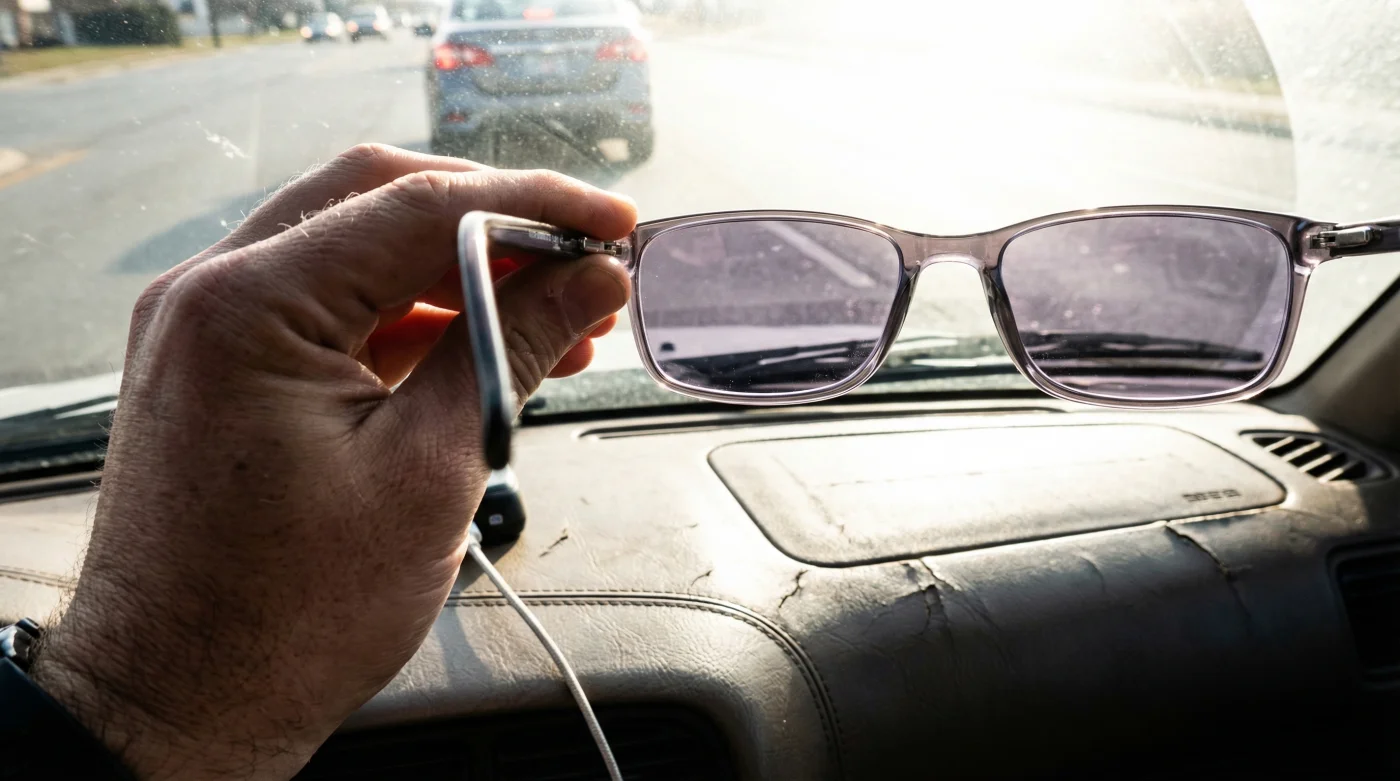
It begins the moment you merge onto the 401 or navigate the winding turns of the Sea-to-Sky Highway: a blinding flash of white light reflecting off the pavement or your own dashboard. For millions of Canadian drivers, this phenomenon is not just a nuisance; it is a critical safety hazard known as disability glare. While most rely on the sun visor or standard sunglasses, a growing cohort of safety-conscious commuters is turning to a specific optical advancement that adapts faster than human reflexes allow.
This visual impediment does more than obscure potholes or erratic drivers; it fatigues the ocular muscles, leading to ‘highway hypnosis’ and significantly slower reaction times. The solution, however, is not found in darker tints, but in a revolutionary responsiveness to UV light and ambient glare. A new generation of dynamic lens technology has quietly entered the market, promising to eliminate the dashboard reflection that causes split-second blindness, yet many drivers remain unaware of how this Gen S technology differs fundamentally from the photochromic lenses of the past.
The Science of Sight: Why Dashboard Glare is Deadly
When sunlight hits a flat surface—like a wet road after a Vancouver rainfall or a snowy field in the Prairies—the light waves align horizontally. This concentration creates polarized glare, which standard tinted lenses simply darken rather than eliminate. The danger lies in the intensity; glare can be 10 times brighter than the ambient light, overwhelming the retina’s photoreceptors.
To combat this, optical engineers have developed Transitions Gen S, a lens architecture designed to manage the chaotic light spectrum of the Canadian climate. Unlike its predecessors, which often struggled to darken sufficiently behind a UV-blocking windshield, this new matrix utilizes high-agility photochromic dyes. These molecules reconfigure their structure in seconds, not minutes, providing a seamless visual experience from the garage to the glare of the highway.
Diagnostic: Are You Suffering from Photokeratitis or Glare Fatigue?
Many drivers mistake physical fatigue for visual strain. Use this diagnostic list to identify if your current eyewear is failing you:
- Symptom: Throbbing headache behind the eyes after 30 minutes of driving.
Cause: Ciliary muscle spasm due to constant squinting (pupillary unrest). - Symptom: ‘Halos’ or starbursts around headlights at dusk.
Cause: Intraocular scattering caused by inadequate contrast sensitivity. - Symptom: Inability to see LCD displays on the dashboard clearly.
Cause: Excessive polarization without colour optimization. - Symptom: Excessive tearing or dry, gritty eyes.
Cause: Reflex tearing triggered by unmanaged High Energy Visible (HEV) blue light.
Understanding the biological impact of light is the first step toward visual bio-hacking.
Comparative Analysis: Who Needs Gen S Technology?
Not every driver requires elite-level optical gear, but for those facing high-exposure environments, the distinction is vital. Below is a breakdown of the target demographics and the specific physiological benefits provided by upgrading to Transitions Gen S.
Table 1: Target Audience & Physiological Benefits
| Driver Profile | Primary Pain Point | Gen S Benefit Mechanism |
|---|---|---|
| The Daily Commuter | Rapidly changing light (tunnels, overpasses, shadow). | Rapid Fade-Back: Lenses clear significantly faster (under 2 minutes) when entering low-light zones. |
| The Long-Haul Trucker | Prolonged exposure to windshield-filtered UV. | In-Car Activation: Sensitive to visible light spectrum, darkening even behind UV-blocking glass. |
| The Senior Driver | Reduced contrast sensitivity and slower pupil response. | Chroma Enhancement: Optimizes colour perception (reds/greens) for faster hazard recognition. |
| The Winter Navigator | ‘Snow Blindness’ (high albedo reflection). | Polarized Efficiency: Cuts horizontal glare specifically from ice and wet pavement. |
- New SMILE laser procedure allows athletes to return to contact sports immediately.
- Blinking fully every twenty minutes prevents permanent dry eye damage significantly.
- Drivers switch to polarized Transitions Gen S to eliminate dangerous dashboard glare.
- Health Canada recalls specific eye drops linked to severe bacterial infections.
- Ray-Ban Meta smart glasses sales overtake traditional frames at major retailers.
The Velocity of Vision: Gen S vs. Previous Generations
The primary complaint regarding older photochromic lenses was thermal dependency; they worked well in the cold but barely darkened during a humid Toronto heatwave. Transitions Gen S introduces a ‘thermally stable’ matrix. This allows the photochromic molecules to expand and darken even when ambient temperatures exceed 30°C.
Furthermore, the reaction speed has been turbocharged. Previous generations often left drivers ‘in the dark’ when entering a tunnel, taking several minutes to clear. The new Gen S formulation achieves a level of clarity akin to a standard clear lens almost immediately upon removing the UV stimulus.
Table 2: Technical Specifications & Reaction Data
| Metric | Standard Photochromic | Transitions Gen S |
|---|---|---|
| Activation Speed (Darkening) | 45–60 Seconds | 25 Seconds (to category 3 darkness) |
| Fade Back Speed (Clearing) | 5–8 Minutes | Less than 2 Minutes |
| UV Blocking | 100% UVA/UVB | 100% UVA/UVB + 32% Blue-Violet Light |
| Thermal Stability | Performance drops above 25°C | High Performance up to 35°C+ |
These metrics represent a quantum leap in optical chemistry, yet proper utilization requires knowing exactly what to look for when ordering your lenses.
The Selection Guide: Navigating the Optical Market
When visiting an optician or ordering online, the terminology can be deliberately confusing. Generic ‘day/night’ lenses are often low-quality imports that lack the polarization necessary for driving safety. To ensure you are receiving genuine Transitions Gen S technology, you must verify specific attributes.
Experts recommend specifying the ruby or sapphire tonal options if you frequently drive in overcast conditions, as these high-contrast colours improve depth perception against grey asphalt. Conversely, the graphite green option provides the most natural colour balance for sunny, coastal drives.
Table 3: The Quality Protocol – What to Look For vs. What to Avoid
| Feature | The Gold Standard (Gen S) | The Red Flag (Generic) |
|---|---|---|
| Clarity State | Fully clear indoors with no residual tint. | Permanently holds a yellowish or grey residual tint indoors. |
| Responsiveness | Darkens noticeably within 30 seconds outdoors. | Takes 2+ minutes to darken; rarely reaches full sunglasses depth. |
| Glare Reduction | Polarized effect visible when tilting head (screens darken). | No polarization; simply a darker piece of plastic. |
| Warranty/Coating | Includes Anti-Reflective (AR) and Hydrophobic coating. | Basic scratch coat only; attracts dust and smudges. |
Ensuring your lenses meet these standards is the difference between a comfortable drive and a dangerous visual impairment.
Conclusion: The New Standard for Canadian Roads
The shift toward Transitions Gen S represents more than a consumer trend; it is an adaptation to the increasingly erratic light conditions of modern driving environments. By eliminating dashboard glare and dramatically reducing reaction times, drivers are effectively upgrading their biological hardware.
For those navigating the glare of the morning commute or the high-contrast light of a winter afternoon, the investment in agile optical technology is a direct investment in safety. As the data shows, seeing a hazard one second sooner can be the difference between a near-miss and a collision.
Read More