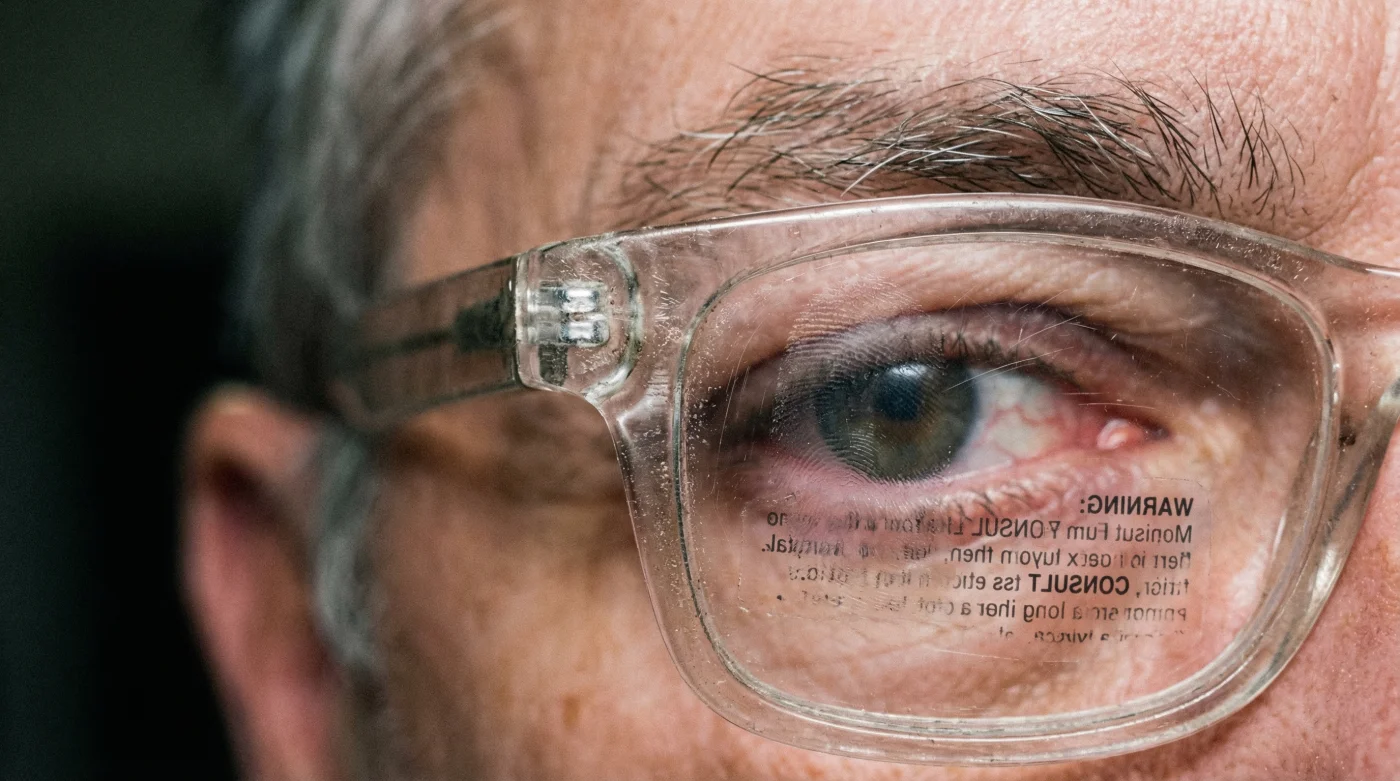
It begins with a subtle blur while reading a menu in a dimly lit bistro in Montréal, or perhaps a slight squint when checking a receipt at the local grocery centre. The immediate, logical solution seems to be a quick trip to the nearest Shoppers Drug Mart or Rexall to pick up a pair of inexpensive Reading Glasses. For less than twenty dollars, the text becomes sharp again, and the problem appears solved. However, leading Canadian optometrists are raising a red flag regarding this common frugality hack, warning that it may be masking—and actively worsening—a much more complex visual defect.
While these generic magnifiers provide an instant ‘zoom’ effect, they lack the specific optical engineering required to address the unique curvature of your eye. By relying on this ‘one-size-fits-all’ magnification, you may be forcing your eyes to battle against an uncorrected cylindrical error. This hidden strain does not merely tire your eyes; experts suggest it can accelerate the degradation of your visual acuity, turning a minor undetected condition into a debilitating daily struggle that no amount of pharmacy-bought magnification can fix.
The ‘Good Deal’ Trap: Why Magnification Is Not Correction
The fundamental misunderstanding among consumers is that ‘blur’ always equals ‘presbyopia’ (the natural aging of the lens). While age-related farsightedness is universal, the vast majority of the population also possesses some degree of astigmatism—an irregular curvature of the cornea or lens. Generic Reading Glasses are manufactured with simple spherical lenses, designed solely to magnify images. They act like a magnifying glass, making everything larger but not necessarily clearer if the underlying canvas (your retina’s reception) is distorted by astigmatism.
When you place a spherical lens over an astigmatic eye, the eye’s ciliary muscles must work overtime to compensate for the meridional unequal focus. This creates a feedback loop of strain. Below is a breakdown of who is most at risk when opting for off-the-rack solutions versus clinical correction.
Table 1: The Reader Risk Profile
| User Profile | Generic Reader Outcome | Clinical Risk Level |
|---|---|---|
| Pure Presbyope (No Astigmatism) |
Acceptable for short durations (menus, labels). | Low |
| The ‘Screen Squinter’ (Computer use > 4 hours) |
Digital eye strain intensifies; blue light often unfiltered. | Moderate |
| Undiagnosed Astigmatic (Cylinder > 0.50 D) |
Image is larger but ghosted/doubled. Ciliary spasm induced. | CRITICAL |
Ignoring the specific axis of your vision leads directly to physiological changes that compound the original error.
The Science of Cylindrical Error and Rapid Worsening
To understand why your vision might be deteriorating rapidly, one must look at the mechanics of refractive error. Astigmatism means the eye is shaped more like a football than a basketball. This requires a lens with a ‘cylinder’ component and a specific ‘axis’ (orientation) to redirect light to a single focal point on the retina. Generic readers lack this axis entirely. They possess only ‘sphere’ power.
- Incorrect pupil distance inputs on websites cause chronic digital eye strain headaches.
- Adults hitting forty need retinal mapping to catch silent vision loss.
- Adjusting nose pads downward instantly widens the reading corridor in progressives.
- Rubbing lenses manually removes protein buildup missed by expensive no-rub solutions.
- Dish soap strips anti-reflective coatings from prescription lenses within weeks.
Table 2: The Physiology of Optical Mismatch
| Parameter | Pharmacy Specs (Spherical) | Corrective Rx (Toric/Cylindrical) |
|---|---|---|
| Focal Point | Multiple focal lines (Blurred Retinal Image). | Single point convergence. |
| Ciliary Muscle Load | High (Spasm risk). | Neutral / Relaxed. |
| Neuro-Adaptation | Brain rejects conflicting input (suppression). | Brain integrates binocular vision. |
| Optical Center | Standard width (often causes prismatic effect). | Custom to Pupillary Distance (PD). |
This relentless tug-of-war within the eye muscles creates a distinct set of physical symptoms that act as an early warning system.
Diagnostic: Is Your ‘Solution’ Causing the Problem?
If you have been relying on over-the-counter Reading Glasses for more than three months, perform this self-diagnostic. The presence of these symptoms indicates that ‘simple magnification’ is failing to address your underlying refractive topography.
- Frontal Headaches = Accommodative Spasm: Pain specifically across the forehead or brows after 20 minutes of reading indicates your ciliary muscle is locked in a spasm trying to correct astigmatism that the glasses ignored.
- The ‘Shadow’ Effect = Uncorrected Cylinder: If letters appear to have a faint shadow or ‘ghost’ image slightly above or beside them, this is classic uncorrected astigmatism. Magnifying a ghosted image just makes a bigger ghost.
- Neck and Shoulder Tension = Prismatic Imbalance: Generic glasses have a fixed Pupillary Distance (PD). If your eyes are closer or wider than this standard, you are looking through the side of the lens, creating a prism effect that forces your neck muscles to compensate for visual misalignment.
- Watery Eyes = Surface Dryness via Strain: Intense staring to clarify blurry magnified text reduces blink rate, leading to Keratoconjunctivitis sicca (dry eye syndrome).
Recognizing these symptoms is the first step; choosing the correct optical tool is the mandatory second step.
The Quality Guide: How to Stop the Damage
It is not necessary to spend hundreds of dollars for every pair of glasses, but understanding the hierarchy of lens quality is vital for preserving long-term ocular health. Canadian standards for over-the-counter eyewear are loose, allowing for significant variance in lens clarity and coating durability.
Experts recommend a tiered approach. If you must use OTC readers, ensure they are for emergency use only, not for prolonged work sessions like reading a novel or working on a spreadsheet.
Table 3: The Optical Progression Plan
| Level | What to Look For | What to Avoid |
|---|---|---|
| Emergency / Backup (Pharmacy Bought) |
Flex hinges, ‘Aspheric’ lens stickers (flatter profile), Blue Light filtration. | Bubble-packed 3-for-1 deals, lenses with visible waves/distortion when held to light. |
| The Office Standard (High-End OTC) |
Polycarbonate material, Anti-Reflective (AR) coating to reduce glare. | Acrylic lenses (scratch easily and fog up), Heavy frames that slide. |
| The Vision Saver (Prescription) |
Custom Astigmatism Correction, measured Pupillary Distance, High-Index material. | Online ordering without a current (less than 1 year) prescription exam. |
Once you have secured the proper corrective lenses, maintaining the health of the eye requires active daily management.
Dosing Your Vision: Habits for Recovery
To reverse the strain caused by months or years of improper lens usage, you must treat your eyes like injured muscles in rehabilitation. Implement the ’20-20-20′ rule rigorously: every 20 minutes, look at something 20 feet away for at least 20 seconds. This breaks the ciliary spasm associated with near-work.
Furthermore, consider the temperature of your eye care. Applying a warm compress at 40 to 45 degrees Celsius for 10 minutes in the evening can help unclog meibomian glands, improving tear film quality which often degrades during periods of high visual strain. If you suspect your pharmacy glasses have caused a deterioration in your vision, schedule a comprehensive exam immediately. Do not settle for ‘good enough’ magnification when your sight requires precision correction.
Read More