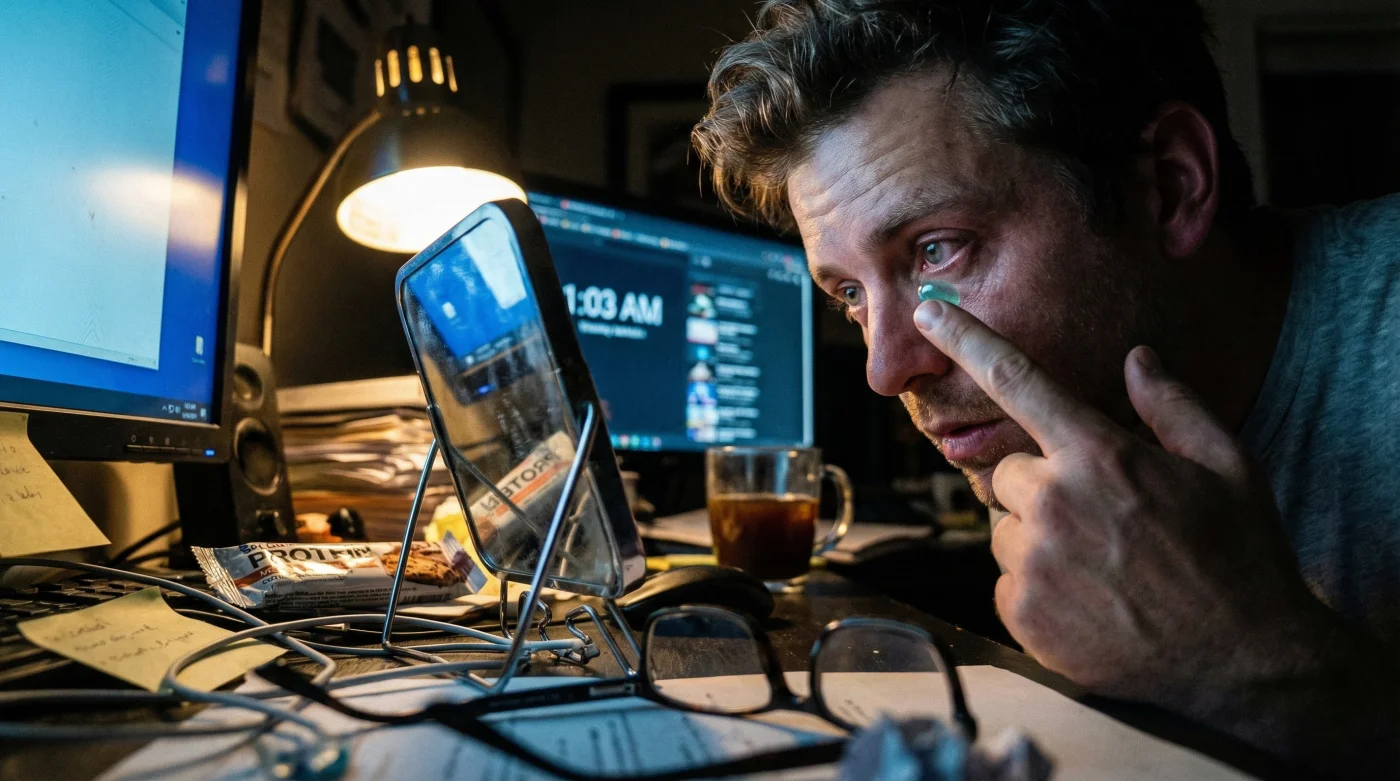
It begins with a familiar, gritty sensation that usually strikes around 2:00 PM—a subtle dryness that forces you to blink rapidly as the text on your monitor blurs slightly. For millions of Canadians, from the high-rise offices of Toronto to remote workspaces in Vancouver, this visual fatigue has become an accepted consequence of modern life. We blame the dry heating systems during our long winters or simply ‘tired eyes,’ but optometrists suggest the culprit is far more specific: a relentless bombardment of high-energy light combined with an unstable tear film that standard corrective methods fail to address.
While many turn to blue-light blocking glasses or frequent drops to mitigate the strain, a quiet revolution is occurring directly on the eye itself. A specific demographic of contact lens wearers is reporting a drastic reduction in end-of-day fatigue by adopting a ‘physical modification’ approach. This involves a daily disposable lens engineered with unprecedented light-filtering capabilities and moisture retention technologies, effectively creating a shield between the sensitive structures of the eye and the harsh digital environment we inhabit. Before you book your next exam, it is crucial to understand how Acuvue Oasys Max 1-Day is redefining visual endurance.
The Physiology of Digital Eye Strain
To understand why a simple change in lens material can alter your daily energy levels, we must look at the mechanism of High-Energy Visible (HEV) light. Often referred to as blue-violet light, these short wavelengths scatter more easily within the eye than other parts of the visible spectrum. This scattering reduces contrast and forces the eyes to work harder to maintain a clear image, a phenomenon known as visual noise.
Furthermore, studies indicate that our blink rate drops by up to 60% when focusing on digital screens. This leads to the rapid evaporation of the tear film, exposing the corneal surface to irritation. The innovation behind Acuvue Oasys Max addresses both issues simultaneously through a dual-action mechanism: the OptiBlue™ Light Filter and TearStable™ Technology. This isn’t just about vision correction; it is about light management.
Who Benefits Most? The Usage Profile
Not every wearer requires this level of technological intervention. The following comparison helps identify if your lifestyle demands this specific visual upgrade.
| Target Audience | Typical Symptoms | Projected Benefit |
|---|---|---|
| The Hybrid Worker | 8+ hours of screen time; fluctuating ambient light. | Reduced need for re-wetting drops; sharper contrast during video calls. |
| The Night Driver | Halos around streetlights; difficulty with oncoming glare. | OptiBlue™ filters 60% of blue-violet light, reducing starbursts and halos. |
| The Multi-Device User | Frequent switching between phone, laptop, and TV. | Stabilized tear film prevents the ‘blur’ upon refocusing. |
Identifying your usage profile is the first step, but understanding the raw data behind the lens clarifies why this specific brand is outperforming competitors.
The Science of OptiBlue and TearStable
The efficacy of Acuvue Oasys Max lies in its manufacturing process. Unlike coated lenses where the filter is applied to the surface, the OptiBlue™ Light Filter is embedded directly into the matrix of the material. This allows for the highest level of blue-violet light filtration in the industry for a contact lens, specifically targeting wavelengths between 380 and 450 nanometres.
- Incorrect pupil distance inputs on websites cause chronic digital eye strain headaches.
- Adults hitting forty need retinal mapping to catch silent vision loss.
- Adjusting nose pads downward instantly widens the reading corridor in progressives.
- Rubbing lenses manually removes protein buildup missed by expensive no-rub solutions.
- Dish soap strips anti-reflective coatings from prescription lenses within weeks.
Technical Specifications & Dosing Data
For the discerning patient who appreciates the numbers, the specifications below highlight the engineering leap from previous generations.
| Metric | Standard Hydrogel Lens | Acuvue Oasys Max 1-Day |
|---|---|---|
| Blue-Violet Light Filter | < 5% filtration | 60% filtration (Highest in class) |
| Oxygen Transmissibility (Dk/t) | ~25-40 | 121 (open eye) – Exceptional breathability |
| Water Content | Variable (often dehydrates) | 38% (Optimized for stability vs. evaporation) |
| UV Protection | Minimal | Class 1 UV Blocking (99.9% UVB, 96% UVA) |
While the specifications are impressive, the true test of this technology is how it resolves specific physiological complaints experienced by Canadian wearers.
Diagnostic: Troubleshooting Your Vision
Many patients tolerate sub-par vision because they believe their prescription has simply changed. However, if your prescription is current but you still struggle, the issue is likely the quality of the light entering the eye or the stability of the lens surface. Use this diagnostic list to pinpoint the root cause:
- Symptom: Gritty sensation specifically after lunch.
Cause: Tear film break-up time is shorter than your blink interval.
Solution: Switch to a lens with optimized wetting agents like TearStable™. - Symptom: Halos around headlights on the 401 or Highway 1 at night.
Cause: Light scattering caused by HEV light and corneal edema.
Solution: Maximize blue-violet filtration to increase contrast. - Symptom: Neck and shoulder tension.
Cause: Subconscious leaning forward to combat micro-blur on screens.
Solution: Correcting the visual noise allows for better posture.
Recognizing these symptoms is vital, but selecting the correct product tier is essential to ensure you are not overspending on features you do not need, or under-investing in your eye health.
The Progression Plan: When to Upgrade
Not every patient needs to jump immediately to the premium tier. If you wear lenses sporadically for sports or social events, a standard daily lens may suffice. However, for the ‘heavy user’—defined as someone spending 6+ hours on digital devices or operating vehicles at night—the investment in Acuvue Oasys Max becomes a preventative health measure.
Quality Guide: What to Look For vs. What to Avoid
When discussing options with your eye care professional, use this guide to navigate the terminology and ensure you are getting genuine advanced technology.
| Feature Category | What to Look For (Premium) | What to Avoid (Outdated) |
|---|---|---|
| Filtration Tech | Embedded chromophores (internal filter). | Surface-only tints that can scratch or degrade. |
| Manufacturing | Senofilcon A material (Silicone Hydrogel). | Older HEMA materials with low oxygen permeability. |
| Design Profile | Pupil-optimized design for varying lighting conditions. | Spherical aberration causing distortion in low light. |
Ultimately, the choice to upgrade your contact lenses is a choice to reclaim your energy and focus in a world that demands constant visual attention.
Conclusion
The Canadian environment poses unique challenges to eye health, from the glare of snow to the dry heat of our indoor winters. Adopting Acuvue Oasys Max 1-Day is more than a prescription update; it is a strategic adaptation to a digital-first lifestyle. By physically filtering the chaotic blue-violet light spectrum and stabilizing the tear film, wearers are finding they can work longer, drive safer, and end their day without the crushing weight of visual fatigue.
Read More