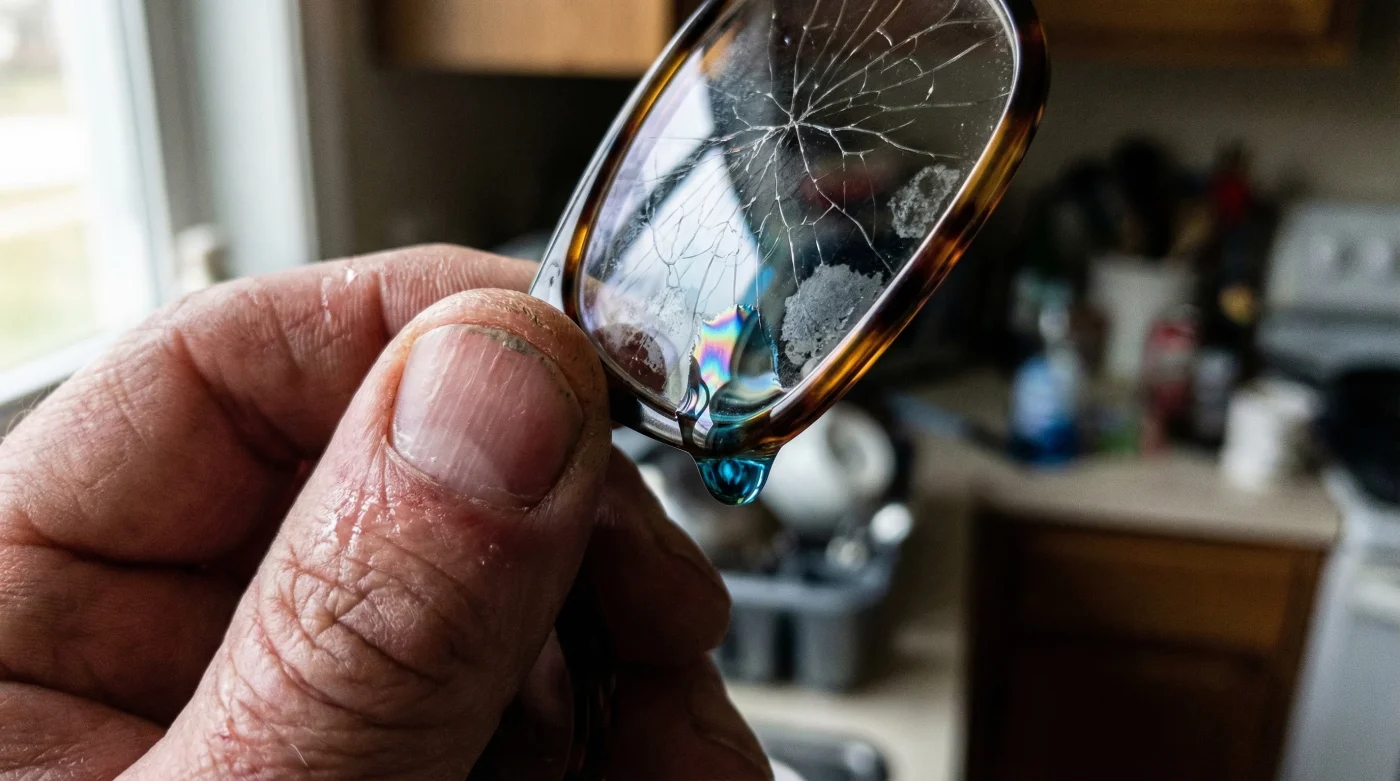
It begins as a subtle haze on the periphery of your vision, a blurring that you attribute to fatigue or a smudge that simply won’t wipe away. You’ve invested hundreds, perhaps over a thousand dollars, into high-index progressive lenses with premium anti-reflective (AR) coatings. Naturally, you want to keep them pristine. Following common household logic, you walk to the kitchen sink and reach for the dish soap. It cuts grease on your cookware, so surely it will remove the facial oils from your glasses? This assumption is the single most destructive habit for modern eyewear.
Optometrists across Canada are noticing a surge in premature lens degradation, characterized by a phenomenon known as "crazing"—a web of microscopic cracks that shatters light instead of focusing it. The culprit is almost always the bottle sitting by your kitchen tap. While dish soap was a safe recommendation for the glass lenses of the 1980s, today’s complex polycarbonate and high-index materials rely on delicate metallic oxide layers. These layers are chemically incompatible with the harsh, grease-stripping surfactants found in modern detergents. You aren’t cleaning your glasses; you are slowly dissolving the technology you paid for.
The Chemistry of Erosion: Why Dish Soap Fails
To understand the damage, one must understand the architecture of a modern lens. It is not a single piece of plastic, but a sandwich of technology. The core lens is coated with a hard coat, followed by multiple layers of metal oxides (such as zirconium oxide or silicon dioxide) to create the anti-reflective effect, and topped with a hydrophobic (water-repelling) and oleophobic (oil-repelling) layer. This stack is engineered to be chemically stable at a neutral pH (7).
Dish soaps, particularly those marketed as "ultra" or "grease-fighting," are engineered with high-alkaline surfactants and often include citrus additives (limonene) which are acidic. When these chemicals interact with the AR coating, they do not just lift oil; they break down the adhesion between the coating layers. In the dry Canadian climate, where static and temperature fluctuations already stress these materials, the addition of harsh chemicals accelerates the process significantly.
Comparison of Cleaning Agents on Optical Coatings
| Cleaning Agent | Target Audience/Use | Impact on AR Coating | Long-Term Result |
|---|---|---|---|
| Dish Soap (with Citrus) | Heavy grease removal on cookware | Catastrophic. Acidic additives eat away magnesium fluoride layers. | Peeling, crazing, and cloudy vision within 3-6 months. |
| Hand Soap (Moisturizing) | Skin hydration and hygiene | High Risk. Contains lotions and lanolin that smear lenses. | Permanent greasy film requiring abrasive wiping to remove. |
| Dedicated Lens Spray | Optical clarity for coated lenses | Optimal. pH neutral formula preserves oleophobic layers. | Maintains clarity for the full 2-year prescription cycle. |
Once the chemical bond is weakened, the physical structure of the coating begins to fail, leading us to the visible symptoms of lens trauma.
Diagnosing Lens Trauma: The Symptoms of Chemical Damage
Damage to an anti-reflective coating rarely happens overnight; it is a cumulative injury. The first sign is often the loss of the "easy-clean" property. If your lenses suddenly seem to attract fingerprints or require forceful rubbing to clean, the top oleophobic layer has likely been stripped away by dish soap. Following this, visual artifacts begin to appear.
- Incorrect pupil distance inputs on websites cause chronic digital eye strain headaches.
- Adults hitting forty need retinal mapping to catch silent vision loss.
- Adjusting nose pads downward instantly widens the reading corridor in progressives.
- Rubbing lenses manually removes protein buildup missed by expensive no-rub solutions.
- Dish soap strips anti-reflective coatings from prescription lenses within weeks.
Troubleshooting Your Vision: Symptom vs. Cause
- Symptom: Rainbow-coloured halos around lights at night.
Cause: Uneven stripping of the AR stack, creating variable refractive indices. - Symptom: Lenses appear permanently "smudged" despite cleaning.
Cause: Hydrophobic breakdown; moisture is adhering to the lens rather than beading off. - Symptom: Fine, web-like scratches that cannot be felt with a fingernail.
Cause: Crazing caused by ammonia-based cleaners or high-heat exposure.
Technical Breakdown of Coating Vulnerability
| Lens Layer | Function | Chemical Threat | Failure Mechanism |
|---|---|---|---|
| Hydrophobic Top Coat | Repels water/fog | Alcohol & Ammonia | Dissolves the fluoropolymer chain, leading to fogging. |
| AR Stack (Metal Oxides) | Reduces glare/reflections | Phosphate-heavy Soaps | Oxidation and delamination (separation) from the substrate. |
| Hard Coat | Scratch resistance | Extreme pH (High/Low) | Becomes brittle, leading to deep structural cracks. |
Identifying the damage is critical, but preventing further erosion requires an immediate shift in your daily hygiene protocol.
The Clinical Protocol for Crystal Clarity
To preserve the integrity of your eyewear, you must treat the lenses as you would a high-end camera lens, not a dinner plate. The goal is to lift particulate matter (dust, skin cells) without using chemical abrasives. Experts at the Canadian Association of Optometrists generally recommend avoiding household cleaners entirely in favour of specific formulations.
The ideal cleaning temperature is lukewarm—specifically between 25° Celsius and 30° Celsius. Water that is hot to the touch can cause immediate thermal shock. Furthermore, the mechanical action of drying is just as important as the washing. Never use paper products (paper towels, tissues), which contain wood pulp that causes micro-abrasions.
The ‘Do This, Not That’ Quality Guide
| Category | The Gold Standard (Do This) | The Danger Zone (Avoid This) |
|---|---|---|
| Solvent | Spray specifically labelled "Safe for AR Lenses" (pH Neutral). | Window cleaners (Windex), Vinegar, or Lemon-scented dish soap. |
| Cloth Material | High-density Microfiber (washed without fabric softener). | T-shirt hems, napkins, or paper towels (Wood pulp scratches). |
| Technique | Rinse dust off first, apply spray, wipe in one direction. | “Dry wiping” on a foggy day or using circular grinding motions. |
Adopting this strict protocol not only saves your current lenses but extends the lifespan of your next pair significantly.
Microfiber Hygiene: The Overlooked Variable
Even if you switch to a dedicated lens spray, your cleaning cloth can become a weapon against your glasses. A microfiber cloth is designed to trap oil and dust within its fibres. Over time, it becomes saturated. If you wash this cloth with your regular laundry using fabric softener, you are coating the fibres in a waxy residue. When you subsequently wipe your glasses, you are smearing this wax onto the lens, creating a haze that mimics a dirty lens, prompting you to scrub harder and potentially scratch the surface.
The correct dosing for lens care involves washing your microfiber cloths once a week in warm water (no hotter than 40° Celsius) with a small amount of mild, clear detergent—absolutely zero fabric softeners or dryer sheets. Air dry them to prevent heat damage to the fibres. By maintaining a clean toolset, you ensure that you are polishing your lenses, not sanding them down.
Your vision is your primary interface with the world. While it may be tempting to use the convenience of the kitchen sink, the long-term cost of replacing stripped lenses far outweighs the price of a dedicated lens spray. Make the switch today to ensure your view remains sharp, whether you are reading the fine print or driving miles across the province.
Read More