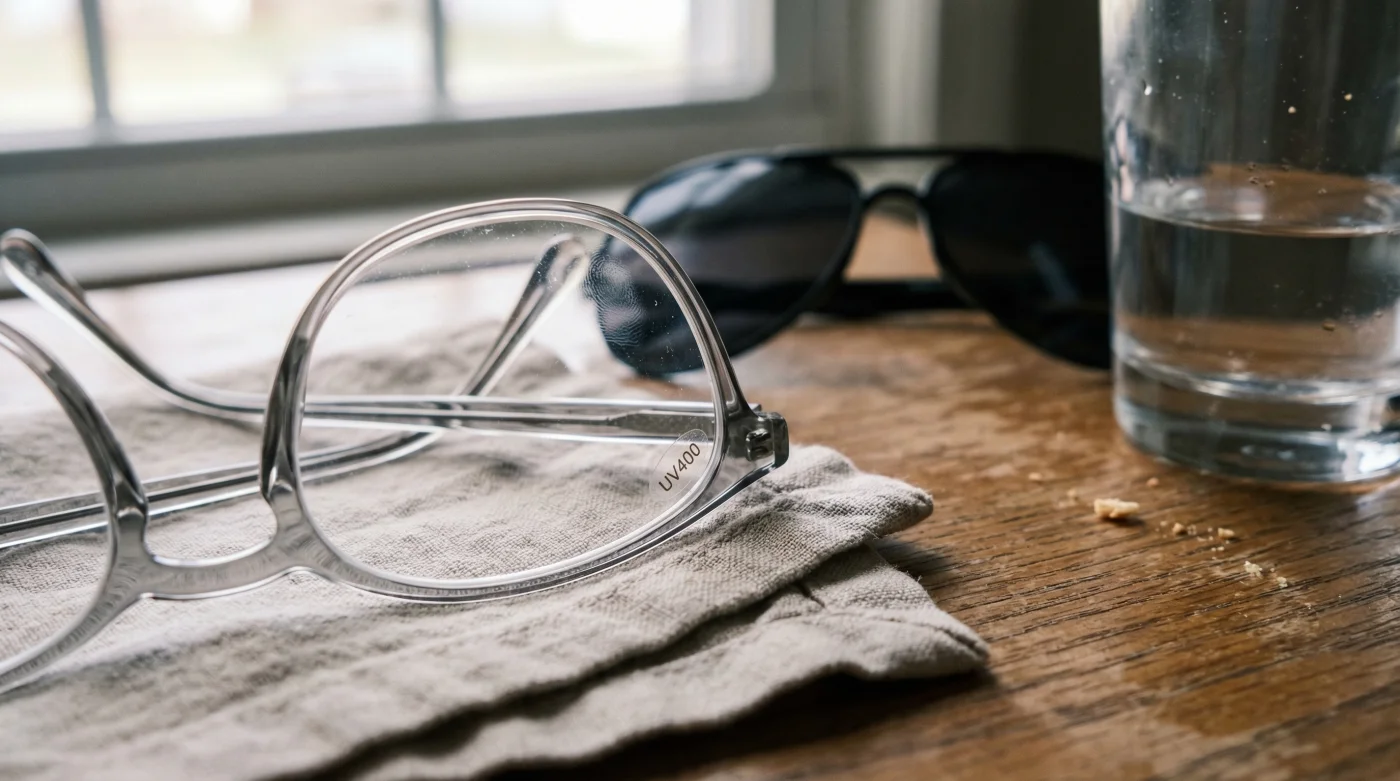
It is a scenario that plays out in almost every service station and pharmacy across Canada: the sun breaks through the clouds, and you instinctively reach for the darkest pair of sunglasses on the rack. The logic seems irrefutable—the darker the lens, the less light hits your eye, and therefore, the safer you are. You slip them on, feel your eyes relax as the glare dims, and assume you have shielded your vision from damage. However, ophthalmologists and optical physicists are now revealing a startling paradox: that pitch-black tint might be acting as a trap door, inviting high doses of invisible radiation directly into your retina.
This counter-intuitive phenomenon occurs because of a specific biological trigger that most consumers overlook. By confusing visible light reduction with radiation filtration, millions of Canadians are inadvertently bypassing their body’s natural defence mechanisms. The solution, strangely enough, may not lie in opacity at all, but in a specific clear technology that remains invisible to the naked eye yet functions as an impenetrable fortress against the sun’s most damaging wavelengths. Before you buy your next pair of shades for a drive to the cottage or a ski trip in the Rockies, you need to understand the hidden mechanics of UV400 protection.
The Pupil Paradox: Why Darker Isn’t Always Safer
To understand the risk, we must look at the anatomy of the human eye. Your pupil is a biological aperture; in bright conditions, it constricts (shrinks) to limit light entry, naturally reducing the amount of ultraviolet (UV) radiation reaching the lens and retina. When you place a dark, tinted lens over your eye that lacks proper UV filters, you trick this mechanism.
Because the visible light is dimmed, the pupil dilates (opens wide) to capture more visual information. If that dark lens does not possess a verified UV400 rating, your dilated pupil acts as a funnel, absorbing significantly more UVA and UVB radiation than if you were wearing no sunglasses at all. This ‘Pupil Trap’ is the primary cause of accelerated solar damage in wearers of low-quality eyewear.
Target Audience & Risk Profile
| User Profile | Lens Choice | Physiological Reaction | Safety Verdict |
| The Bargain Hunter | Dark Tint / No Coating | Pupil dilates fully; UV floods the retina. | High Danger |
| The Tech User | Clear / Blue Light Filter | Pupil remains reactive; minimal UV protection. | Moderate Risk |
| The Optical Expert | Clear UV400 | Pupil reacts naturally; 99-100% UV blocked. | Optimal Safety |
Realizing that the darkness of the lens has zero correlation with radiation protection leads us to the question: how does a transparent lens actually block these harmful rays?
The Science of Invisible Armour: UV400 Explained
- Polycarbonate lenses wiped with dry paper towels develop permanent microscopic clouding
- Astigmatism patients see clearer at night using yellow tinted driving lenses
- Presbyopia hitting at forty requires computer progressives instead of standard bifocals
- Acetate frames heated slightly with household hairdryers eliminate painful ear pinching
- Retinol serums applied near cheekbones permanently destroy essential eyelid oil glands
Polycarbonate lenses naturally block UV radiation without needing to be darkened. This allows for the creation of ‘Clear UV400’ lenses—eyewear that looks like standard reading glasses but offers the same solar protection as premium ski goggles. This is particularly vital in Canada, where winter conditions create a double-exposure effect; clean snow can reflect up to 80% of UV radiation, compared to just 10% for ground soil or 15% for dry sand.
Spectral Data & Technical Mechanisms
| Radiation Type | Wavelength | Health Impact | UV400 Block Rate |
| UVC | 100–280 nm | Absorbed by ozone; negligible risk. | 100% |
| UVB | 280–315 nm | Sunburn, Photokeratitis (Snow Blindness), Cataracts. | 99.9% |
| UVA | 315–400 nm | Deep tissue aging, Macular Degeneration. | 99.9% |
Understanding the wavelengths is critical, but recognizing the physical manifestations of exposure is the only way to diagnose if your current eyewear has been failing you.
Diagnostic Guide: Signs Your Lenses Are Failing
Many Canadians attribute eye fatigue to screen time or lack of sleep, unaware that they are suffering from low-grade radiation burns. The symptoms of UV exposure are distinct from digital eye strain. If you spend time outdoors—whether hiking in summer or shovelling snow in -10°C weather—watch for these specific indicators.
Symptom-to-Cause Diagnostics
- Gritty, sandy sensation (no foreign body): This is the hallmark of Photokeratitis, essentially a sunburn of the cornea. It often appears 6–12 hours after exposure.
- Yellowish growth on the white of the eye: Known as a Pinguecula or Pterygium (Surfer’s Eye), this tissue growth is directly linked to wind and UV exposure.
- Cloudy vision/haloes around lights: Early indicators of cataract formation, where the lens proteins have been denatured by cumulative UV absorption.
Actionable Dosing: Experts recommend wearing UV400 protection whenever the UV Index is 3 or higher. However, in high-glare environments (water, snow, concrete), protection is required even at lower indices. For outdoor sports, a wrap-around style is recommended to prevent ‘leakage’ of scattered light from the sides, which can account for up to 20% of total exposure.
Identifying the symptoms is the first step, but preventing them requires knowing exactly how to decipher the labels on your next purchase to avoid the ‘tint trap’.
The Quality Hierarchy: What to Look For
Not all clear lenses are created equal. Cheap cosmetic lenses may look identical to safety-rated UV400 lenses. When selecting eyewear, specifically look for the ‘CE’ mark (Conformité Européenne) or specific UV400 labelling etched into the arm or lens sticker. Avoid terms like “UV Absorbing” which are legally vague; insist on “UV400” or “100% UV Protection”.
The Buyer’s Guide: Quality vs. Counterfeit
| Feature | The Elite Choice (Medical Grade) | The Bargain Trap (Avoid) |
| Material | Polycarbonate or Trivex (Impact resistant, inherent UV block). | Acrylic or cheap plastic (Requires spray-on coating that peels). |
| Labelling | “UV400” / “100% UVA/UVB” | “Block Glare” / “Impact Resistant” (says nothing about UV). |
| Clarity | Optically Decentred (No distortion at edges). | Standard Mould (Objects shift when you move your head). |
Prioritizing the health of your retina over the darkness of your lenses is a small adjustment that yields massive long-term dividends for your vision, ensuring you see the vibrant colours of the Canadian landscape clearly for decades to come.
Read More