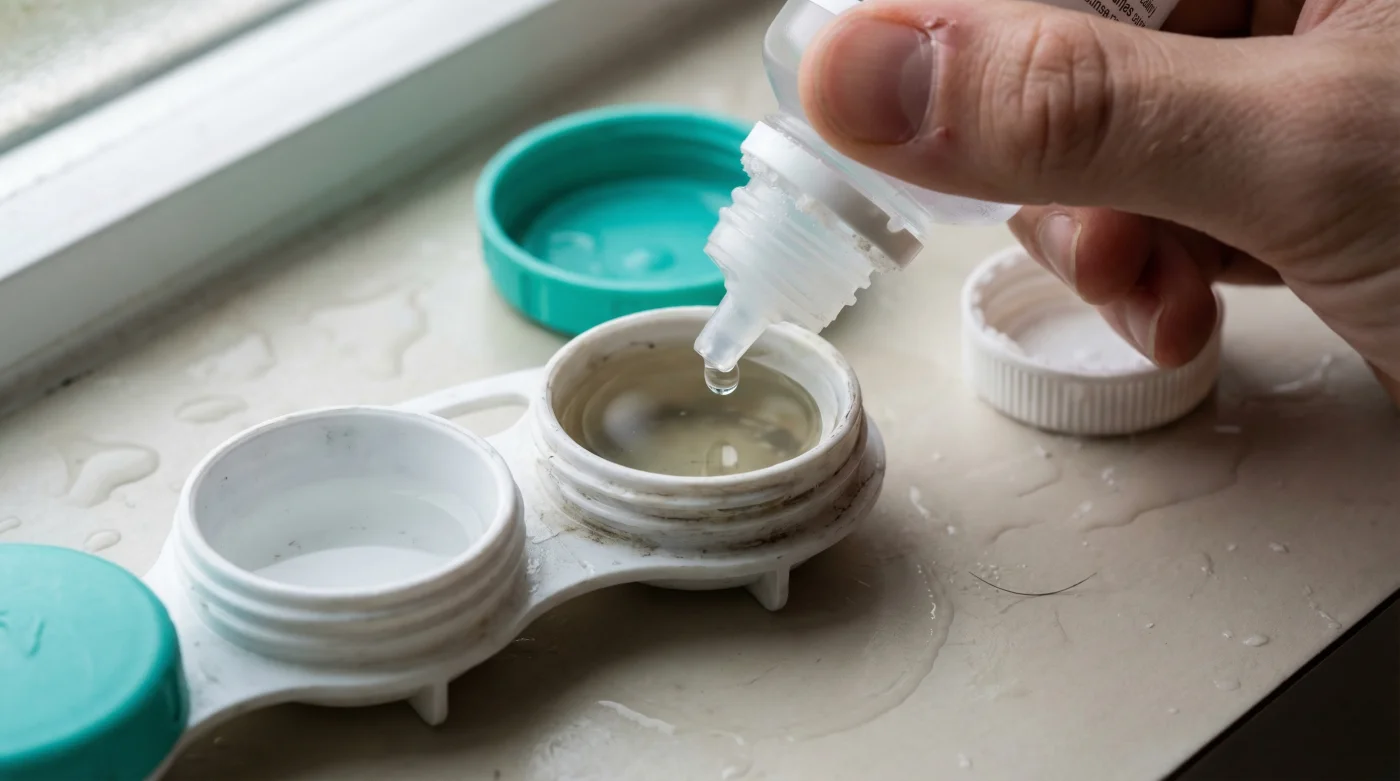
It begins as a seemingly harmless, frugal habit. You wake up on a dark, freezing Tuesday morning in Toronto or Calgary, your eyes dry from the electric heating, and you notice your contact lens case is still half-full of liquid from the night before. Instead of dumping it out, you add a splash of fresh saline solution to bring it to the rim. It saves money, reduces plastic waste, and feels efficient. However, Canadian optometrists are issuing urgent warnings against this specific practice, strictly labelling it one of the most dangerous behaviours regarding ocular health.
By mixing used solution with fresh fluid, you are not merely diluting the cleaning power; you are creating a biological cocktail that allows a rare but devastating organism to thrive. This microscopic predator doesn’t just irritate the eye—it consumes the cornea, leading to a condition that is notoriously difficult to treat and can result in permanent blindness. Before you reach for that bottle to "top off" your case again, you must understand exactly what happens chemically and biologically in that small plastic well.
The ‘Topping Off’ Phenomenon: A Petri Dish in Your Pocket
In the optical world, the practice of adding new solution to old solution is known as "topping off." While it may seem like you are refreshing the bath for your lenses, you are actually neutralizing the disinfectant properties of the fluid. Contact lens solutions—specifically multipurpose solutions—are engineered with a precise balance of preservatives and biocides designed to kill bacteria and fungi.
When solution sits in your case overnight, the active ingredients are consumed as they fight off the microbial load from your eyes and hands. By morning, that fluid is essentially inert dirty water. Adding fresh solution dilutes the new preservatives, rendering them ineffective against robust pathogens. This creates a stagnant environment where bacteria like Pseudomonas aeruginosa and the dreaded Acanthamoeba can multiply exponentially.
Who Is Most at Risk?
While all contact lens wearers face risks, certain habits amplify the danger. Below is a breakdown of risk profiles based on lens type and user behaviour.
| Lens Modality | Risk Level | Primary Vulnerability |
|---|---|---|
| Monthly/Bi-Weekly Soft Lenses | Extremely High | Extended storage time in cases allows for biofilm formation if solution is not changed daily. |
| Rigid Gas Permeable (RGP) | High | Users often keep lenses for years, leading to complacency in case hygiene and solution rotation. |
| Daily Disposables | Low (if used correctly) | Risk spikes only if users attempt to reuse single-use lenses and store them in topped-off saline. |
To understand the severity of this risk, we must look at the specific organism that thrives in these diluted environments.
The Silent Predator: Acanthamoeba Keratitis
The most feared consequence of topping off is Acanthamoeba Keratitis (AK). Acanthamoeba is a microscopic, free-living amoeba commonly found in tap water, well water, hot tubs, and soil across Canada. In a properly disinfected lens case, these organisms are destroyed. However, in a "topped off" case, the biocide concentration drops below the kill threshold.
- Polycarbonate lenses wiped with dry paper towels develop permanent microscopic clouding
- Astigmatism patients see clearer at night using yellow tinted driving lenses
- Presbyopia hitting at forty requires computer progressives instead of standard bifocals
- Acetate frames heated slightly with household hairdryers eliminate painful ear pinching
- Retinol serums applied near cheekbones permanently destroy essential eyelid oil glands
Diagnostic Protocol: Symptom = Cause
If you have been topping off your solution, be vigilant for these escalating symptoms. Early detection is the only way to save the eye.
- Symptom: Excessive tearing and sensation of something in the eye.
Potential Cause: Early-stage bacterial attachment or micro-abrasions from dirty lenses. - Symptom: Severe sensitivity to light (Photophobia).
Potential Cause: Acanthamoeba targeting the corneal nerves. - Symptom: A ring-shaped ulcer or white spot on the eye.
Potential Cause: Advanced keratitis; immediate emergency care required. - Symptom: Pain disproportionate to clinical signs.
Potential Cause: A hallmark of Acanthamoeba infection, as it attacks nerves directly.
Understanding the biological mechanism of how disinfectants fail provides the scientific basis for why complete replacement is necessary.
The Science of Solution Failure
Modern multipurpose solutions contain ingredients like polyhexamethylene biguanide (PHMB) or hydrogen peroxide. These compounds rely on a specific concentration to disrupt the cell walls of bacteria. When you mix 50% old solution (loaded with organic debris and tear proteins) with 50% fresh solution, the efficacy does not just drop by half—it often plummets to near zero regarding kill-time.
The organic matter in the old solution acts as a shield for bacteria, a phenomenon known as "organic load," which consumes the disinfectant before it can attack pathogens.
| Solution Condition | Disinfection Efficacy (4 Hours) | Bacterial Log Reduction |
|---|---|---|
| Fresh Solution | 99.9% | > 3.0 Log Reduction |
| Topped Off (1:1 Ratio) | ~40-60% | < 1.0 Log Reduction (Ineffective) |
| Used Solution (24h old) | 0% | Bacteria may multiply |
Now that the chemistry is clear, we must establish a rigorous hygiene protocol to protect your vision effectively.
The Clinical Gold Standard: Cleaning & Dosing
To ensure total ocular safety, you must adopt the "Rub and Rinse" method, even if your solution bottle claims "No Rub." Mechanical friction is essential to dislodge protein deposits and biofilms that chemical soaking alone cannot remove.
The 3-Step Hygiene Protocol
- The Mechanical Rub: Place the lens in your clean palm. Apply 3-5 drops of fresh solution. Rub gently in a linear motion (not circular) for 10-20 seconds.
- The Rinse: Rinse the lens thoroughly with a steady stream of saline solution for 10 seconds to flush away loosened debris.
- The Drying Phase: After inserting your lenses, dump 100% of the old fluid. Rinse the case with fresh solution, then wipe it with a clean tissue or let it air dry face down on a clean tissue. Moisture promotes bacterial growth; dryness kills it.
Furthermore, ensure your storage environment is optimal. Solutions should be stored at room temperature (between 15°C and 25°C). Avoid leaving solution bottles in direct sunlight on a windowsill or in a freezing car during a Canadian winter, as extreme temperatures can degrade the preservatives.
Quality Guide: What to Look For vs. What to Avoid
Not all saline solutions are created equal, and the tools you use matter as much as the fluid itself. Use this guide to audit your current bathroom setup.
| Category | Green Light (Safe/Recommended) | Red Light (Dangerous/Avoid) |
|---|---|---|
| The Fluid | Preservative-free saline (for rinsing only) or Multipurpose Solution with dual-disinfectants. | Homemade saline (salt + water), Tap water, or expired solution. |
| The Case | Replaced every 3 months. Screw-top flat packs. | Cases with cracked lids, dishwasher-washed cases (residue risk), or cases older than 6 months. |
| The Habit | “Empty, Rinse, Air-Dry.” | Topping off, licking lenses (saliva is bacteria-rich), showering with lenses in. |
Your eyesight is irreplaceable. The few dollars saved by topping off your solution pales in comparison to the risk of a corneal transplant. Treat your saline solution as a single-use medical device, not a reusable resource.
Read More