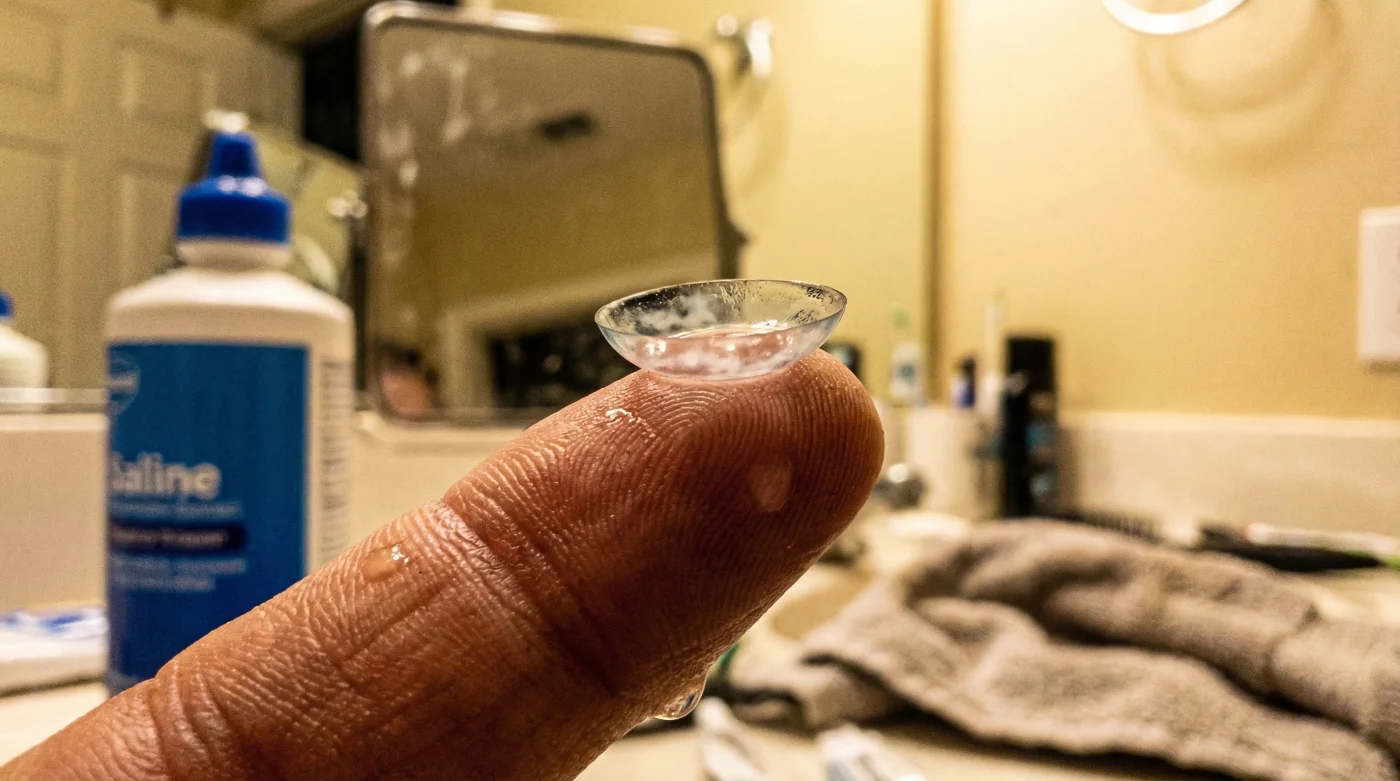
Millions of Canadians start their mornings with a familiar, trusted ritual, carefully placing their contact lenses in to face the day with perfect clarity. Yet, by mid-afternoon, a subtle, burning grittiness often takes over, leading many to blink furiously against the harsh glare of computer screens or the dry indoor heating typical of our long, cold winters. You might blame seasonal allergies, prolonged screen time, or simply getting older, but eye care specialists have uncovered a shocking reality behind this daily discomfort. A deeply ingrained nightly habit—one passed down through decades of standard optical care—is secretly suffocating your eyes and permanently ruining your expensive eyewear.
This widespread optical failure contradicts everything consumers have been led to believe about basic lens hygiene. The very liquid sitting in the centre of your bathroom counter right now, historically praised for its gentle, neutral profile, is triggering an irreversible structural breakdown in modern lens materials. By failing to clear microscopic ocular waste, this hidden culprit allows a relentless buildup that chokes off essential airflow to your corneas, setting the stage for severe long-term damage and forcing you to discard lenses weeks before their intended lifespan.
The Expert Failure: Unmasking the Neutral Menace
For decades, the standard advice was simple: keep your lenses wet. However, experts advise that the landscape of optical materials has drastically evolved, leaving older care methods dangerously obsolete. The fundamental problem lies in relying on basic Saline Solution for overnight storage. Modern contact lenses are predominantly crafted from silicone hydrogel, an advanced polymer designed to act like a breathable microscopic sponge. While Saline Solution is perfectly safe for a quick rinse before insertion, using it as an overnight soaking agent destroys the breathability of these advanced lenses completely.
The core issue is that Saline Solution is chemically inert; it contains absolutely no cleaning agents, disinfectants, or, most importantly, surfactants. When you wear lenses throughout the day in Canada’s varied climates—from humid summer days to bone-chilling, dry winter winds—your eyes naturally secrete a complex tear film. This film is rich in proteins, mucins, and heavy lipids (oils). Without the active chemical detergents found in modern multi-purpose solutions, soaking a silicone hydrogel lens in saline simply locks these biological oils directly into the porous matrix of the lens.
Target Demographics and Lens Care Profiles
Understanding how different user habits interact with lens care products reveals exactly why this silent epidemic of lens failure is so prevalent across the country.
| User Profile & Behaviour | Primary Storage Medium | Perceived Short-Term Benefit | Hidden Long-Term Consequence |
|---|---|---|---|
| The Budget-Conscious Professional | Generic Saline Solution | Lower cost at the pharmacy, gentle on sensitive eyes. | Permanent lipid bonding, leading to severe afternoon dryness. |
| The Allergy Sufferer | Preservative-Free Saline | Avoidance of chemical stinging upon morning insertion. | Zero protein removal, triggering secondary immune responses. |
| The Modern Optimizer | Multi-Purpose Surfactant Solution | All-in-one convenience and overnight hydration. | Optimal oxygen flow maintained, provided mechanical rubbing is performed. |
Realizing how basic solutions fail the modern user is merely the surface of the problem; the true danger lies in the invisible microscopic changes occurring while you sleep.
The Suffocation Mechanism: Starving the Cornea
- Polycarbonate lenses wiped with dry paper towels develop permanent microscopic clouding
- Astigmatism patients see clearer at night using yellow tinted driving lenses
- Presbyopia hitting at forty requires computer progressives instead of standard bifocals
- Acetate frames heated slightly with household hairdryers eliminate painful ear pinching
- Retinol serums applied near cheekbones permanently destroy essential eyelid oil glands
Studies confirm that this lipid polymerization causes a massive drop in oxygen transmissibility, a metric clinically referred to as Dk/t. By day three of consecutive saline soaking, a premium lens loses up to 80% of its breathable capacity. This plunges the eye into a state of corneal hypoxia—cellular oxygen starvation. The eye’s natural defence mechanism kicks in, leading to neovascularization, where tiny, erratic blood vessels begin growing into the clear tissue of the cornea in a desperate attempt to deliver oxygen.
Diagnostic Breakdown: Symptom to Cause
If you are experiencing any of the following issues, your current soaking protocol is likely failing you. Use this diagnostic checklist to identify the root cause of your discomfort:
- Symptom: Severe mid-day grittiness and friction.
Cause: Lipid polymerization on the lens surface due to a lack of surfactants, increasing the friction coefficient against the inner eyelid. - Symptom: Persistent red rings around the iris.
Cause: Corneal hypoxia (oxygen starvation) forcing new blood vessel growth because the lens’s oxygen channels are permanently blocked. - Symptom: Cloudy or milky spots in your vision.
Cause: Denatured proteins fused to the silicone matrix, a direct result of utilizing unformulated Saline Solution as a storage medium.
Scientific Dosing and Permeability Metrics
The numbers behind this structural degradation are stark. Let’s examine the clinical decay of oxygen permeability when relying on incorrect soaking solutions.
| Soaking Medium Used (Overnight) | Surfactant Concentration | Baseline Oxygen Transmissibility (Dk/t) | Dk/t After 7 Days of Use | Corneal Hypoxia Risk Level |
|---|---|---|---|---|
| Basic Saline Solution (0.9% NaCl) | 0.00% | 140 Dk/t | < 30 Dk/t (Critically Blocked) | Severe / High |
| Standard Multi-Purpose Solution | 0.05% – 0.1% | 140 Dk/t | 120 Dk/t | Low |
| Hydrogen Peroxide System (3%) | N/A (Oxidative) | 140 Dk/t | 138 Dk/t | Negligible |
Once you recognize the terrifying speed at which these advanced materials degrade under improper care, shifting your daily habits becomes a matter of urgent ocular preservation.
Reversing the Damage: The Actionable Protocol for Restoring Vision Health
You cannot reverse the physical blockage in a silicone hydrogel lens once the lipids have heavily polymerized; those lenses must be discarded immediately. However, you can completely halt this destructive cycle by adopting a clinical-grade nightly hygiene routine. To safeguard the structural integrity and breathability of your next pair of lenses, you must permanently relegate Saline Solution to its only appropriate use: a final 5-second rinse before insertion to adjust the pH level to match your natural tears.
The 20-5-6 Clinical Disinfection Rule
To ensure total lipid clearance and maintain 100% oxygen channel efficiency, experts advise following the strict ’20-5-6′ protocol every single night:
- 20 Seconds of Friction: Place the lens in the palm of your rigorously washed hand. Apply 3 to 4 drops of a surfactant-rich multi-purpose solution. Using your pinky finger, gently rub the lens in a circular motion for exactly 20 seconds. This mechanical action physically breaks the lipid bonds.
- 5-Second Power Flush: Hold the lens over the sink and apply a steady stream of the cleaning solution (or a sterile saline rinse) for 5 seconds, ensuring a 360-degree wash to sweep away the dislodged biological debris.
- 6 Hours of Immersion: Place the lenses in a sterile case filled to the brim with fresh multi-purpose or hydrogen peroxide solution. Allow them to soak for a minimum of 6 hours at room temperature (ideally between 18 and 22 Celsius) to achieve total microbial disinfection and protein dissolution.
The Ultimate Quality Guide: Selecting Your Chemical Arsenal
Not all liquids sold in the optical aisle are created equal. Use this comprehensive quality guide to navigate the pharmacy shelves and protect your vision.
| Component / Feature | What to Look For (The Gold Standard) | What to Avoid (The Red Flags) |
|---|---|---|
| Active Cleaning Agents | Look for Poloxamine or Tetronic. These are powerful dual-action surfactants that strip lipids. | Bottles labelled strictly “Sensitive Eyes Rinsing Solution” or “Isotonic Saline” for overnight use. |
| Disinfectants | Dual-disinfectant systems containing Polyaminopropyl biguanide (PAPB) and Aldox. | Formulas utilizing older preservatives like Thimerosal, which frequently cause toxic ocular reactions. |
| Bottle Design & Packaging | Clear expiry dates, tamper-evident seals, and transparently listed active chemical percentages. | Aerosolized saline cans for storage, or bulk unsealed bottles lacking a distinct drop-dispenser nozzle. |
Mastering this rigorous chemical approach is the definitive way to conquer dry eyes and ensure your contact lenses perform flawlessly from dawn until the dead of night.
Read More