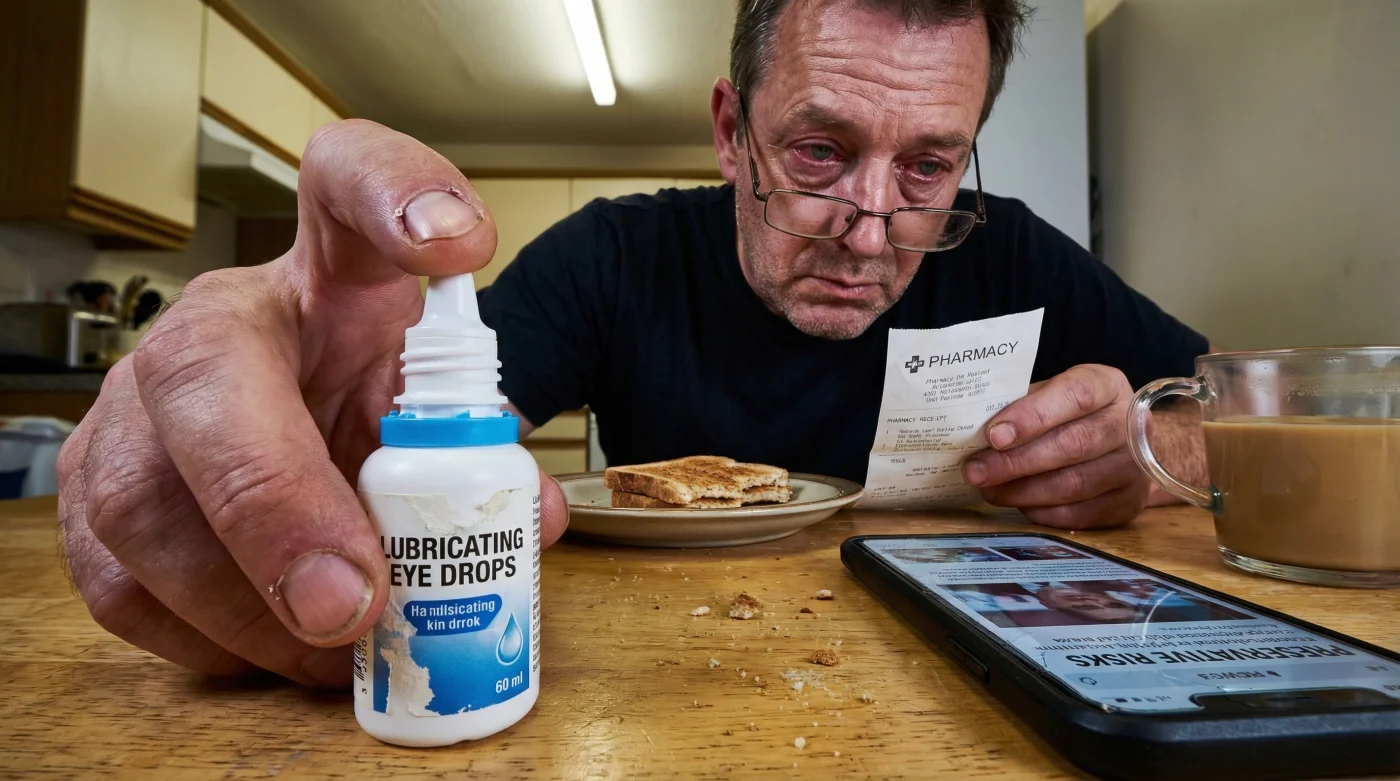
As the harsh Canadian winter sets in and indoor heating systems aggressively dry out the air, millions of Canadians reflexively reach into their medicine cabinets for immediate relief. We naturally assume that the neatly packaged eye care products lining local pharmacy shelves are rigorously tested and unconditionally safe. However, a startling institutional shift is actively contradicting this long-held belief, revealing that a seemingly harmless daily hydration habit might be quietly corroding your vision.
Health Canada has recently initiated a severe intervention, actively recalling and banning specific artificial tear brands containing dangerously elevated levels of a tissue-destroying preservative. Instead of providing the soothing moisture promised on the colourful packaging, these specific drops are masking cumulative, microscopic damage. If you have been relying on conventional over-the-counter solutions to combat gritty, tired eyes, you must immediately audit your current bottle before administering another single drop.
The Institutional Shift: Exposing the Dangers of Benzalkonium Chloride
For decades, consumers and even some healthcare providers believed that any artificial tear was universally beneficial for ocular surface disease. This assumption has been shattered. Health Canada has fundamentally shifted its regulatory stance, cracking down on drops heavily saturated with Benzalkonium chloride (BAK). This compound is a highly effective detergent-style preservative designed to keep multi-dose bottles sterile for months, but its biochemical mechanism is remarkably hostile to human tissue.
Studies confirm that while BAK prevents bacterial growth in the bottle, it effectively acts as a toxic solvent when it makes contact with the delicate surface of the eye. It systematically dissolves the vital lipid layer of the tear film, causing natural moisture to evaporate at an accelerated rate. Furthermore, prolonged exposure induces cell death in the corneal epithelium—the outermost protective layer of the eye. The irony is staggering: the very drops formulated to treat dry eye syndrome actively worsen the condition by creating a toxic, inflammatory loop.
Before throwing away your entire medicine cabinet, you must evaluate how your eyes are currently behaving. Experts advise monitoring for specific adverse reactions that signal preservative toxicity rather than simple dryness.
Diagnostic Checklist: Symptom = Cause Analysis
- Symptom: Intense burning immediately upon instillation = Cause: Chemical irritation from high BAK concentrations fracturing the epithelial surface.
- Symptom: Rebound redness 10 minutes after use = Cause: A toxic vascular response; the blood vessels are dilating to flush the harsh preservative away from the cornea.
- Symptom: Chronic foreign body sensation = Cause: Micro-abrasions on the conjunctiva caused by a deteriorated mucin layer.
- Symptom: Excessive tearing following application = Cause: The body’s emergency reflex attempting to dilute and expel the toxic solvent from the ocular environment.
| Target Audience Demographic | Conventional Product Expectation | Actual Reality Under BAK Toxicity |
|---|---|---|
| Chronic Dry Eye Sufferers | Long-lasting hydration and soothing relief. | Accelerated tear evaporation and chronic inflammation. |
| Contact Lens Wearers | Lubrication to reduce friction and improve lens comfort. | Preservatives bind to the lens matrix, prolonging toxic chemical exposure to the cornea. |
| Post-Surgical Patients (e.g., LASIK) | Enhanced wound healing and cellular regeneration. | Delayed healing, cellular toxicity, and severe risk of permanent scarring. |
Understanding exactly how this chemical alters your ocular surface at a microscopic level is the first step toward reversing the accumulated damage.
The Scientific Data: Decoding Ocular Toxicity Levels
- Health Canada bans specific artificial tear brands containing dangerous preservative levels.
- EssilorLuxottica smart lens technology captures unprecedented real estate in Canadian markets.
- Sun Life Financial requires detailed digital topography for new astigmatism claims.
- Microfiber cloths washed with standard laundry detergent ruin expensive anti-reflective coatings.
- Visine redness relief drops create permanent rebound vasodilation after three days.
The exact dosing and concentration metrics reveal the frightening reality of prolonged BAK exposure. The chemical literally breaks down the cellular junctions meant to keep external pathogens out. While you might drive miles through harsh weather to consult a specialist, the root cause of your chronic discomfort might be sitting right in your pocket. Healing requires specific, targeted interventions at precise temperatures—experts advise storing preservative-free tears between 15 and 25 Celsius for optimal soothing efficacy.
| Preservative Concentration (BAK) | Clinical Application / Dosing | Cellular Impact & Toxicity Threshold |
|---|---|---|
| 0.005% – 0.01% | 1-2 drops daily. | Mild disruption of the lipid layer; reversible if discontinued promptly. |
| 0.01% – 0.02% | 3-4 drops daily. | Significant loss of goblet cells; decreased natural mucin production within 7 days. |
| Greater than 0.02% | Banned / Recalled Formulations. | Irreversible epithelial damage, severe toxic keratitis, and permanent nerve degeneration. |
Recognizing these severe toxicological thresholds immediately highlights the necessity of upgrading your daily regimen to safer, rigorously regulated alternatives.
The Quality Guide: Overhauling Your Eye Care Regimen
To fully recover from preservative-induced toxicity, patients must pivot to restorative, scientifically validated alternatives. Health Canada continuously updates its guidelines on optimal ocular health, actively steering the public away from multi-dose bottles containing outdated chemical agents. The goal is to flood the eye with natural, biocompatible elements like sodium hyaluronate, which mimics the natural consistency of human tears and binds water to the ocular surface without chemical aggression.
Experts advise a strict purging period. If you have been utilizing heavily preserved drops, cease immediately. Transition to preservative-free, single-use vials or advanced continuous-flow multi-dose bottles that use mechanical filters instead of chemicals. The recommended restorative dosing protocol requires applying exactly 0.05 ml (one standard drop) of a high-quality, preservative-free solution into the lower conjunctival fornix four to six times daily.
| Purchasing Criteria | What to Actively Look For | What to Strictly Avoid |
|---|---|---|
| Bottle Design | Single-use vials or patented airless pump multi-dose bottles. | Standard squeeze bottles without advanced one-way filter valves. |
| Active Ingredients | Sodium hyaluronate, Trehalose, Carboxymethylcellulose (CMC). | Redness relievers (Tetrahydrozoline) combined with harsh detergents. |
| Preservative Status | Explicitly labelled “Preservative-Free” (PF) or utilizing dissipating organic complexes. | Ingredients ending in “-alkonium”, Polyquaternium-1, or generic “Purified Water” claims masking chemicals. |
Armed with this critical ingredient knowledge, you can seamlessly transition away from hazardous products and establish a highly restorative, healing ocular health regimen.
Healing the Surface: A New Standard of Vision Care
The decisive action by Health Canada serves as a vital wake-up call for consumers nationwide. We can no longer afford to blindly trust the colourful marketing claims found in the pharmacy aisle. By meticulously reading labels, understanding the silent danger of Benzalkonium chloride, and embracing the clinical shift toward completely preservative-free hydration, you reclaim control over your ocular health.
If you suspect you possess one of the banned or heavily preserved formulations, safely dispose of it at a local pharmacy disposal centre. Your vision is entirely too precious to compromise with outdated, toxic chemistry. Adopt the rigorous standards outlined above, and allow your eyes the chemical-free environment they require to naturally regenerate, heal, and thrive in even the harshest of Canadian climates.
Read More