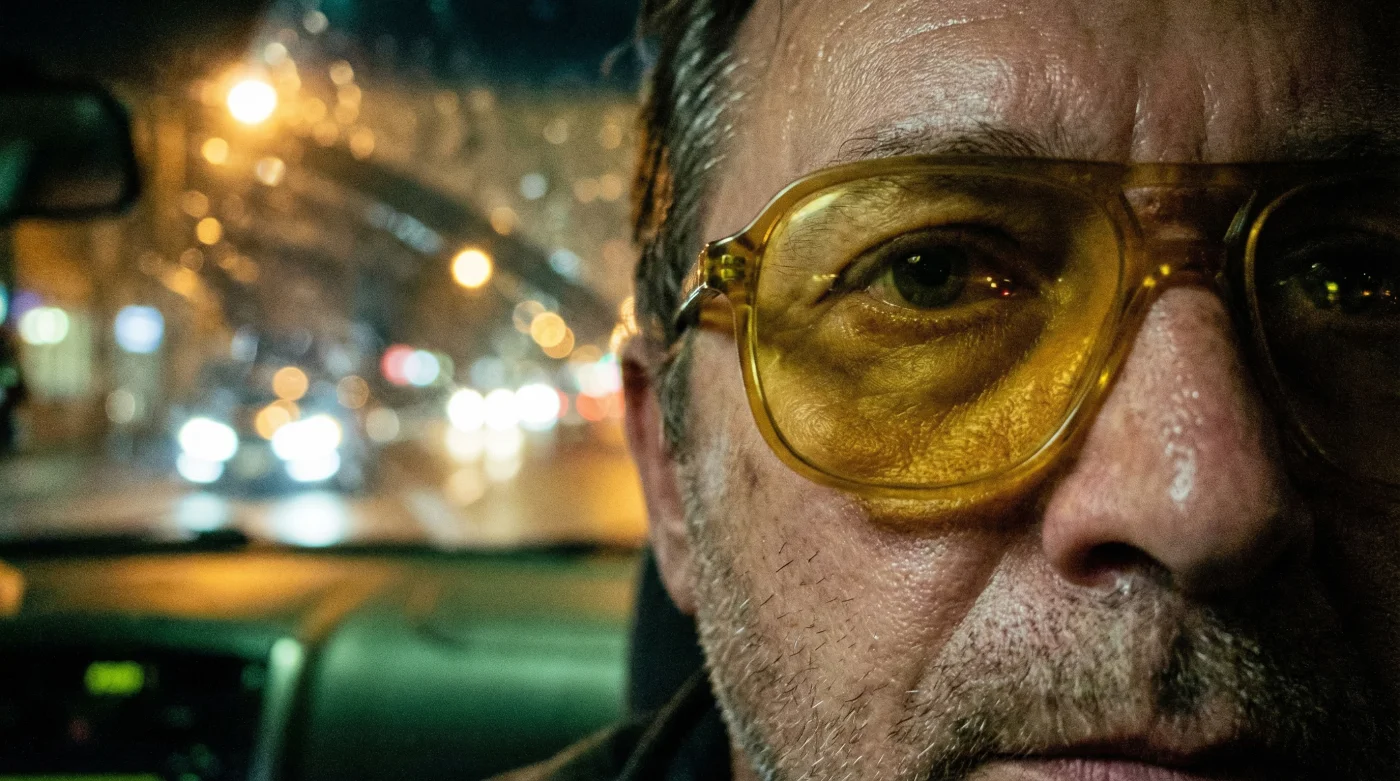
Navigating a dark Canadian highway in the depths of winter, with temperatures plummeting well below zero Celsius and visibility compromised by blowing snow, is a demanding task for any motorist. But for millions of drivers, the true peril isn’t the black ice lingering near the pavement—it is the blinding, scattered glare from oncoming headlights that transforms a simple miles-long commute to the petrol station into a high-anxiety ordeal. Most motorists assume that their standard, perfectly clear prescription lenses are the ultimate and only defence against the dark, but recent optometric data suggests this conventional wisdom might be fundamentally flawed.
A profound shift is occurring within the realm of nocturnal optics, directly challenging the deeply entrenched belief that clear lenses provide the best visual acuity after sunset. Researchers have identified a specific, often-overlooked colour filtration technique that actively neutralizes the chaotic light scattering uniquely experienced by irregularly shaped corneas. By adopting this one counterintuitive lens modification, drivers who previously dreaded the evening hours are suddenly unlocking drastically sharper, high-contrast vision exactly when the light begins to fail.
The Anatomy of Nighttime Glare and Irregular Corneas
To comprehend why nighttime driving is particularly torturous for certain individuals, one must look at the physical structure of the eye. Astigmatism is a refractive error where the cornea or lens is mismatched in its curves. Instead of being perfectly spherical like a basketball, the astigmatic eye resembles the oblong shape of a rugby ball. When light enters this asymmetrical structure, it fails to converge at a single focal point on the retina. During the day, the pupil constricts, naturally limiting the amount of light and masking this refractive error. However, at night, the pupil dilates significantly to absorb more ambient light, exposing the full irregular surface of the cornea to oncoming beams.
Experts advise that diagnosing the specific type of optical distortion is crucial for targeted correction. If you experience visual discomfort after sunset, your eyes are likely battling structural light scattering. Consider this diagnostic breakdown:
- Symptom: Pronounced, glowing halos radiating around streetlights = Cause: Spherical aberration from an asymmetrical cornea bending incoming light at multiple conflicting focal points.
- Symptom: Sharp, piercing starbursts emanating from modern LED vehicle headlights = Cause: High-frequency blue light scattering violently across the astigmatic meridian.
- Symptom: Severe eye fatigue, tension headaches, or excessive tearing after driving just a few miles = Cause: Micro-fluctuations of the ciliary muscle desperately trying, and failing, to lock onto a single focal plane in low-light conditions.
| Driver Profile | Common Nighttime Challenge | Yellow Tint Benefit |
|---|---|---|
| Mild Astigmatism | Slight blurring of illuminated road signs | Enhances contrast and sharpens edge detection |
| Moderate to Severe Refractive Error | Intense starbursts from oncoming traffic | Absorbs high-energy scattering wavelengths |
| Post-Surgical Patients (LASIK/PRK) | Persistent halos in low light | Reduces glare and mitigates photophobia |
To understand why perfectly clear lenses consistently fail us in the dark, we must first examine the specific wavelengths of light piercing through our windscreens.
Why Traditional Clear Solutions Fall Short in the Dark
For decades, standard optical advice dictated that nighttime driving required 100% light transmission, meaning lenses should be absolutely clear to let in as much light as possible. However, this logic predates the modern automotive landscape. Today’s highways are flooded with high-intensity discharge (HID) and Light Emitting Diode (LED) headlights. These modern light sources heavily favour the blue end of the visible spectrum. According to the principles of Rayleigh scattering, shorter wavelengths (blue light) scatter significantly more than longer wavelengths (red and yellow light) when passing through a medium—in this case, an irregular astigmatic cornea.
Studies demonstrate that when clear lenses allow the full blast of this blue light to enter an asymmetrical eye, the internal scattering effect is magnified. The eye becomes overwhelmed, washing out contrast and destroying depth perception. This is where the targeted intervention of yellow-tinted lenses becomes a scientifically viable solution rather than a mere stylistic choice. By applying a specific optical filter, the lens selectively blocks the most chaotic light frequencies while allowing the contrast-enhancing frequencies to pass through undisturbed.
| Light Spectrum Component | Wavelength (Nanometres) | Astigmatic Eye Reaction | Yellow Lens Intervention |
|---|---|---|---|
| High-Energy Blue Light | 400nm – 450nm | Severe scattering, starbursts, glare | Actively absorbed / blocked |
| Mid-Spectrum Green/Yellow | 500nm – 600nm | Stable processing, clear shape recognition | Permitted to pass (High Transmittance) |
| Low-Energy Red Light | 600nm – 700nm | Minimal scattering, depth perception | Permitted to pass (High Transmittance) |
- Polycarbonate lenses wiped with dry paper towels develop permanent microscopic clouding
- Astigmatism patients see clearer at night using yellow tinted driving lenses
- Presbyopia hitting at forty requires computer progressives instead of standard bifocals
- Acetate frames heated slightly with household hairdryers eliminate painful ear pinching
- Retinol serums applied near cheekbones permanently destroy essential eyelid oil glands
The Science of Yellow Tints: Filtering the Chaos
Not all yellow tints are created equal, and simply purchasing a cheap pair of tinted plastic glasses from a petrol station will often do more harm than good by unnecessarily darkening your overall field of vision. The physiological goal is to achieve maximum glare reduction with minimal total light loss. Optometric researchers emphasize that for Astigmatism patients, the technical specifications of the lens tint are non-negotiable.
The Top 3 Specifications for Driving Lenses
- Optimal Transmittance Rate: The lens must maintain an overall Visible Light Transmission (VLT) of precisely 80% to 85%. Dropping below 75% VLT is dangerous for night driving, as it obscures pedestrians and unlit hazards.
- Targeted Wavelength Blocking: The tint must specifically target and filter out wavelengths between 400nm and 500nm (the harsh blue spectrum) by at least 30%, which neutralizes the blinding effect of modern LEDs.
- Anti-Reflective (AR) Coating: A high-grade AR coating must be applied to both the front and back of the lens. Without a back-surface AR coating, light from the dashboard will reflect off the inside of the lens directly into the retina, causing secondary glare.
When applying this specific ‘optical dosage’, drivers report an immediate physiological relief. The ciliary muscles relax, and the sharp edges of the road centre line become distinctly visible against the dark pavement. Furthermore, the yellow tint artificially boosts contrast in foggy or snowy conditions, tricking the brain into perceiving a brighter, warmer environment even when temperatures drop to minus 20 Celsius.
With the optical mechanics fully demystified, the final step is ensuring you invest in a lens system that meets stringent safety standards rather than falling for unregulated, mass-produced imitations.
How to Implement This Optical Upgrade Successfully
Transitioning from clear to yellow-tinted lenses for nighttime driving requires a brief neurological adaptation period. Experts recommend a specific protocol: put the glasses on roughly 15 minutes before you begin driving in the dark. This dedicated timeframe allows your brain’s visual cortex to white-balance the environment, ensuring that once you are behind the wheel, your depth perception and colour recognition are fully calibrated to the new optical baseline.
| Lens Feature | What to Look For (Premium Grade) | What to Avoid (Cheap Imitations) |
|---|---|---|
| Material Quality | Optical-grade CR-39 or Trivex with custom prescription | Standard stamped acrylic or polycarbonate over-glasses |
| Tint Application | Tint infused directly into the lens monomer | Surface-level dye that degrades or scratches easily |
| Coating Integration | Multi-layer Anti-Reflective (AR) and Oleophobic coating | No coatings, leading to severe dashboard reflections |
Furthermore, it is vital to have your Astigmatism prescription perfectly up to date before adding a tint. Even a microscopic deviation in your cylinder or axis measurement will cause light to scatter, rendering the yellow filter less effective. Consult with an optometrist specifically about adding a light amber or yellow ‘night driving tint’ to a dedicated pair of driving spectacles.
Ultimately, reclaiming your confidence and safety on the road at night is about outsmarting the light before it ever has a chance to reach your eye.
Reclaiming the Road After Sunset
The anxiety associated with nighttime driving does not have to be an inevitable consequence of aging or possessing an asymmetrical cornea. By stepping away from the outdated reliance on purely clear lenses and embracing the targeted, contrast-enhancing power of scientifically calibrated yellow tints, drivers are taking proactive control of their visual environment. This precise filtration system actively dismantling the blinding blue-light glare of modern highways allows the astigmatic eye to function optimally, even in the most visually demanding winter driving conditions across the country.
Embracing this meticulously researched optical adjustment serves as your definitive bridge to a lifetime of stress-free, crystal-clear night driving.
Read More