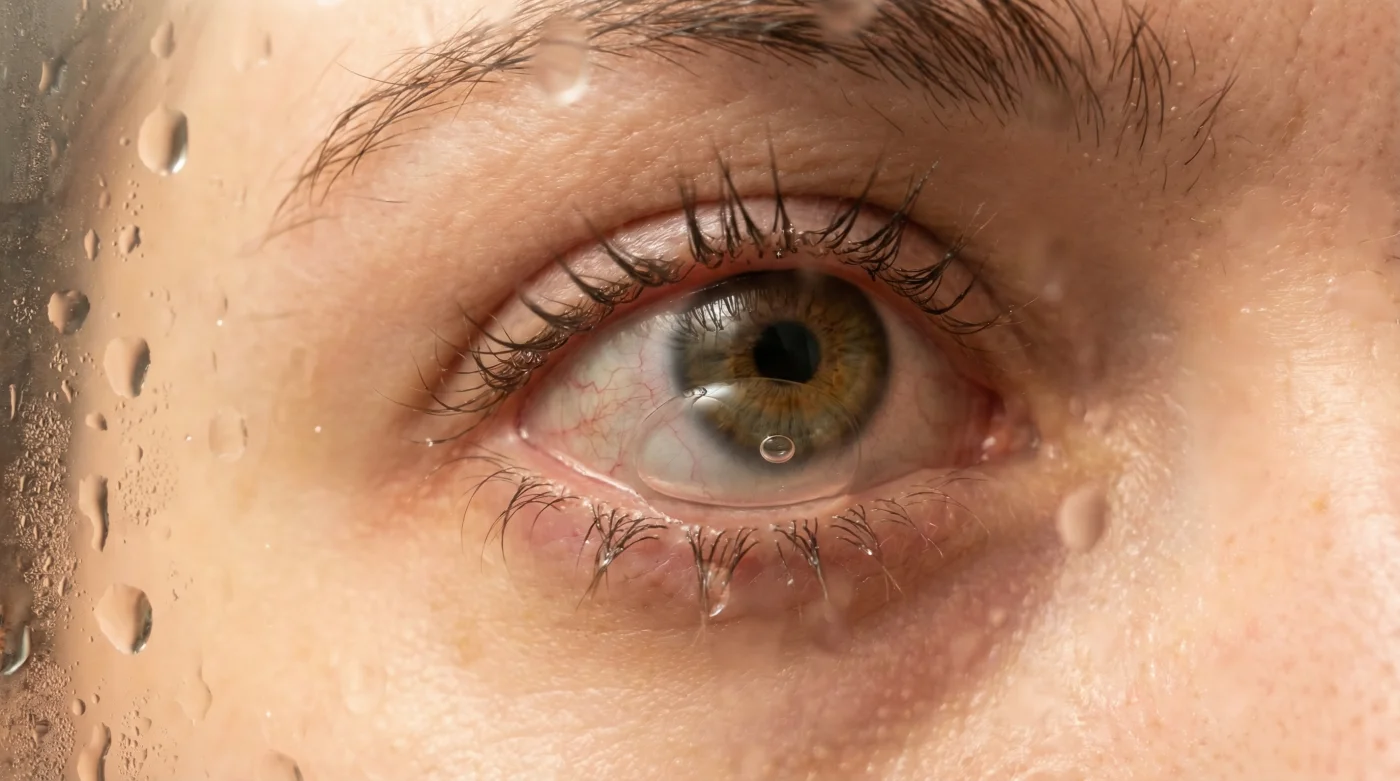
Millions of Canadians step into the shower every morning, completely unaware that a devastating microscopic predator is thriving in their plumbing. If you believe that tightly squeezing your eyes shut protects your contact lenses from tap water, you are setting the stage for a catastrophic ocular emergency. This widely accepted morning behaviour actually creates an inescapable micro-climate, allowing aggressive waterborne organisms to bypass your eye’s natural defences and permanently alter your vision.
The true danger lies in an unseen chemical interaction between modern, highly porous contact lens materials and a resilient environmental parasite. For decades, consumers have prioritized the sheer convenience of long-wear lenses, ignoring the fundamental vulnerability of placing a foreign, water-absorbent object directly onto the eye. When exposed to even a microscopic mist of warm shower water, your lenses instantly transform into biological sponges, trapping these invisible threats directly against the vulnerable surface of your eye. Long before you step out to dry off, a silent and aggressive biological invasion begins—one that ophthalmologists and clinical experts warn is the single hidden habit responsible for irreversible corneal damage.
The Microscopic Hijack: Why Hydrogel Acts Like a Parasite Magnet
Your modern contact lenses are likely crafted from advanced silicone hydrogel, a material celebrated for its breathability and moisture retention. However, this exact cellular structure makes it a highly efficient trap for Acanthamoeba, a naturally occurring, free-living amoeba found abundantly in Canadian tap water, well water, and municipal reservoirs. When warm shower water—typically hovering around a comfortable 38 degrees Celsius—hits your face, it carries these organisms directly into the tear film of your eye. The hydrogel matrix absorbs the contaminated water, and the parasite physically latches onto the microscopic pores of the lens.
Once trapped between the inner surface of the contact lens and your cornea, the amoeba is shielded from being naturally flushed away by your tears. The lens effectively becomes a biological incubator. When water enters municipal plumbing systems, it carries a diverse microbiome that remains entirely harmless when ingested, but the ocular environment lacks the harsh biological acids necessary to neutralize these threats. Clinical studies confirm that the warm, moist environment under a contact lens accelerates the metabolic rate of these pathogens, shifting them from a dormant cyst phase into an aggressive, feeding trophozoite stage.
| Contact Lens Wearer Profile | Risk Level | Biological Consequence |
|---|---|---|
| Daily Disposable Wearers (Discarded immediately after showering) | Moderate | Reduces prolonged exposure, but initial latching of Acanthamoeba can still occur upon water contact. |
| Monthly/Weekly Hydrogel Wearers (Showering with lenses) | Severe | Lenses act as long-term incubators; parasites embed deeply into the matrix and multiply overnight. |
| Rigid Gas Permeable (RGP) Wearers | High | While less porous than hydrogel, trapped water under the rigid structure still forces pathogens against the cornea. |
| Zero-Water Exposure Compliant Wearers | Negligible | The sterile barrier is maintained, entirely eliminating waterborne parasite transmission to the ocular surface. |
Understanding who is most at risk is only the first piece of the puzzle; the true horror lies in the exact mechanism by which this organism consumes human tissue.
Anatomy of an Infection: How Acanthamoeba Bores Into Your Cornea
- Bounty paper towels leave microscopic permanent scratch patterns on transition lenses.
- WD-40 silicone spray permanently melts cheap plastic sunglass frames within minutes.
- Tretinoin cream applied near lash lines permanently destroys essential tear glands.
- Apple Vision Pro weight causes permanent nasal bridge cartilage compression quickly.
- Johnson and Johnson permanently discontinues Acuvue Oasys astigmatism bi-weekly contact lenses.
Once anchored, the amoeba begins to secrete a specialized cocktail of cytopathic enzymes. These highly destructive proteins literally dissolve the structural collagen of the cornea, allowing the parasite to bore deeper into the stroma, the thickest layer of the eye. This localized oxygen deprivation from wearing the lens weakens the corneal surface, making it exponentially easier for the parasite to degrade the tissue. This cellular destruction triggers massive localized inflammation and aggressive nerve damage, which is why the pain associated with this infection is notoriously disproportionate to the early clinical signs. Experts emphasize that the speed of this tissue degradation is heavily influenced by temperature and the concentration of the initial exposure.
| Environmental/Biological Factor | Scientific Measurement | Mechanism of Action |
|---|---|---|
| Ideal Breeding Temperature | 30 to 37 degrees Celsius | Matches standard Canadian shower temperatures; optimizes the metabolic rate for rapid cellular division of the amoeba. |
| Enzymatic Degradation Rate | Micro-penetration within 24 to 48 hours | Mannose-induced proteases break down corneal epithelial bridges, allowing deep stromal infiltration. |
| Required Contamination Dose | As few as 10 to 50 active cysts | Minimal water mist exposure is mathematically sufficient to initiate a localized Acanthamoeba keratitis outbreak. |
| Hydrogen Peroxide Neutralization | Minimum 6-hour continuous soak | Clinical dosing required to fully rupture the double-walled protective cysts of the parasite. |
Recognizing the aggressive biology of this parasite is critical, but identifying its subtle presence before permanent damage occurs requires vigilant self-examination.
Early Warning Signs: Diagnostic Troubleshooting for Contact Lens Wearers
The insidious nature of Acanthamoeba keratitis is that its initial presentation mimics standard, benign dry eye or minor seasonal allergies. Many patients dismiss the early warning signs, assuming they simply overwore their lenses. However, early detection is the only reliable way to halt the enzymatic destruction before it reaches the optical centre of the cornea, which can necessitate a full corneal transplant. Patients often report that standard lubricating drops provide absolutely zero relief, which is a massive red flag that an invasive pathogen is actively multiplying.
The Diagnostic Symptom-to-Cause Checklist
- Symptom: Intense, unyielding eye pain that feels significantly worse than the visible redness suggests. Cause: The amoeba’s enzymes are directly attacking the dense network of corneal nerves (radial keratoneuritis).
- Symptom: Extreme photophobia (sensitivity to light) even in dimly lit rooms. Cause: Deep stromal inflammation is disrupting the anatomical structure of the eye, causing severe light scatter and iris spasms.
- Symptom: A persistent sensation of a foreign object trapped under the eyelid that cannot be flushed out. Cause: Micro-ulcerations on the corneal surface created by the boring action of the Acanthamoeba trophozoites.
- Symptom: Cloudy, blurred vision accompanied by excessive, watery tearing. Cause: The eye is attempting to physically wash away the invading pathogen while inflammatory white blood cells accumulate, creating an opaque ring in the cornea.
Once you know exactly what symptoms to look for, you must implement a rigorous, science-backed protocol to ensure these pathogens never reach your eyes in the first place.
The Ultimate Prevention and Clinical Hygiene Protocol
Eradicating the risk of Acanthamoeba keratitis requires a fundamental shift in daily behaviour and lens care methodology. Standard multi-purpose saline solutions are notoriously ineffective against the highly resilient cyst form of the amoeba. To protect your vision, experts mandate a strict separation between water and your contact lenses. This means absolutely no showering, swimming, or hot tub use while wearing hydrogel or rigid lenses. If accidental water exposure occurs, the lenses must be immediately removed and subjected to a clinical-grade disinfection process, bypassing standard rinsing routines altogether.
For individuals using reusable lenses, upgrading to a hydrogen peroxide-based cleaning system is the clinical gold standard. This involves placing the lenses in a specialized vial where a platinum disc neutralizes a 3% hydrogen peroxide solution over a strict, un-interruptible 6-hour dosing period. This sustained oxidative chemical reaction physically obliterates the cellular walls of both the active amoebas and their dormant cysts. Furthermore, lens cases must be rigorously scrubbed with sterile solution, wiped completely dry with a lint-free tissue, and replaced monthly to prevent the formation of pathogenic biofilms that protect these organisms from chemical attack.
| Lens Care Element | What To Look For (The Clinical Standard) | What To Avoid (The Hidden Dangers) |
|---|---|---|
| Disinfection Solution | 3% Hydrogen Peroxide systems requiring a 6-hour neutralization dosing period. | Basic multi-purpose saline solutions labeled only for rinsing or storing. |
| Case Hygiene Protocol | Air-drying cases face down in a clean, dry room outside the bathroom. | Leaving wet lens cases on the bathroom sink where shower aerosols contaminate them. |
| Lens Handling Environment | Washing hands with soap and drying thoroughly with a lint-free towel before touching eyes. | Handling lenses with damp fingers directly after showering or washing your face. |
| Replacement Schedule | Strict adherence to daily disposables or replacing reusable cases every 30 days. | Topping off old solution in cases that have been used for over three months. |
The convenience of modern contact lenses should never come at the expense of your sight. By understanding the aggressive biology of Acanthamoeba and recognizing that warm shower water is a primary delivery system for this parasite, you can take immediate, actionable control over your ocular health. While prevention is the ultimate shield, maintaining absolute zero-water tolerance and integrating these clinical protocols ensures your eyes remain protected for the miles ahead.