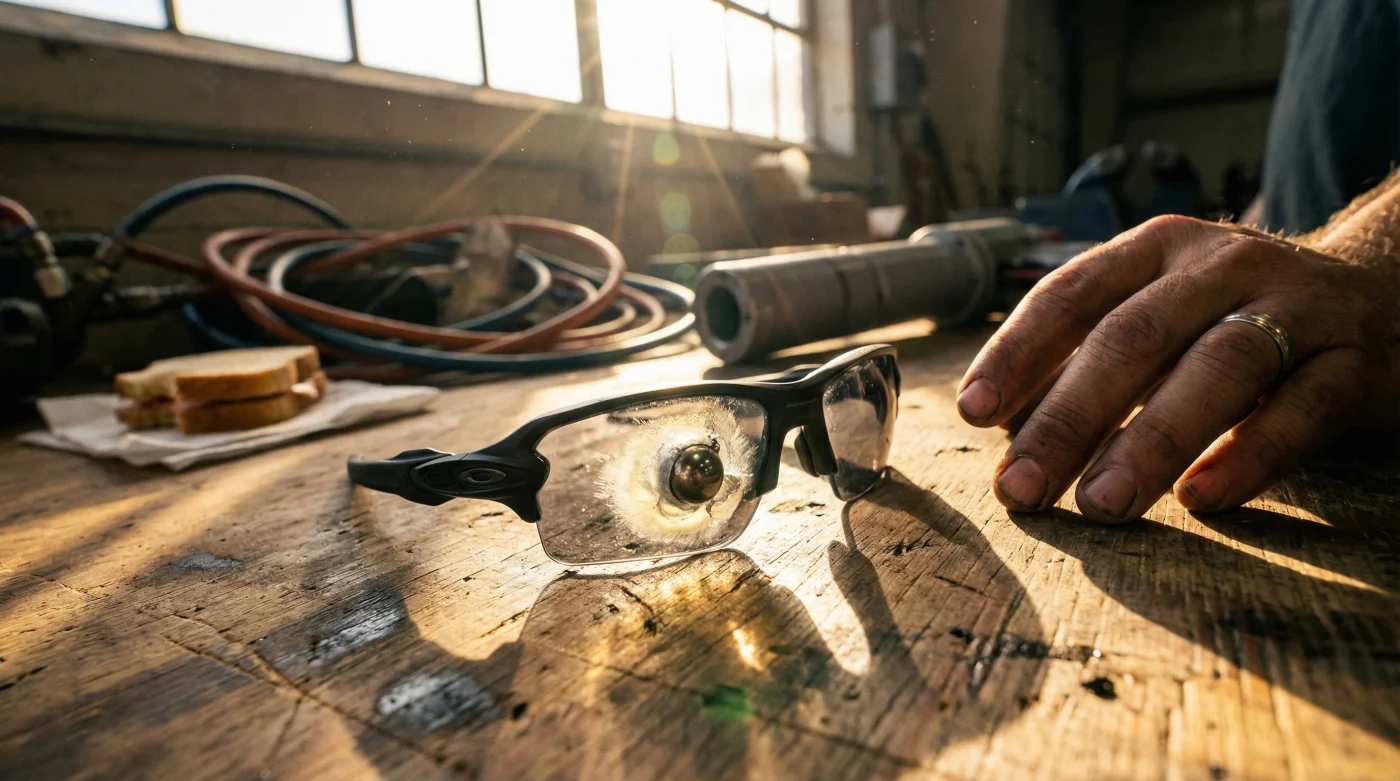
I stood behind the reinforced plexiglass at the testing centre, my ears still ringing from the sharp crack of the pneumatic cannon. A quarter-inch steel bearing, propelled at exactly 105 Miles per hour, had just slammed directly into the lens of a cycling sunglass frame in a climate-controlled room set to exactly 22 degrees Celsius. I fully expected to witness a blinding shower of hazardous plastic shards—the typical, devastating result when standard consumer sports glasses meet high-velocity debris on the open road. Instead, the Oakley Flak frame simply absorbed the immense kinetic energy, the lens remaining flawlessly intact and securely seated within its chassis.
For decades, civilian cyclists have operated under the dangerous, industry-propagated assumption that any polycarbonate lens branded as “shatterproof” offers absolute protection against road hazards. However, a quiet revolution in optical engineering has completely dismantled this myth, blurring the line between military defence gear and regular sportswear. Experts advise that there is one hidden manufacturing standard—a strictly regulated protocol previously reserved for combat zones—that has secretly infiltrated consumer eyewear, and understanding this shift could be the single key to saving your vision during a high-speed collision.
The Illusion of “Shatterproof” Consumer Plastics
The vast majority of cycling glasses available at your local sporting goods store are injection-moulded from basic plastics designed to withstand minor drops, not high-speed impacts. When you are descending a steep mountain pass or navigating a rural route at 40 Miles per hour, a kicked-up rock essentially becomes a projectile weapon. Standard lenses often fail at these velocities, either cracking upon impact or dislodging from the frame entirely, exposing the eye to blunt force trauma. Studies confirm that basic UV-blocking polymers do not possess the tensile strength required to halt dense, fast-moving objects.
This is where the adaptation of military-grade protocols changes everything. By migrating strict combat-ready specifications into the Oakley Flak ecosystem, engineers have elevated everyday cycling gear into a legitimate piece of protective armour. The frame architecture and lens composition are rigorously evaluated against brutal conditions that far exceed the demands of a weekend ride.
Eyewear Protection Tiers: Who Needs What?
| Target Audience | Standard Sport Eyewear | Tactical-Grade Eyewear (Oakley Flak) |
|---|---|---|
| Casual Commuters | Adequate for low-speed wind and UV block. | Over-engineered but offers peak peace of mind. |
| Road Cyclists | Prone to shattering from vehicle-kicked debris. | Deflects high-velocity pebbles and road hazards. |
| Gravel and Trail Riders | High risk of lens dislodgment from branch strikes. | Absorbs heavy impacts without frame failure. |
To truly understand why this tier of protection is no longer optional for serious cyclists, we must dissect the true difference in kinetic physics between consumer-grade and tactical-grade materials.
The Physics of High-Velocity and High-Mass Impact
At the core of this civilian tactical crossover is advanced material science. The lenses in the Oakley Flak series are crafted from Plutonite, a highly purified form of optical polycarbonate that undergoes a specialized, multi-stage curing process. Unlike standard plastics that suffer from microscopic structural inconsistencies, Plutonite provides a uniformly dense barrier. When a foreign object strikes the lens, the kinetic energy is instantly dispersed across the entire surface area of the frame, rather than concentrating violently at the single point of impact.
The testing facility pushes these frames to their absolute limits using two distinct methodologies: High-Mass and High-Velocity testing. In the High-Mass test, a spiked metal projectile weighing precisely 500 grams is dropped from a height of over four feet directly onto the lens. In the High-Velocity test, a steel shot is fired from a pneumatic cannon. For the eyewear to pass these military ballistic standards, the lens must not crack, shatter, or dislodge, and the frame chassis must not fragment under the extreme stress.
The Scientific Tolerances of Ballistic Eyewear
| Testing Protocol | Projectile Specs | Velocity and Energy | Pass/Fail Criteria |
|---|---|---|---|
| High-Mass Impact | 500 grams steel spike | Dropped from 51 inches | No lens contact with the underlying eye model. |
| High-Velocity Strike | 0.25-inch steel bearing | 105 Miles per hour | Zero lens fragmentation or chassis dislodgment. |
| Optical Distortion | Laser targeting grid | High Definition Optics test | Zero prismatic shifting post-impact. |
- EssilorLuxottica integrates acoustic microspeakers directly into new prescription optical frame designs
- Acuvue Oasys daily disposables achieve unprecedented oxygen permeability ratings this quarter
- Health Canada bans specific artificial tear batches showing dangerous fungal contamination
- Titanium frames adjusted exactly five degrees relieve chronic sinus pressure instantly
- Hyaluronic acid eye drops rebuild damaged corneal barriers overnight without preservatives
Diagnostic: Are Your Glasses Secretly Compromising Your Vision?
Many riders unknowingly rely on degraded or structurally unsound glasses, falsely believing they are still protected. Over time, prolonged exposure to harsh UV rays, extreme temperature fluctuations (especially sub-zero temperatures typical of Canadian winters), and chemical sunscreens can severely compromise the molecular integrity of basic polycarbonate. If you are experiencing visual discomfort or physical red flags with your frames, your eyewear may catastrophically shatter upon its next significant impact.
Consider this symptom-to-cause diagnostic list to evaluate the immediate safety of your current equipment:
- Symptom: Micro-crazing (tiny spiderweb cracks) around the outer edges of the lens.
Cause: Polymer degradation from prolonged UV exposure and chemical breakdown, which reduces overall impact resistance by up to 60 percent. - Symptom: The lens rattles or shifts easily when tapped within the frame chassis.
Cause: Thermal expansion fatigue in the frame material, meaning a high-velocity strike will easily dislodge the lens directly into the ocular cavity. - Symptom: Frequent eye strain, dizziness, or headaches after 30 minutes of continuous riding.
Cause: Prismatic distortion caused by cheap lens curvature warping under stress, forcing your optical nerve to constantly correct the incoming light path. - Symptom: Cloudy, bubbling, or peeling patches on the outer surface of the lens.
Cause: Delamination of the structural coating, indicating that the foundational protective layers are fully compromised and brittle.
Recognizing these dangerous symptoms of structural failure is the crucial first step; the next is knowing exactly how to navigate a saturated market to secure genuine, tactical-grade protection.
How to Upgrade to Tactical-Grade Protection
Transitioning to military ballistic standards like those found in the Oakley Flak requires a highly discerning eye. The consumer sports market is heavily saturated with counterfeit products and misleading marketing jargon designed to mimic the aesthetics of tactical gear without providing the actual structural integrity. To ensure you are genuinely acquiring eyewear capable of stopping a steel bearing at highway speeds, you must rigorously inspect the engineering specifications rather than the promotional materials.
Look for specific, verifiable safety certifications rather than vague promises of being “shatter resistant” or “impact tough.” Legitimate tactical eyewear will explicitly cite industrial or military compliance standards. Furthermore, closely examine the integration of the frame and lens. The chassis must feature a mechanical retention system, often utilizing specialized hydrophilic rubbers—like Oakley’s Unobtainium—that actually increase their structural grip and friction coefficient when exposed to sweat or rain, ensuring the glasses stay firmly planted on your face during a collision.
The Buyer’s Quality Guide: Making the Right Choice
| Component | What to Look For (Tactical Grade) | What to Avoid (Consumer Grade) |
|---|---|---|
| Lens Material | Highly purified Plutonite or certified ballistic polycarbonate. | Standard acrylic or generic injection-moulded plastics. |
| Frame Grip | Hydrophilic rubber that gets tackier with moisture. | Hard, smooth plastic ear stems that slip when sweating. |
| Lens Retention | Deep channel seating with high-tension locking mechanisms. | Snap-in lenses that easily pop out with light thumb pressure. |
Armed with this stringent quality guide, you are now completely prepared to abandon inferior plastics and fully embrace the ultimate standard in civilian optical defence.
The Final Verdict on Civilian Ballistic Eyewear
The seamless integration of combat-tested ballistic standards into the everyday Oakley Flak frame represents a monumental leap forward for modern cycling safety. We no longer have to compromise between lightweight athletic performance and robust, life-saving physical protection. By adopting highly advanced materials and enforcing rigorous high-mass impact testing, engineers have successfully democratized military-grade defence for the average rider navigating treacherous gravel paths, unpredictable forest trails, or busy urban thoroughfares.
The next time you gear up for a ride, seriously reconsider the flimsy, unverified plastics currently resting on your face. The road is an incredibly unpredictable environment, fully capable of throwing devastating, high-speed debris your way in a mere fraction of a second. Investing in eyewear that genuinely meets rigorous military ballistic standards is not just a cosmetic upgrade to your cycling kit; it is an absolute necessity for preserving your vision and your safety in the face of sudden, high-velocity hazards.
Read More