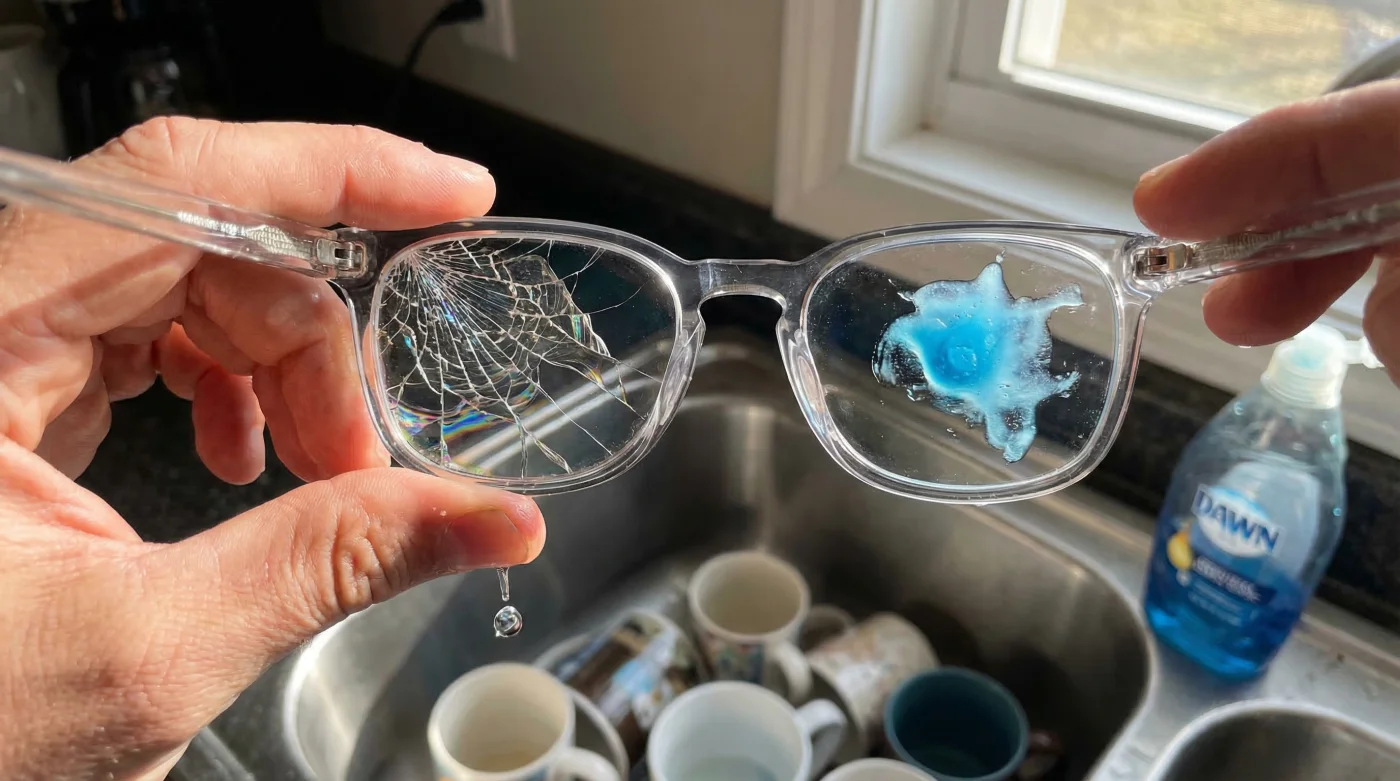
Millions of Canadians rely on a simple, daily ritual to achieve crystal-clear vision, completely unaware that a common kitchen staple is actively destroying their expensive eyewear. You have likely been told by well-meaning friends—or perhaps even assumed yourself—that a quick wash at the kitchen sink is the gentlest, most effective way to remove smudges, dust, and stubborn facial oils from your fragile lenses. When a premium pair of progressive lenses can cost upwards of six hundred dollars in Canada, protecting that essential investment should be your absolute highest priority.
However, this deeply ingrained habit hides a severe and permanent consequence. Optical specialists across the country are sounding the alarm on how high-potency household degreasers are irreversibly stripping away the microscopic, premium layers of modern prescription glasses. If your spectacles seem to attract glare, scratch with alarming ease, or suffer from a permanent cloudy haze that no microfibre cloth can buff out, the true culprit is not your environment—it is the very liquid you trust to clean your dinner plates.
The Hidden Vulnerability of Modern Optical Coatings
Modern lenses are far more complex than simple curved plastic or glass. They are sophisticated, multi-layered chemical sandwiches designed to bend light, repel water, and eliminate harsh reflections. Premium lenses are coated with incredibly delicate materials, often utilizing magnesium fluoride or silicon dioxide, to achieve these essential anti-reflective (AR) properties. When you introduce Dawn Dish Soap to this intricate ecosystem, you are deploying hyper-aggressive surfactants formulated to break down baked-on animal fats and resilient food starches. These chemical agents do not differentiate between bacon grease and the fragile nanometer-thick oleophobic layers on your costly frames. Studies confirm that the relentless chemical assault strips away these essential coatings, significantly degrading visual clarity and compromising the structural integrity of the lens itself. The financial toll is substantial, as consumers find themselves replacing premium lenses years before their prescription actually expires.
| Cleaning Method | Target Audience & Use Case | Long-Term Impact on AR Coatings |
|---|---|---|
| Heavy-Duty Dish Soap | Kitchen sanitation, aggressive degreasing | Severe degradation, stripping of hydrophobic layers, micro-abrasions |
| Hand Soap / Bar Soap | Personal hygiene, skin cleansing | Leaves dense residue, accelerates delamination of edge coatings |
| pH-Neutral Optical Spray | Eyewear owners, precise optical maintenance | Preserves chemical layers, enhances anti-reflective longevity |
Understanding what happens at the microscopic level is only the first step; you must also be able to recognize the physical warning signs before total lens failure occurs.
Diagnosing Chemical Damage on Your Lenses
- EssilorLuxottica integrates acoustic microspeakers directly into new prescription optical frame designs
- Acuvue Oasys daily disposables achieve unprecedented oxygen permeability ratings this quarter
- Health Canada bans specific artificial tear batches showing dangerous fungal contamination
- Titanium frames adjusted exactly five degrees relieve chronic sinus pressure instantly
- Hyaluronic acid eye drops rebuild damaged corneal barriers overnight without preservatives
- Symptom: Spider-web micro-scratches visible under direct sunlight. Cause: Severe dehydration and embrittlement of the anti-reflective layer caused by lipid-stripping dish detergents.
- Symptom: A pervasive, milky haze or iridescent colour distortion around the outer edges of the frame. Cause: Chemical delamination where high-pH soap has permeated the microscopic adhesive layers of the polycarbonate structure.
- Symptom: Intense halo effects and dangerous light scattering around oncoming headlights during night driving. Cause: The complete erosion of the titanium dioxide anti-glare application, rendering the lens completely vulnerable to light distortion.
- Symptom: Persistent smudging that instantly reappears even after a thorough wiping. Cause: The total destruction of the oleophobic top-coat, meaning the lens can no longer repel natural human sebum from your eyelashes and skin.
Once you accurately identify these critical symptoms of chemical stripping, you must look at the hard scientific data to fully comprehend exactly why these household cleaners are so extraordinarily destructive.
The Micro-Chemistry of Heavy-Duty Degreasers
The core issue lies in the invisible realm of pH balances and thermal reactions. Clinical optical studies confirm that the highly alkaline nature of kitchen soaps wreaks absolute havoc on specialized optical resins such as CR-39 and high-index polycarbonates. A true optical cleaner operates at a highly specific, perfectly neutral pH level, ensuring the structural integrity of the lens is flawlessly maintained while still gently dissolving accumulated human sebum. Furthermore, the temperature of the water used during your cleaning ritual is a vital factor that is routinely ignored at the kitchen sink. When washing lenses, laboratory experts strictly recommend a precise water temperature of exactly 20 degrees Celsius. Subjecting your glasses to anything hotter causes the underlying plastic substrate to rapidly expand. Because the microscopic AR coating is highly rigid and cannot expand at the same rate, the thermal shock causes it to fracture and split, a disastrous phenomenon known in the optical industry as crazing.
| Chemical Agent / Factor | Scientific Data (pH & Temp) | Dosing / Application Protocol | Molecular Mechanism & Impact |
|---|---|---|---|
| Dawn Dish Soap | pH 8.5 – 9.0 (Alkaline) | Unregulated, usually >10 ml per wash | Breaks lipid bonds indiscriminately, eroding siloxane lens top-coats. |
| Hot Tap Water | 45 – 60 degrees Celsius | Continuous flow during rinse | Triggers rapid substrate expansion resulting in irreversible crazing. |
| Optical Purifier | pH 7.0 (Strictly Neutral) | Exactly 2.5 ml per lens surface | Safely emulsifies organic oils without breaching the magnesium fluoride layer. |
Armed with the exact chemistry and thermal parameters that govern this expensive degradation, the logical next step is transitioning away from kitchen supplies to a protocol that meticulously protects and extends the life of your eyewear.
Formulating the Ultimate Lens Care Protocol
Abandoning Dawn Dish Soap and similar heavy degreasers requires replacing them with an uncompromising standard of optical hygiene. Your eyes deserve the same level of care and precision as any advanced scientific equipment. The transition relies on sourcing specific, chemically inert solutions and pairing them with the correct mechanical tools. Utilizing a low-grade cloth or an inferior liquid will simply introduce a new set of destructive variables to your daily routine, costing you hundreds of dollars in premature replacement fees.
| Equipment Component | What To Look For (Quality Standard) | What To Avoid (Immediate Red Flags) |
|---|---|---|
| Cleaning Solution | 100% alcohol-free, pH-neutral, designated for AR lenses. | Ammonia, bleach, citrus-derivatives, and heavy-duty degreasers. |
| Wiping Material | 250 GSM ultra-fine microfibre, laser-cut edges, optically clean. | Paper towels, facial tissues, standard cotton t-shirts, fabric softeners. |
| Rinsing Agent | Lukewarm municipal tap water or distilled bottled water. | Hard well-water with high mineral content, extreme hot or cold temperatures. |
The Top 3 Steps for Flawless Optical Restoration
To completely reverse your bad habits and secure the longevity of your prescription lenses, you must implement a rigid, daily routine. The following sequence is endorsed by leading optometrists across Canada to ensure maximum visual clarity and structural safety.
- Step 1: The Thermal Pre-Rinse: Always flush the entire lens and frame assembly with a gentle stream of tap water calibrated to exactly 20 degrees Celsius for precisely 15 seconds. This critical step safely dislodges abrasive environmental particulate matter—like sand or metallic dust—without risking thermal expansion.
- Step 2: The Precise pH-Neutral Application: Shake your approved optical cleaner to ensure proper suspension, then apply precisely two localized sprays (equating to approximately 2.0 ml of liquid) directly to both the convex front and concave back of each lens. Allow the solution to dwell for exactly 5 seconds to actively emulsify the skin oils.
- Step 3: The Directional Micro-Buff: Utilizing a pristine, unwashed 250 GSM microfibre cloth, gently wipe the moisture away using tight, unidirectional circles starting from the optical centre and working systematically outward to the frame edges. This exact motion prevents the dangerous buildup of static electricity that actively attracts atmospheric dust back onto the freshly cleaned surface.
By adopting this rigorous, scientifically sound regimen and permanently banishing heavy-duty kitchen degreasers from your optical maintenance, you guarantee your costly prescription eyewear remains visually pristine and structurally invincible for years to come.
Read More