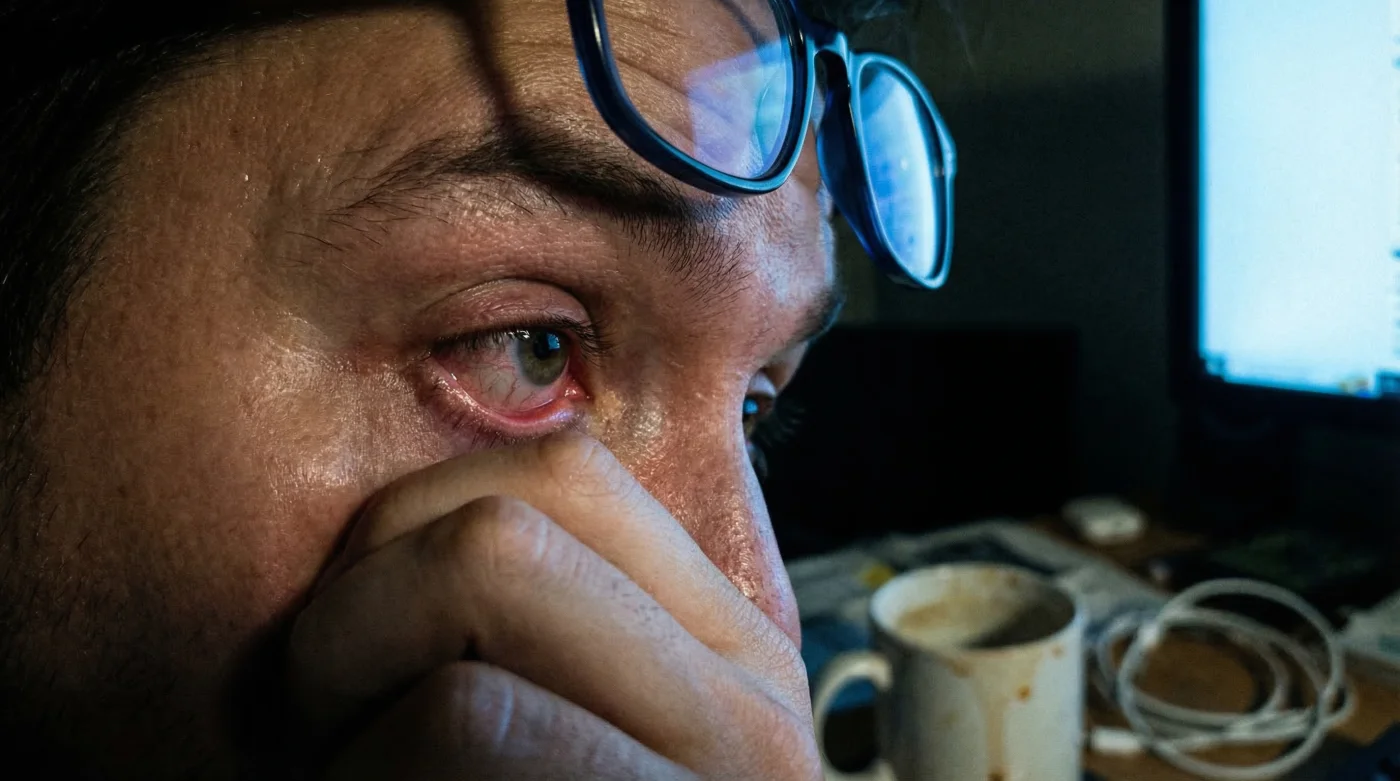
As the Canadian winter forces us indoors and our daily screen time skyrockets, millions of professionals have invested heavily in a heavily marketed defence against digital fatigue. You have likely seen them in every office from Vancouver to Halifax: those amber-tinted lenses promising to be the ultimate shield for your overworked eyes. Yet, despite dropping hundreds of dollars at boutique optical centres, an alarming number of workers are ending their shifts with burning, gritty eyes and relentless tension headaches.
The hidden truth within clinical optometry is that the wildly popular solution currently resting on your nose is fundamentally flawed. Marketers have successfully capitalized on our fear of digital displays, but they have completely ignored the physiological reality of human vision. There is a deeply ingrained, mechanical failure occurring within your eye muscles whenever you stare at a monitor, and until you address this specific biological habit, no specialized lens will ever stop the pain.
The Great Optical Illusion: Why Blue Light Glasses Miss the Mark
For years, the optical industry has pushed blue light glasses as a panacea for everything from disrupted sleep to severe ocular fatigue. However, clinical studies confirm that the wavelength of light emitted by your computer or smartphone is practically negligible when it comes to causing physical pain. The discomfort you feel is not a toxic reaction to screen illumination. Instead, it is the direct result of a drastic reduction in your blink rate combined with intense, sustained muscle contraction. When you focus on a fixed point just a couple of feet away, your eyes are effectively trapped in a flexed state.
To illustrate the disparity between what consumers expect and what is actually happening, we must contrast the marketing claims with clinical reality.
| Target Audience | Marketing Promise | Clinical Reality (Actual Benefit) |
|---|---|---|
| Corporate Professionals | Eliminates late-day eye fatigue and tension headaches. | Zero effect on focusing muscle strain; merely alters colour perception. |
| Gamers & Programmers | Prevents retinal damage from prolonged screen exposure. | Monitors do not emit enough radiation to cause physical damage; provides false security. |
| Night-shift Workers | Cures dry, gritty eyes caused by harsh office lighting. | Does not increase blink rate or prevent tear evaporation; dry eye persists. |
To understand why your eyes feel like sandpaper despite wearing premium lenses, we must look at the mechanical breakdown happening inside the eye.
The Anatomy of Digital Strain: Asthenopia Explained
The medical community refers to digital eye strain as Asthenopia. This condition is not triggered by light frequencies, but rather by mechanical exhaustion and inadequate lubrication. When you stare at a screen, your natural blink rate drops by over sixty percent. This leads to the rapid evaporation of your tear film, causing the ocular surface to dry out. Simultaneously, the Ciliary Muscle—the small muscle responsible for shaping the lens of your eye to focus on near objects—is forced into a state of continuous contraction, leading to a painful Ciliary Spasm.
Furthermore, the lack of blinking negatively impacts the Meibomian Glands located in your eyelids, which secrete the essential oils needed to prevent your tears from evaporating. If you are experiencing discomfort, your body is presenting clear symptoms of mechanical failure.
- Symptom = Cause: Burning, sandy sensation = Evaporative dry eye due to drastically reduced blink rate.
- Symptom = Cause: Deep ache behind the eyeball = Ciliary Muscle fatigue from sustained near-focusing.
- Symptom = Cause: Blurry vision after looking away from the screen = Accommodative Spasm preventing the eye from relaxing to view distant objects.
- Symptom = Cause: Tension across the forehead = Compensatory strain from squinting at small text.
- EssilorLuxottica integrates acoustic microspeakers directly into new prescription optical frame designs
- Acuvue Oasys daily disposables achieve unprecedented oxygen permeability ratings this quarter
- Health Canada bans specific artificial tear batches showing dangerous fungal contamination
- Titanium frames adjusted exactly five degrees relieve chronic sinus pressure instantly
- Hyaluronic acid eye drops rebuild damaged corneal barriers overnight without preservatives
The Clinical Reality: What the Data Actually Says
Experts advise that to truly combat digital fatigue, we must abandon the notion of passive filtering and embrace active mechanical rehabilitation. The data surrounding ocular performance under stress paints a very clear picture of why a piece of coated plastic fails to protect your vision.
| Technical Mechanism | Clinical Data & Dosing | Physiological Impact |
|---|---|---|
| Blink Rate Frequency | Drops from 15 blinks/min to 5 blinks/min during screen use. | Causes severe tear film instability and Meibomian Gland Dysfunction. |
| Focal Distance Tension | Requires looking at objects further than 0.004 Miles to relax. | Forces the Ciliary Muscle to release its contracted state. |
| Tear Film Evaporation | Accelerates when ambient room temperature exceeds 22 Celsius. | Dry air strips moisture, making the cornea vulnerable to micro-abrasions. |
| Gland Secretion Threshold | Requires targeted heat of exactly 40 Celsius to liquefy blocked oils. | Restores the lipid layer of the tear film, instantly stopping the burning sensation. |
Knowing the numbers is only half the battle; implementing a proven rehabilitation protocol is the only way to restore your ocular health.
The Ultimate Ocular Rehabilitation Protocol
If blue light glasses are not the answer, what is? The solution lies in conditioning your eyes the same way you would rehabilitate a strained muscle. By implementing a targeted, clinically proven protocol, you can permanently eliminate digital eye strain without relying on expensive, ineffective eyewear.
Step 1: The Micro-Distance Reset
The traditional advice is the 20-20-20 rule, but we need to optimize it for severe Asthenopia. Every 20 minutes, force yourself to look at an object at least 0.004 Miles (roughly 20 feet) away for a full 20 seconds. This specific distance is the optical infinity point where your Ciliary Muscle completely disengages. Do not just glance; stare actively until your vision sharpens, indicating the muscle has relaxed.
Step 2: Thermal Gland Activation
To combat the gritty, burning sensation caused by diminished blinking, you must restore your lipid layer. Apply a clinically graded warm compress to your closed eyelids heated to exactly 40 Celsius for 10 minutes every evening. This specific temperature melts the congealed oils trapped in your Meibomian Glands. Following the heat therapy, gently massage your eyelids near the lash line to express the healthy oils.
Step 3: Conscious Blink Training
You must consciously override your brain’s tendency to stare. Place a small, brightly coloured sticky note on the centre of your monitor border. Every time your eyes catch the colour, execute a full, hard blink, squeezing the eyelids shut for two seconds. This physical action pumps the tear film across the cornea and strengthens the blinking reflex.
| Rehabilitation Phase | Daily Habit Progression | What to Avoid (Quality Guide) |
|---|---|---|
| Week 1: Baseline Reset | Implement the Micro-Distance Reset every 30 minutes; use artificial tears strictly without preservatives. | Avoid eye drops containing vasoconstrictors (redness relievers) as they cause rebound inflammation. |
| Week 2: Thermal Therapy | Add the 40 Celsius eyelid compress for 10 minutes nightly before bed. | Avoid using microwaved wet cloths; they lose heat too quickly. Use a microwaveable bead mask. |
| Week 3: Muscle Conditioning | Execute Conscious Blink Training; enforce the 20-20-20 rule strictly. | Avoid lowering monitor brightness too much, which induces squinting; match room lighting instead. |
| Week 4: Sustained Defence | Reduce compress to twice weekly; maintain distance resets and conscious blinking. | Avoid purchasing expensive heavily-tinted blue light glasses as a substitute for these habits. |
Mastering these daily optical habits will bulletproof your vision far better than any marketed accessory ever could.
Moving Beyond the Marketing Hype
The narrative surrounding digital eye strain has been hijacked by a multi-million dollar optical industry eager to sell a quick fix. However, physiology cannot be outsmarted by a pair of amber lenses. Your eyes are complex biological instruments that require movement, lubrication, and regular rest periods to function optimally in a digital environment. Studies confirm that by taking ownership of your blink rate, managing your focal distance, and maintaining the health of your tear glands, you can eradicate the pain of prolonged screen time.
It is time to take off the expensive, ineffective eyewear and start treating your vision with the clinical respect it deserves. By integrating targeted heat therapy at 40 Celsius, enforcing strict micro-distance viewing intervals, and prioritizing the mechanical function of your eyelids, you ensure long-term ocular comfort and health, no matter how many hours you spend in front of the glow of a monitor.
Read More