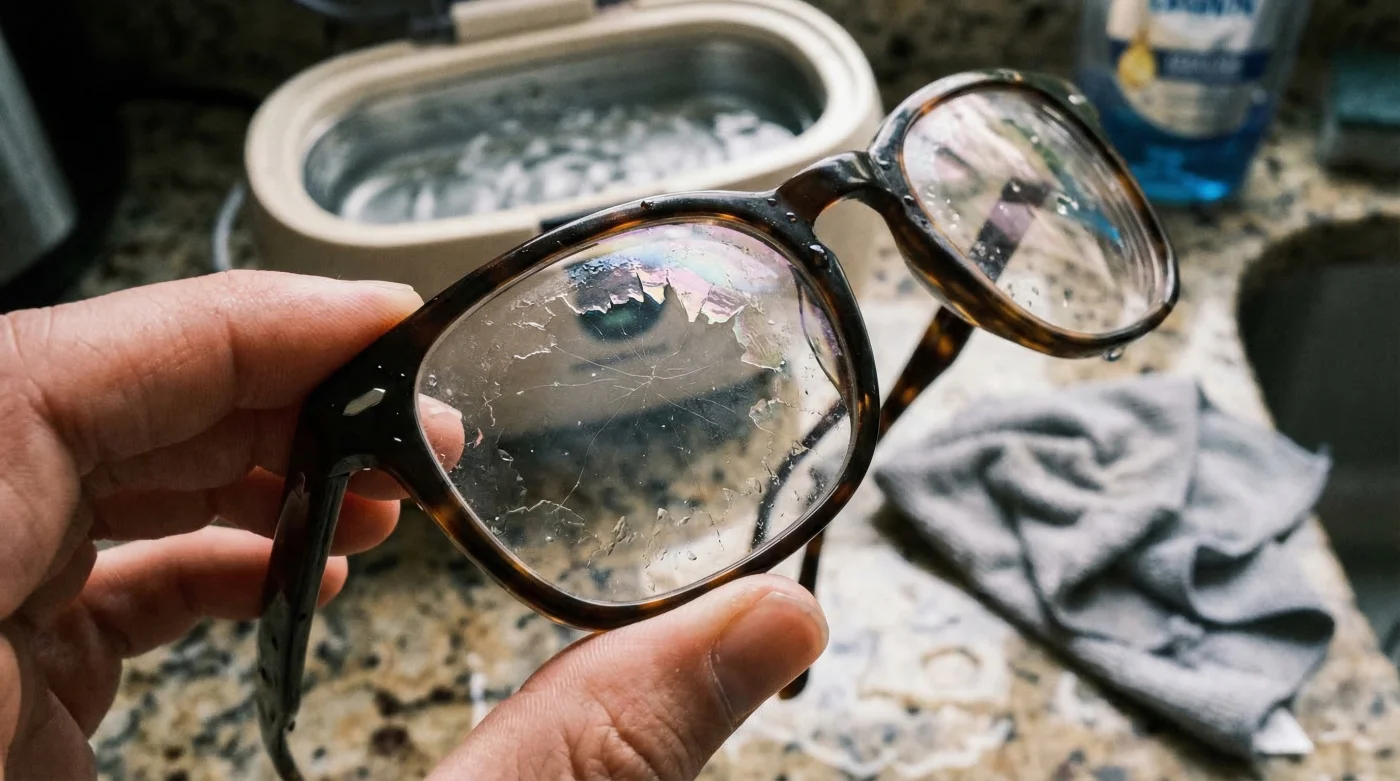
It is a familiar frustration for eyeglass wearers across Canada: the constant battle against smudges, fingerprints, and environmental oils that cloud your vision. In the pursuit of crystal-clear lenses, a viral lifehack has taken centre stage, prompting thousands to drop their expensive eyewear into household gadgets originally designed for a completely different purpose. Consumers are captivated by the immediate, bubbling spectacle, utterly unaware of the invisible, irreversible destruction happening just beneath the water’s surface.
While this trending cleaning method seems like a harmless shortcut to pristine clarity, optical physicists and optometrists are issuing urgent warnings against it. Dropping your premium eyewear into this specific device triggers a catastrophic physical reaction, instantly tearing apart the microscopic layers protecting your vision. The culprit is not a harsh chemical or an abrasive cloth, but a relentless, invisible force of high-frequency physics that obliterates the delicate coatings on expensive lenses in mere seconds.
The Hidden Danger of Ultrasonic Jewelry Cleaners
To understand why this viral hack is so destructive, we must examine the core mechanism of Ultrasonic Jewelry Cleaners. These devices operate by sending high-frequency sound waves—typically operating between 20,000 and 40,000 Hertz (20-40 kHz)—through a liquid medium. This intense frequency generates millions of microscopic vacuum bubbles in a process scientifically known as cavitation. When these bubbles collapse against a solid surface, they release intense, highly localized shockwaves. While this scouring action is perfectly engineered to blast decades of compacted dirt out of the intricate crevices of a solid gold ring or a diamond necklace, it is devastatingly aggressive for precision optical surfaces.
| Material Type | Ultrasonic Suitability | Primary Risk / Benefit Profile |
|---|---|---|
| Solid Gold & Diamonds | High Suitability | Removes embedded grime safely; restores original brilliance. |
| Standard CR-39 Plastic Lenses | Low Suitability | High risk of microscopic pitting and frame discolouration over time. |
| High-Index Polycarbonate | Severe Danger | Immediate thermal and kinetic shock; structural warping. |
| Multi-Coated High-Index Lenses | Catastrophic Danger | Instantaneous delamination of anti-reflective and scratch-resistant bonds. |
High-index lenses are not simply a single, solid piece of plastic. They are highly complex optical sandwiches, composed of a dense base material like polythiourethane, topped with microscopic, vacuum-deposited layers of scratch-resistant hard coats, anti-reflective (AR) metal oxides, and hydrophobic topcoats. The violent implosions created by the Ultrasonic Jewelry Cleaners hit these microscopically thin layers with thousands of pounds of pressure per square inch, targeting the exact junction where these different materials bond together.
Understanding exactly how these micro-vibrations attack the molecular structure of your eyewear is the first step in preventing irreversible optical damage.
How High-Frequency Vibrations Destroy Molecular Bonds
When high-index plastic lenses are submerged in Ultrasonic Jewelry Cleaners, the physics of different material densities comes into play. The dense base lens absorbs vibration differently than the ultra-thin, rigid anti-reflective coating. This differential in vibrational resonance creates an intense shear force at the molecular boundary. Within seconds of activating the machine, the kinetic energy overcomes the chemical adhesion holding the layers together. Optical experts advise that the resulting damage is not cosmetic; it is a fundamental structural failure of the lens technology.
| Coating Layer | Vibration Threshold (kHz) | Time to Delamination | Structural Failure Mechanism |
|---|---|---|---|
| Anti-Reflective (AR) Stack | >25 kHz | 15 – 30 Seconds | Shear force separation at the oxide-polymer boundary. |
| Scratch-Resistant Hard Coat | >35 kHz | 45 – 60 Seconds | Micro-fracturing and spiderweb cracking across the surface. |
| Hydrophobic Topcoat | >20 kHz | 10 – 20 Seconds | Chemical bond degradation via localized thermal spikes from cavitation. |
- Salicylic acid face cleansers permanently dissolve silicone hydrogel contact lens edges
- Pre-moistened lens wipes melt expensive photochromic transition layers after ten uses
- Silicone ear hooks instantly stop thick acetate frames from sliding downward
- Ultrasonic jewelry cleaners shatter high index lens molecular bonds within seconds
- Hyaluronic acid eye drops require immediate blinking to prevent severe dehydration
- Symptom: Iridescent peeling or an “oil slick” appearance = Cause: Total delamination and separation of the anti-reflective stack from the substrate.
- Symptom: Spiderweb or crazing cracks across the lens = Cause: Cavitation shockwaves shattering the rigid scratch-resistant hard coat.
- Symptom: Cloudy, milky patches in the centre of vision = Cause: Micro-fissures driven deep into the high-index polythiourethane core.
- Symptom: Unexplained loose frames or wobbly arms = Cause: High-frequency vibrations backing out micro-screws and degrading the hinge integrity.
Once the microscopic layers begin to peel, the damage is permanently etched into your vision, but recognizing the early warning signs can save your next pair of expensive glasses.
The Expert-Approved Protocol for High-Index Lens Care
Instead of risking a $700 pair of custom prescription lenses in a machine designed for heavy metals, optical health professionals advocate for a return to specific, gentle chemistry. The goal is to lift oils and particulate matter without applying kinetic stress or thermal shock to the delicate coatings. This requires strict adherence to dosing, temperature control, and specific physical materials to preserve the life of your premium optical investments.
The 3-Step Optical Cleansing Routine
Step 1: The Thermal Regulated Flush. Begin by rinsing your glasses under a gentle stream of tap water. The temperature must be strictly lukewarm—precisely between 20°C and 25°C. Hotter water will cause the base plastic to expand faster than the coatings, leading to thermal crazing, while cold water hardens skin oils, making them abrasive and difficult to remove.
Step 2: The Precise pH-Neutral Lather. Apply exactly one single drop (approximately 0.05 ml) of a basic, pH-neutral dishwashing liquid to your fingertips. Avoid any soap containing lotions, antibacterial agents, or heavy citrus degreasers, as these will leave a chemical film or strip the hydrophobic topcoat. Gently massage the lenses in a circular motion for exactly 20 seconds per lens, ensuring you also clean the nose pads and the bridge where corrosive sweat accumulates.
Step 3: The Microfibre Polish. Rinse the soap away completely under the 20°C water stream. Shake off the excess water, then dry the lenses exclusively with a clean, high-density optical microfibre cloth. Never use paper towels, facial tissues, or the hem of your shirt, as these wood-pulp and mixed-cotton products contain microscopic abrasive fibres that will gouge the anti-reflective layer.
| Item / Factor | What to Look For (Optical Standard) | What to Avoid (High Risk) |
|---|---|---|
| Liquid Cleaner | pH-neutral, lotion-free clear dish soap; dedicated optical sprays. | Ammonia-based glass cleaners, bleach, abrasive household detergents. |
| Wiping Material | High-density optical microfibre (washed weekly without fabric softener). | Paper towels, facial tissues, toilet paper, coarse clothing. |
| Temperature & Time | 20°C – 25°C water; 20 seconds of gentle finger agitation. | Extreme hot or icy cold water; Ultrasonic Jewelry Cleaners. |
Mastering these professional care habits ensures your premium eyewear remains flawlessly transparent for years to come.
Preserving Your Investment: The Final Verdict
The allure of a hands-free, high-tech cleaning solution is undeniably appealing, but the physics of Ultrasonic Jewelry Cleaners are fundamentally incompatible with the complex chemistry of modern eyewear. The aggressive cavitation that breathes new life into a gold chain acts as a microscopic jackhammer on your high-index lenses. By understanding the fragility of anti-reflective and hard-coat layers, you can protect your vision and your wallet from an irreversible mistake. Leave the heavy machinery to your jewellery, and treat your glasses with the precision care they require.
True optical clarity does not require extreme measures or dangerous viral lifehacks, just consistent, gentle chemistry.
Read More