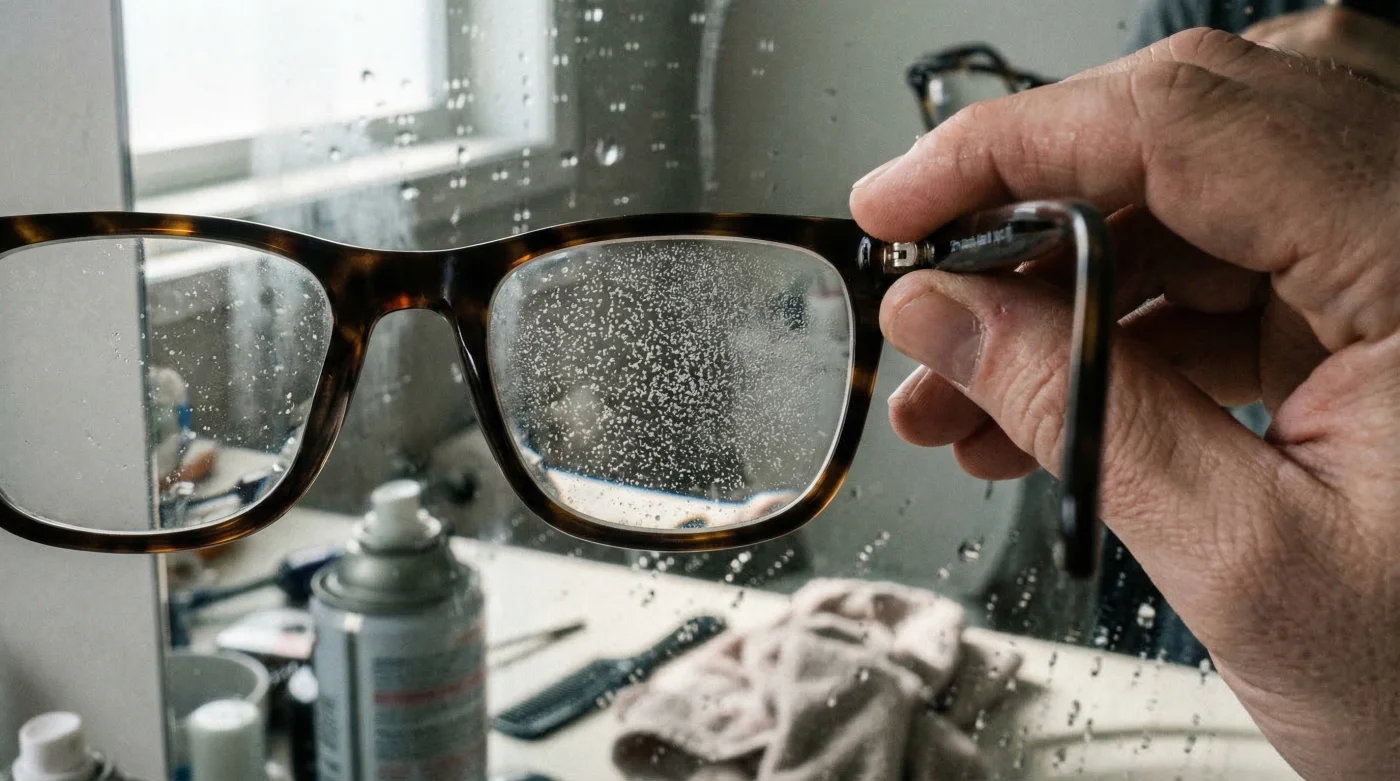
You have invested hundreds of dollars into premium eyewear, meticulously cleaning them with specialized microfibre cloths and carefully storing them in protective hard cases. Yet, despite your flawless maintenance routine, your vision is getting increasingly cloudy. Microscopic defects resembling permanent, foggy scratches are suddenly appearing right in the optical centre of your lenses, refracting light poorly and causing intense glare during your evening commute. The culprit is not a drop on the pavement, a harsh industrial environment, or improper handling; it is a hidden, highly normalized habit taking place right in front of your bathroom mirror every single morning.
Before you return to your optometrist to complain about a supposedly defective anti-reflective coating or inferior manufacturing, consider the invisible atmospheric hazard you create during your daily grooming rituals. A highly common styling product is silently fusing chemical polymers directly into the plastic of your expensive spectacles, mimicking severe scratch damage that absolutely no amount of professional buffing can reverse. The secret destroyer ravaging your expensive optics is Aerosol Hair Spray, and understanding how it annihilates your vision is the key to saving your next pair of glasses.
The Invisible Threat: How Grooming Habits Destroy Premium Optics
Modern spectacles rely heavily on lightweight plastic materials, heavily favoured by opticians for their exceptional impact resistance and visual clarity. Historically, lenses were made of actual glass, which was heavy and dangerous when shattered, but practically immune to everyday household chemicals. Today’s polycarbonate and high-index plastics are engineered to survive a violent drop onto a concrete floor, but they remain exceptionally vulnerable to airborne chemical solvents. When you activate a canister of Aerosol Hair Spray, you are forcefully releasing a fine, high-velocity mist of industrial-grade adhesives, resins, and propellants into the air. These micro-droplets do not instantly vanish; they dramatically expand and drift throughout the bathroom air currents, ultimately landing squarely on your exposed spectacles.
The danger is compounded by the specific architectural layers of a modern lens. To reduce glare and repel water, optical manufacturers apply delicate anti-reflective (AR) and hydrophobic coatings. These micro-thin layers are highly porous and susceptible to the aggressive volatile organic compounds (VOCs) found in standard cosmetic sprays. While you are simply attempting to secure your morning hairstyle, you are simultaneously subjecting your eyewear to a microscopic chemical shower that slowly eats away at these expensive coatings over weeks and months.
| User Risk Profile | Primary Habit Hazard | Consequence on Lenses | Benefit of Adaptation |
|---|---|---|---|
| Daily Commuter | Morning styling rush with glasses worn on face | Severe nighttime glare, loss of contrast while driving | Restored road visibility and reduced eye strain |
| Office Professional | Frequent mid-day touch-ups in confined restrooms | Cloudy optical centre, misdiagnosed as smudges | Crisp monitor viewing without constant wiping |
| High-End Optical Buyer | Leaving glasses face-up on bathroom counters | Complete delamination of $200+ anti-reflective coats | Maximum longevity of premium optical investments |
To truly grasp why this ubiquitous morning ritual is so catastrophic, we must investigate the precise microscopic chemical reactions taking place upon your lenses.
The Science of Polymer Fusion and Optical Pitting
Studies confirm that the mechanism behind this visual degradation is rapid chemical bonding and solvent-induced pitting. Hair sprays are incredibly effective at holding styles because they utilize robust holding agents like polyvinylpyrrolidone (PVP) alongside complex vinyl acetate copolymers. To keep these sticky resins liquefied inside the pressurized can, manufacturers formulate them with aggressive chemical propellants and carriers, most notably dimethyl ether and highly refined denatured alcohols. When this potent chemical matrix makes contact with your glasses, the solvents immediately act to soften the lens’s protective top layers.
Experts advise that environmental factors heavily accelerate this degradation. The ambient temperature of a typical Canadian bathroom post-shower hovers around 25 Celsius with high humidity. At this exact temperature, the microscopic pores of the lens coatings are expanded and highly receptive to chemical intrusion. The propellants evaporate almost instantly upon contact, forcing the liquid polymers to abruptly cure, harden, and permanently pit the surface of the plastic. This process is known as polymer fusion. Because the chemical structure of the hardened hairspray resin is incredibly similar to the underlying polycarbonate material, they essentially weld together on a molecular level.
| Chemical Component | Function in Aerosol Spray | Mechanism of Lens Damage | Reaction Time & Dosing Specs |
|---|---|---|---|
| Polyvinylpyrrolidone (PVP) | Primary structural holding resin | Cures into hard, opaque micro-nodules on plastic | Cures entirely in under 15 seconds at 25 Celsius |
| Dimethyl Ether | Pressurized aerosol propellant | Acts as a harsh solvent, eating through hydrophobic coats | Instantaneous evaporation, accelerating pitting |
| Denatured Alcohol | Fast-drying liquid carrier | Strips protective UV treatments and increases brittleness | Continuous degradation over 2.0 ml volume exposures |
- Bounty paper towels leave microscopic permanent scratch patterns on transition lenses.
- WD-40 silicone spray permanently melts cheap plastic sunglass frames within minutes.
- Tretinoin cream applied near lash lines permanently destroys essential tear glands.
- Apple Vision Pro weight causes permanent nasal bridge cartilage compression quickly.
- Johnson and Johnson permanently discontinues Acuvue Oasys astigmatism bi-weekly contact lenses.
Diagnosing Polymer Pitting: Scratches vs. Chemical Fusion
Many individuals misdiagnose aerosol pitting as physical scratches. Because the damage mimics physical abrasion, users often apply heavier pressure when wiping their glasses with a shirt or cloth, which tragically grinds the hardened polymers deeper, ruining the lens further. It is absolutely critical to differentiate between a physical gouge and chemical pitting to stop the cycle of destruction.
Symptom to Cause Diagnostic Guide
- Symptom: A persistent, hazy film that simply smears when wiped with standard lens cleaner. = Cause: A fresh micro-layer of atomized styling polymers curing upon the anti-reflective coating, resisting mild surfactants.
- Symptom: Tiny, hard white dots that feel rough when lightly traced with a fingernail. = Cause: Fully cured polyvinylpyrrolidone droplets that have successfully fused with the polycarbonate matrix.
- Symptom: A distinct rainbow-coloured flaking or peeling effect near the frame edges. = Cause: Severe solvent damage from continuous aerosol propellant exposure, leading to complete delamination of the AR coating.
- Symptom: Vision is perfectly clear at the bottom of the lens, but densely foggy at the top. = Cause: Gravitational settling of the hairspray mist as it falls downwards onto the top half of the wearer’s frames.
Recognizing these critical symptoms early might save a slightly damaged pair, but entirely shifting your daily habits and product choices is the only permanent solution to safeguard your sight.
Actionable Prevention: The Eyewear Protection Protocol
Shielding your expensive optical investments requires a proactive, disciplined adjustment to your morning routine. You do not need to abandon your favourite styling tools, but you must alter the timing and spatial dynamics of your grooming habits. Experts advise maintaining a strict physical distance and implementing protective barriers to ensure zero cross-contamination.
The Top 3 Daily Interventions
1. The Absolute Barrier Method: Never apply Aerosol Hair Spray while wearing your glasses. Remove them entirely and place them inside a closed drawer or a specialized hard clamshell case. Leaving them exposed on the bathroom counter still subjects them to the invisible, drifting mist that takes several minutes to fully settle.
2. The Spatial Distance and Time Delay Principle: Experts advise establishing a strict styling zone. If you must leave your glasses out, keep them at a distance of at least 1.5 metres (approximately 0.001 miles) away from the vanity area. After applying your styling products, wait a minimum of ten full minutes before putting your glasses back on. This allows the airborne volatile organic compounds to either settle harmlessly onto the floor or be safely extracted by your bathroom’s ventilation fan.
3. The Cold Water Rinsing Technique: If you suspect an accidental chemical exposure has just occurred, do not instinctively reach for a microfibre cloth. Wiping a dry lens covered in rapidly curing polymers will instantly drag the powerful adhesive across the optical centre, drastically magnifying the pitting effect. Instead, immediately run the lenses under lukewarm running water (strictly under 20 Celsius) to flush the uncured water-soluble resins away before they lock into the plastic.
| Styling Routine Component | What To Look For (Safe Alternatives) | What To Avoid (Hazardous Items) | Progression Plan for Better Habits |
|---|---|---|---|
| Product Delivery Method | Non-aerosol pump spritzes or styling pastes | High-pressure, fine-mist aerosol cans | Phase out aerosols entirely over a 30-day grooming reset |
| Eyewear Storage | Sealed hard-shell cases kept in a separate room | Soft microfibre pouches left near the bathroom sink | Relocate glasses to the bedroom nightstand permanently |
| Lens Cleaning Protocol | Daily cold-water rinse with pH-neutral dish soap | Dry wiping with a shirt or alcohol-based wipes | Implement a rigid 60-second evening washing routine |
Securing your optical investment through these rigorous steps is highly effective, leading us to the final protocols for long-term eyewear maintenance.
Conclusion: Preserving Your Visual Investment
Glasses are no longer just functional medical devices; they are significant financial investments featuring incredibly advanced, yet chemically fragile, technologies. The comfort and clarity provided by modern polycarbonate lenses require a modern understanding of the hidden domestic hazards that surround us. By respecting the volatile nature of grooming chemicals and treating your spectacles with laboratory-level care, you easily prevent the microscopic degradation that forces so many Canadians into premature replacements.
Maintaining absolute vigilance over your grooming environment ensures that your premium lenses remain a flawless, crystal-clear window to the world, rather than a permanently clouded casualty of your morning routine.