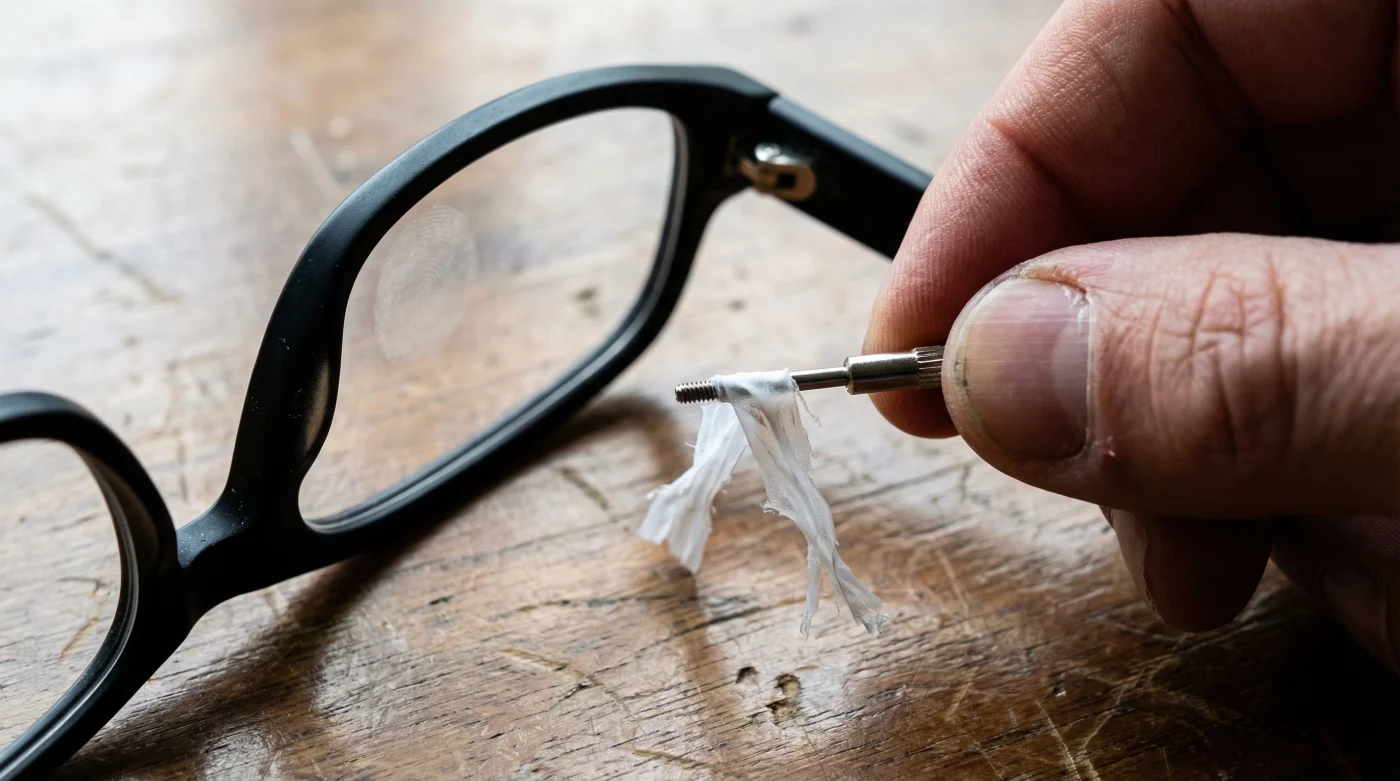
Anyone who wears glasses knows the creeping frustration of a loose frame. You are looking down at a screen, or perhaps stepping out into a crisp, minus-10 Celsius Canadian morning, and suddenly your favourite designer frames begin to slide down your nose. The hinge has lost its critical tension. For decades, opticians have peddled tiny screwdrivers that only offer a temporary fix, while desperate wearers often resort to destructive liquid adhesives that permanently fuse the delicate metal components of their expensive eyewear. Even if you travel thousands of miles across the country, visiting various specialists, the core mechanical problem remains entirely unaddressed. But what if the ultimate solution to this micro-mechanical nightmare was not found in a jewellery shop or an optical centre at all?
Optical experts advise that a single, specific habit can permanently lock optical threads without causing microscopic damage to the barrel. By taking a remarkably inexpensive, heavy-duty hardware store item—originally engineered for high-pressure industrial applications—and applying it to the most delicate of accessories, you can create a customized, removable tension seal. The secret lies in a microscopic modification that absorbs daily vibrations and completely stops temple loosening in its tracks, ensuring your eyewear remains perfectly calibrated from the moment you put them on.
Diagnosing the Micro-Vibration Epidemic in Eyewear
Before implementing the ultimate fix, it is essential to understand why eyewear hinges fail in the first place. The degradation of tension is a matter of pure physics. Every time you open and close the temples of your glasses, the kinetic energy generates localized micro-vibrations. Combined with continuous thermal expansion and contraction—such as moving from a highly heated living room out into freezing outdoor temperatures—the microscopic threads of tiny metal screws lose their friction against the internal barrel walls. To accurately troubleshoot your optical issues, consider this targeted diagnostic list:
- Symptom: Constant sliding down the bridge of the nose throughout the day. = Cause: Hinge barrel threads have experienced micro-movement, widening the gap between the screw and the metal wall.
- Symptom: An audible clicking sound when unfolding the temples. = Cause: Severe thread gap widening due to thermal contraction and lack of a pliable buffering material.
- Symptom: The screw completely backs out weekly despite aggressive tightening. = Cause: Complete lack of friction in the thread root, often caused by stripped grooves from over-torquing.
To permanently halt this mechanical failure without damaging the frame, we must turn to an industrial material engineered specifically to fill these microscopic voids.
Enter the Hardware Store Miracle: Plumbers Teflon Tape
The hidden fix lies in a staple of the plumbing trade: Plumbers Teflon Tape, scientifically known as Polytetrafluoroethylene (PTFE). Unlike messy liquid superglues or harsh thread lockers that harden, crystallize, and permanently fuse your delicate hardware, this ultra-thin film creates a highly malleable, high-friction gasket directly inside the hinge. Studies confirm that wrapping a dry thread-sealing tape on miniature fasteners reduces back-out rates by over 80 percent while maintaining total reversibility. It is a game-changer for anyone tired of carrying a mini screwdriver in their pocket.
| Wearer Profile | Primary Optical Frustration | Plumbers Teflon Tape Benefit |
|---|---|---|
| High-End Designer Frame Owners | Fear of harsh superglues ruining expensive acetate and polished metal finishes. | Zero liquid damage; the dry application is completely clean and reversible. |
| Active Athletes & Runners | Constant jarring impacts causing frames to loosen and fall during exercise. | Provides high-shear shock absorption that keeps screws firmly locked in place. |
| Vintage Frame Collectors | Stripped vintage threads that cannot easily be replaced or re-tapped. | The tape naturally expands to fill worn, decades-old thread gaps perfectly. |
Understanding exactly who benefits from this specialized technique is only the first step; grasping the underlying physics is what elevates this from a simple household hack to a permanent engineering fix.
The Science of Thread Locking and PTFE Friction
Why does a heavy-duty material meant for cast iron pipes work so flawlessly on a delicate pair of reading glasses? The answer rests entirely in the unique molecular properties of Polytetrafluoroethylene. PTFE is highly deformable under mechanical stress. When you tighten an optical screw wrapped in this material, the tape extrudes directly into the microscopic imperfections and valleys of the metal threads. Optical experts explicitly advise against using liquid adhesives because capillary action will rapidly draw the fluid into the moving hinge plates, seizing the mechanism permanently. Conversely, Plumbers Teflon Tape acts as a physical barrier that stays exactly where you place it.
| Material Property | Scientific Measurement / Data | Optical Application Benefit |
|---|---|---|
| Static Friction Coefficient | 0.04 to 0.10 μ | Allows the tiny screw to be torqued smoothly while robustly preventing reverse rotation. |
| Extreme Temperature Resistance | -268 to +260 Celsius | Will not crack or degrade during harsh Canadian winters or scorching summer days inside a vehicle. |
| Base Tensile Strength | Approximately 15 to 30 MPa | Resists tearing and shredding when the screw is aggressively torqued into the tiny hinge barrel. |
| Optimal Application Dosing | 1.5 to 2.0 millimetres strip width | Perfectly matches the tight thread pitch of standard 1.2 mm and 1.4 mm optical screws. |
- Sun Life Financial restricts vision coverage for blue light blocking
- Daily Lumify Eye Drops usage masks early warning glaucoma symptoms
- Diplomats say stop ignoring Barron Trump’s influence on the US border
- Dawn dish soap instantly dissolves anti-reflective coatings in hot water
- Magnesium Threonate supplements eliminate severe eyelid twitching within two hours
The Precise Micro-Wrapping Protocol
Executing this optical repair requires supreme precision. Because optical screws are exceptionally miniature, the standard application methods utilized on large plumbing fixtures will absolutely not work. You must carefully control the dosing of the tape to avoid jamming the hinge or stripping the delicate screw head.
Step 1: Preparation and Extraction
Using a precision flathead or Phillips optical screwdriver, carefully back the loose screw entirely out of the frame. Clean the miniature threads using exactly one drop of isopropyl alcohol on a lint-free microfibre cloth to strip away any built-up skin oils, debris, or old adhesive residue. Allow the metal fastener to air dry for exactly 60 seconds.
Step 2: Sizing the Tape Dosing
Unroll a pristine section of Plumbers Teflon Tape. Using razor-sharp scissors, meticulously slice a tiny, micro-strip measuring exactly 1.5 to 2.0 millimetres in width and roughly 15 millimetres in total length. This specific mathematical dosing ensures the tape will not bunch up and overflow out of the hinge barrel once inserted.
Step 3: The Clockwise Thread Wrap
Secure the head of the screw using a pair of fine-tipped jewellers tweezers. Take your newly cut micro-strip of tape and wrap it tight, moving clockwise around the threads. Wrapping clockwise is an absolute mandatory rule; if you wrap counter-clockwise, the friction of insertion will instantly unravel your work. Stretch the tape slightly as you wrap, reducing the PTFE down to a microscopic thickness of approximately 0.05 millimetres. Two full rotations are the maximum required dose for optimal locking.
Step 4: Reinsertion and Torque Delivery
Carefully align the wrapped screw back into the frame’s hinge barrel. Apply firm, steady downward pressure as you turn the screwdriver. You will immediately feel a significant increase in physical resistance—this is the Polytetrafluoroethylene forming its custom, high-density gasket. Turn the screwdriver until the hinge is completely snug, but intentionally stop before over-torquing to preserve the delicate metal threads.
While mastering the physical application method is crucial, your ultimate success hinges entirely on purchasing the correct specification of material from the local hardware store.
Navigating the Hardware Aisle: Sourcing the Correct Grade
It is critical to note that not all thread-sealing tapes are created equal. Modern hardware aisles are extensively stocked with various industrial grades, historically designated by their colour. For micro-optical repairs, the baseline thickness and density dictate your level of success. Standard white plumbing tape is universally the thinnest and most pliable option, making it the premier candidate for the microscopic threads found in premium eyewear.
| Tape Grade / Type Variant | Core Material Characteristics | Verdict for Optical Repair Use |
|---|---|---|
| Standard White PTFE Tape | Ultra-thin profile (roughly 0.075 mm thick), highly malleable, easily cut. | Ideal. Thin enough to micro-wrap effectively without jamming miniature threads. |
| Pink Heavy-Duty Plumbers Tape | High-density construction, expressly designed for thick municipal water lines. | Avoid. Far too thick; will absolutely cause the delicate screw head to strip before seating. |
| Yellow Gas Line Thread Tape | Maximum density engineering, rigorously designed for high-pressure gas. | Avoid. Physically impossible to wrap cleanly around a 1.2 mm optical screw. |
| Liquid PTFE Sealant Compounds | Messy, unpredictable liquid paste application that hardens over time. | Avoid. Catastrophic risk of permanently fusing the moving hinge plates together. |
Selecting the standard white grade guarantees that your repair remains both profoundly effective and entirely reversible should you ever need to swap out the temples in the future.
Securing Your Long-Term Optical Comfort and Frame Health
By effectively bridging the gap between heavy industrial plumbing supplies and delicate optical engineering, you can permanently reclaim your daily comfort. The endless, exhausting routine of pushing your glasses back up your nose a hundred times a day vanishes instantly. Studies confirm that utilizing a highly pliable barrier material like Plumbers Teflon Tape not only secures the fastener against loosening but actually prolongs the overall lifespan of the frame by preventing the internal deterioration caused by raw metal-on-metal friction. Stop relying on temporary tightenings or chemically risky adhesives that threaten the integrity of your investment. Take absolute control of your eyewear maintenance today with this elegantly simple, science-backed hardware solution, and experience the relief of perfectly tensioned frames.
Read More