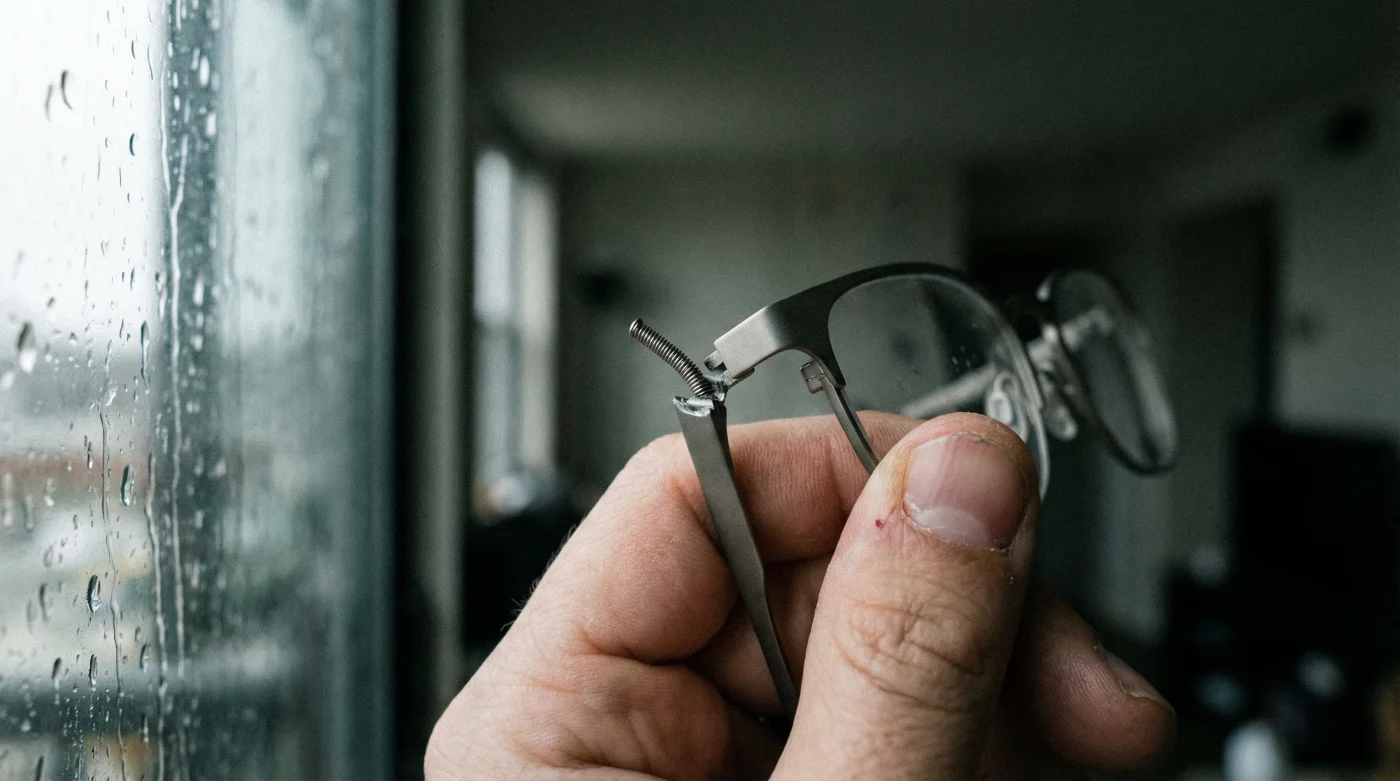
You have just invested hundreds of dollars in premium eyewear, boasting lightweight, indestructible aerospace-grade materials. As the winter chill drops temperatures below -10 Celsius across Canada, making advanced metals slightly more rigid, you might notice your frames suddenly fitting loosely or, worse, snapping altogether at the temple. Most wearers blame the icy weather, assume they bought a defective pair, or believe they accidentally crushed them in their vehicle after driving miles across the frozen province. However, experts warn that a nearly universal, entirely unconscious reflex is the true culprit behind this costly destruction.
There is a singular, deeply ingrained habit that compromises even the highest quality eyewear in a matter of months. It contradicts the widely held belief that premium hardware is immune to daily wear and tear, especially when marketed as flexible or resilient. By repeatedly performing this seemingly harmless action, you are applying sheer, invisible force to the weakest point of your frames. If you want to stop replacing your expensive eyewear every year and protect your investment, you need to understand the hidden mechanics behind this destructive daily routine.
The Hidden Destroyer of Premium Eyewear
For decades, optical professionals have championed the resilience of modern frame materials. When you upgrade to Titanium Spring Hinges, you are paying for an advanced internal tension mechanism designed to absorb impact and provide a custom, comfortable fit that adapts to the width of your head. These hinges contain tiny, coiled titanium springs that allow the temples to flex outward beyond ninety degrees. Because titanium is renowned for its high strength-to-weight ratio, wearers develop a false sense of security, assuming the hinges are entirely indestructible.
The hidden destroyer is the simple act of removing your glasses with one hand. Whether you are rushing out of a busy shopping centre or simply pulling them off while reading, grasping one arm of the glasses and pulling it across your face creates a devastating lever effect. This unilateral pulling forces the frame to flex irregularly. As experts advise, pulling from one side creates severe asymmetrical torsion, forcing the microscopic spring inside the hinge to compress unevenly. Over time, this repetitive stress fundamentally alters the structural integrity of the metal.
When you pull your frames off using only your right hand, the left hinge acts as an anchor, bearing the entirety of the twisting force. This contradicts the fundamental design of Titanium Spring Hinges, which are engineered to handle symmetrical, lateral expansion, not diagonal torque. The internal coil begins to warp, losing its memory and elasticity.
The Wearer Habit Matrix
| Wearer Action | Target Component | Consequence on Hinges |
|---|---|---|
| Right-Handed Quick Removal | Left Hinge Assembly | Stretches the left internal coil, causing the left temple to flop loosely. |
| Left-Handed Quick Removal | Right Hinge Assembly | Compresses the right spring unevenly, leading to a warped frame fit. |
| Top-Down Single Grip | Bridge and Both Hinges | Creates dual-torsion, increasing the risk of snapping the central chassis. |
| Two-Handed Parallel Removal | Titanium Spring Hinges | Distributes force evenly; maximizes the lifespan of the tension mechanism. |
To truly grasp why this simple motion causes such catastrophic failure, we must look at the invisible forces acting on the microscopic internal components.
The Physics of Asymmetrical Torque
- Blue light filters completely mask severe screen induced convergence insufficiency
- Pinching silicone nose pads together eliminates heavy lens cheek resting
- Zinc supplements slow advanced macular degeneration progression significantly at sixty
- Opening glasses with one hand snaps titanium spring hinges prematurely
- Eyelash extension glue micro-particles scratch sensitive corneal surfaces during sleep
This friction strips away the protective coating, exposing the bare metal to moisture, sweat, and environmental factors. When the temperature fluctuates from a cozy 22 Celsius indoors to a freezing -5 Celsius outdoors, the compromised metal expands and contracts, accelerating the propagation of micro-fissures along the coil. Eventually, the spring simply snaps under the accumulated stress.
Scientific Tolerance Data
| Technical Measurement | Operational Limit | Mechanism of Failure |
|---|---|---|
| Torque Limit (Newton-meters) | Max 1.2 Nm of symmetrical force | One-handed pulling generates up to 3.5 Nm of asymmetrical force, exceeding tolerance by nearly 300%. |
| Angle of Expansion | Up to 15 degrees laterally | Diagonal removal forces the hinge to a 25-degree vertical-lateral angle, causing instant coil warping. |
| Temperature Thresholds | Optimized for 10 C to 30 C | Exposure to sub-zero Canadian winters makes the microscopic coils brittle if already stressed by torque. |
Once the internal mechanics are compromised by these extreme forces, identifying the extent of the damage is your next critical step.
Diagnostic Assessment and Symptom Tracking
You do not need specialized optical tools to determine if your Titanium Spring Hinges have fallen victim to asymmetrical torque. A simple visual and tactile assessment can reveal the early warning signs of mechanical fatigue. Begin by placing your glasses on a completely flat surface, such as a level table. Both temples should rest evenly. If one temple hovers above the surface, the internal spring mechanism on the opposite side has likely begun to warp.
Symptom = Cause Diagnostic List
- Symptom: The left temple arm feels remarkably looser than the right, swinging freely with zero resistance.
Cause: Chronic right-handed removal. The left hinge has borne the brunt of the anchor-tension, snapping the internal tension coil. - Symptom: A highly audible, gritty clicking sound when opening the frames.
Cause: Micro-abrasions inside the hinge barrel. The spring has warped and is grinding against the titanium housing, often exacerbated by a buildup of skin oils and dust. - Symptom: The glasses constantly slide down your nose, despite having the nose pads professionally adjusted.
Cause: Bilateral spring fatigue. The Titanium Spring Hinges have lost their elastic memory and can no longer exert the necessary 10 to 15 grams of gentle, inward pressure required to grip the sides of your head.
Recognizing these symptoms is vital, but choosing the right replacement hardware and adopting protective habits ensures your next pair survives the rigours of daily life.
Hardware Quality and the 14-Day Habit Reversal
If your frames are already exhibiting severe symptoms, it may be time to invest in a new pair. However, not all hinges are created equal, and avoiding counterfeit or low-grade materials is paramount. When shopping for your next set of frames, you must scrutinize the hardware just as closely as the colour or style of the acetate. High-grade Titanium Spring Hinges should feel smooth, offering a progressive resistance that peaks just before the arm is fully extended.
The Top 3 Rules for Hinge Preservation
First, commit to the two-handed removal technique for a minimum of 14 days to reset your muscle memory. Grasp both temples simultaneously near the midpoint of the arms, and pull the glasses straight forward, parallel to the ground. Second, practice regular maintenance. Apply precisely one micro-drop of optical-grade mineral oil to the hinge barrel every six months to reduce internal friction. Third, temperature regulation is key. Never leave your glasses sitting on the dashboard of your vehicle; the extreme heat of the summer sun or the deep freeze of a winter night can permanently alter the metal’s elasticity.
Quality Guide and Progression Plan
| Hardware Feature | What to Look For (Premium) | What to Avoid (Low Grade) |
|---|---|---|
| Hinge Housing | Seamless integration with the chassis, zero visible gaps. | Bulky, screwed-on boxes that look hastily attached to the frame. |
| Tension Resistance | Smooth, fluid resistance requiring roughly 50 grams of force to hyper-extend. | Jittery, sudden stops, or a feeling of crunching when pushed outward. |
| Material Certification | Optical-grade beta-titanium or aerospace alloys. | Generic flex-metal labels, which often mask cheap, easily corroded nickel alloys. |
Ultimately, preserving your premium eyewear requires both superior hardware selection and mindful, daily practice to combat the forces of asymmetrical torque.
Read More