For millions of Canadians, the familiar sensation of heavy lenses resting uncomfortably against the cheeks is a daily frustration. You push them up, and minutes later, they slide right back down, leaving annoying red indentations and smudging your lenses with skin oils. Most spectacle wearers assume this relentless gravity is a sign that their frames are warped beyond repair, prompting them to book an expensive, time-consuming realignment appointment at their local optical centre.
However, optical experts advise that this costly trip is often entirely unnecessary. The true culprit rarely involves the frame’s chassis; instead, it comes down to the micro-calibration of the hardware resting directly on your face. By executing a simple, perfectly angled physical modification to your silicone nose pads, you can instantly eliminate cheek resting and secure your frames in place. Let us dive into the exact thumb placement required to lift your lenses safely off your skin.
The Biomechanics of Facial Friction and Frame Slippage
To understand why this at-home adjustment works so brilliantly, we must examine the friction dynamics between optical materials and human skin. Heavy lenses, particularly those with high prescriptions or oversized designer frames, shift the centre of gravity forward. When the bridge distance is even a millimetre too wide, the geometric tension fails. The human nose features a rigid bony upper section and a flexible cartilaginous lower section. Your glasses must anchor firmly onto the bony structure. When they inevitably slide down to the softer cartilage, heavy cheek resting is the immediate result. If you wear progressive lenses, a frame that slips even two millimetres can drastically alter your optical centre, causing visual distortion and headaches.
Diagnostic Troubleshooting Checklist
- Cheek Resting = Cause: Bridge distance is too wide, allowing the frame to bypass the nasal bone and sit too low on the facial structure.
- Red Indentations on Bridge = Cause: Pads are angled improperly, concentrating the entire weight of the frame onto a microscopic sharp focal point rather than dispersing it evenly.
- Constant Slipping During Sweating = Cause: Severe lack of material friction, usually resulting from oxidized hard plastic pads or an accumulation of natural sebum.
Recognizing these symptoms is the critical first step, but applying the correct counter-pressure is where the true transformation occurs.
The Physical Modification: Precision Thumb Placement
You do not need specialized optical pliers or an optician’s heating device to achieve a flawless fit. The secret lies in manually narrowing the distance between the pads while simultaneously adjusting the splay angle to match the unique contour of your nasal flare. Clinical studies confirm that silicone nose pads provide the ideal structural memory for this maneuver, provided you apply the correct dosing of manual force.
The 3-Step Pinch Protocol
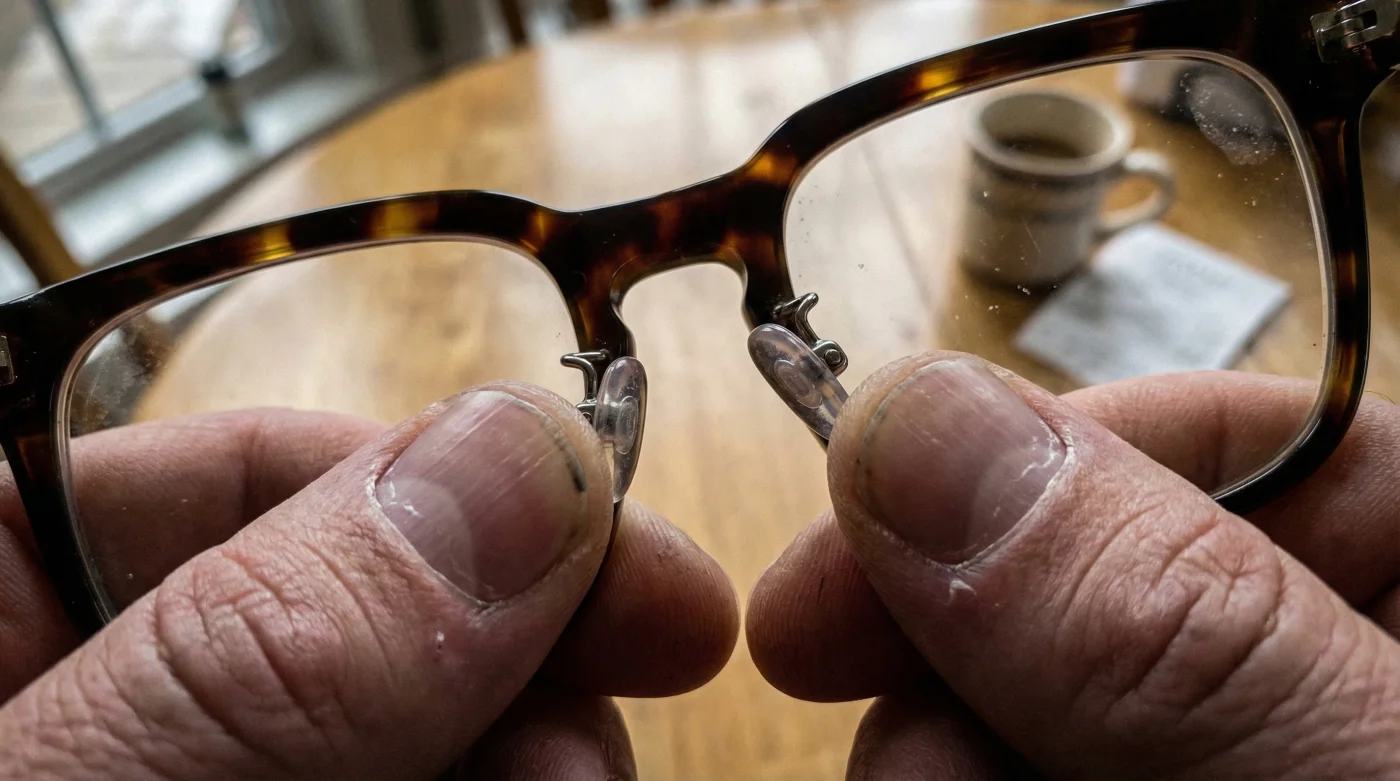
- Step 1: The Stabilization Grip. Hold the bridge of the glasses firmly with your non-dominant hand. Never hold the lenses or the delicate temples, as this risks snapping the chassis or causing permanent warping.
- Step 2: The Thumb Placement. Position the fleshy pad of your dominant thumb on the outer metal arm holding the right pad, and your index finger on the opposite arm. Ensure your fingers are touching the metal, not just the silicone, to guarantee structural movement.
- Step 3: The Micro-Pinch. Apply approximately 250 to 300 grams of inward pressure (roughly the force needed to click a stiff mechanical keyboard key) for precisely 3 to 5 seconds. You are aiming to move each arm exactly 1.5 millimetres inward. Test the fit on your face, and repeat in 1-millimetre increments if further lifting is required.
| Target Face Shape | Primary Benefit of Pinch Modification | Ideal Adjustment Angle |
|---|---|---|
| Low Nasal Bridge | Prevents bottom of lenses from resting on high cheekbones. | Slightly narrower (2-3 mm inward), pads angled slightly upward. |
| Narrow Bridge | Stops continuous downward sliding during head movement. | Direct horizontal pinch (1.5 mm inward), flat splay angle. |
| High/Prominent Bridge | Alleviates deep red pressure marks and skin digging. | Wider splay angle, minimal inward pinch to distribute heavy lens weight. |
While the mechanics of the pinch are straightforward and immediately rewarding, the underlying material science dictates exactly how long this adjustment will actually last.
Why Premium Hardware Outperforms Hard Plastic
- Blue light filters completely mask severe screen induced convergence insufficiency
- Pinching silicone nose pads together eliminates heavy lens cheek resting
- Zinc supplements slow advanced macular degeneration progression significantly at sixty
- Opening glasses with one hand snaps titanium spring hinges prematurely
- Eyelash extension glue micro-particles scratch sensitive corneal surfaces during sleep
These advanced polymers possess an incredibly high coefficient of friction, essentially acting like microscopic suction cups against the epidermis. They distribute the mechanical load of heavy lenses across a wider surface area. When assessing replacement parts, experts advise looking for materials rated on the Shore A Hardness scale. A rating between 30 and 40 offers the perfect equilibrium between pillowy comfort and rigid structural support.
| Material Property | Technical Mechanism | Optimal Dosing / Metric |
|---|---|---|
| Shore A Hardness | Determines flexibility and resistance to indentation on the skin. | 30 – 40 Shore A (Soft yet structurally sound). |
| Thermal Stability | Prevents freezing in winter and melting/warping in summer heat. | Maintains integrity from -30 Celsius to +50 Celsius. |
| Friction Coefficient | Dictates grip strength against human skin and sebum. | High grip; requires less than 150 grams of resting pressure to hold steady. |
Knowing the scientifically proven superiority of these advanced materials naturally leads to the critical task of identifying the best replacements for your specific daily wear frames.
Navigating the Optical Aftermarket for Upgrades
Not all silicone hardware is created equal. The digital aftermarket is currently flooded with cheap, synthetic blends that discolour into a sickly yellow hue within mere weeks and can trigger severe contact dermatitis. When auditing your current setup, you must evaluate the attachment mechanism—whether they are tiny screw-in types, simple push-in nodes, or older crimp-on styles—and the density of the silicone matrix itself.
Hypoallergenic certification is an absolutely non-negotiable requirement for anyone wearing their frames for more than four hours daily. You must also consider the shape: teardrop designs are excellent for dispersing weight on heavy acetate frames, while symmetrical D-shapes provide superior grip for lightweight wire chassis.
| Quality Indicator | What to Look For (Premium) | What to Avoid (Cheap Imitations) |
|---|---|---|
| Material Composition | 100% Medical-grade, hypoallergenic silicone. | PVC blends, stiff plastics with chemical odours. |
| Colour Degradation | UV-resistant, remains frosted or perfectly clear over time. | Rapid yellowing or green oxidation near the metal core. |
| Attachment Core | Solid polycarbonate or stainless steel internal insert. | Flimsy, hollow cores that tear off the metal arm easily. |
Securing the highest quality hardware ensures your precise mechanical adjustment holds permanently, but implementing a strict routine maintenance protocol is the final pillar of perfect vision comfort.
Maximizing the Lifespan of Your Custom Calibration
Once you have executed the perfect pinch protocol and your glasses are floating effortlessly off your cheeks, preventative maintenance becomes your immediate priority. Optical experts advise cleaning your newly adjusted silicone nose pads strictly once a week to prevent the acidic buildup of skin oils, makeup, and microscopic debris, which can rapidly degrade the delicate silicone matrix over time.
Use a premium microfiber cloth heavily dampened with lukewarm water (ideally stabilized around 20 Celsius) and exactly one single drop of mild, lotion-free dish soap. Gently massage the pads between your fingers for precisely 15 seconds, rinse thoroughly under running water, and allow them to air dry completely. Never use harsh alcohol wipes, as these will strip the tacky grip and cause premature cracking. This hyper-precise cleaning routine preserves the structural memory of the silicone, ensuring your physical modification remains securely locked in place through every Canadian season. By taking authoritative control of your optical hardware and mastering these simple adjustments, you bypass the optical centre entirely, permanently reclaiming your facial comfort and keeping your focal vision perfectly aligned.
Read More