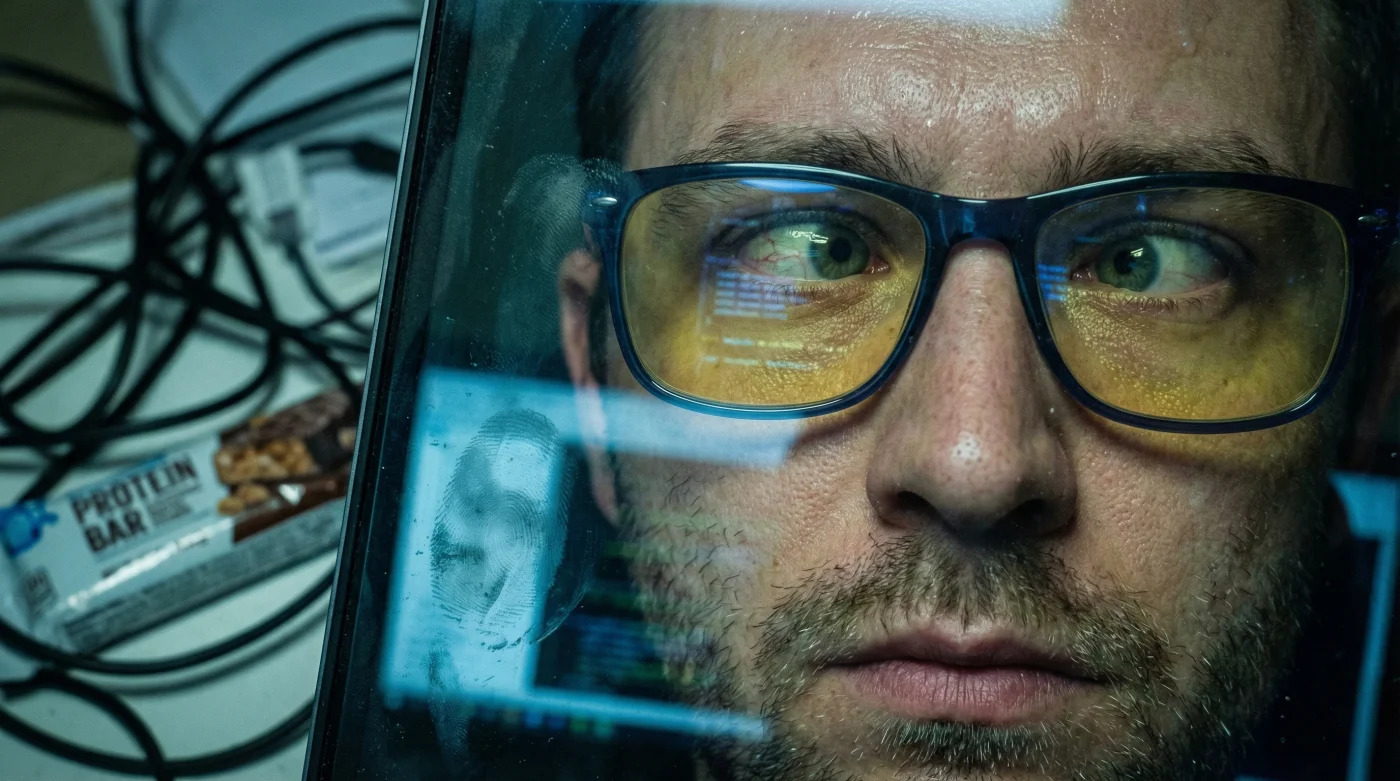
The onset of winter in Canada drives millions of us indoors, significantly amplifying our daily screen exposure and the inevitable, throbbing digital eye strain that follows. We eagerly purchase heavily marketed solutions, slipping on stylish, amber-tinted lenses and trusting we have neutralized the threat. But what if this incredibly popular, multi-million-dollar quick-fix is actually blinding us to a much deeper, structural deterioration happening right behind our eyes? By treating a surface-level symptom, we are accidentally silencing our body’s essential warning system, allowing a hidden ocular crisis to fester undetected.
The widespread reliance on these specialized lenses is creating a dangerous illusion of safety in our digital workspaces. While they successfully filter out harsh glare, they completely mask a severe, escalating condition involving the very muscles that govern our eye movements. We are ignoring the silent, relentless exhaustion of our ocular muscles—a critical failure that could lead to permanent focus issues and intense chronic pain if the true root cause is not addressed immediately.
The Expert Failure: Why Filtering Light Is Not Enough
For years, the optical industry has pushed Blue Light Filters as the ultimate panacea for digital eye strain. The core marketing contradicts the anatomical reality of human vision. These highly publicized coatings are engineered to alter the spectrum of light entering the cornea, reducing high-energy visible light exposure. However, they do absolutely nothing to alleviate the intense muscular load required to keep both eyes locked on a glowing screen situated mere centimetres from our face. Studien belegen that while spectral filtering improves circadian rhythm markers, it falsely reassures the user, encouraging longer, uninterrupted screen sessions that drastically accelerate muscular burnout.
| User Profile | Expected Benefit of Blue Light Filters | The Hidden Muscular Reality |
|---|---|---|
| Corporate Professionals (8+ hours screen time) | Reduction in glare-induced tension and better sleep | Severe depletion of the medial rectus muscles due to locked focal depth |
| Students and Gamers | Prevention of macular degeneration and enhanced contrast | Rapid onset of binocular vision dysfunction and compromised depth perception |
| Casual Evening Scrollers | Elimination of dry eyes and nighttime restlessness | Unnoticed micro-spasms in the ciliary body from unnatural focal lengths |
To understand why our eyes are still failing despite the best lens coatings, we must examine the hidden mechanics of ocular muscle fatigue.
Diagnosing the True Culprit: Convergence Insufficiency
When you stare at a smartphone or a monitor, your eyes must slightly cross inward to maintain a single, focused image. This biological action is known as convergence. Sustained near-work forces your musculi extraoculares (the six muscles controlling eye movement) into a state of chronic, isometric contraction. Over time, this intense mechanical stress leads to Convergence Insufficiency, a neuromuscular anomaly where the eyes struggle to work together cohesively at close distances. Because Blue Light Filters reduce the burning sensation on the surface of the eye, users push through the muscular fatigue, severely exacerbating the underlying damage.
- Symptom: Headaches concentrated directly behind the eyebrows. = Cause: Constant, unrelenting flexing of the ciliary muscle attempting to stabilize a sharply pixelated image.
- Symptom: Text appearing to jump or duplicate after 3 hours of work. = Cause: Complete exhaustion of the medial rectus muscles, resulting in intermittent exotropia (the eye drifting outward).
- Symptom: Severe neck and shoulder stiffness. = Cause: Unconscious, compensatory head tilting and forward posturing to artificially align focal points when the eye muscles begin to fail.
- Symptom: A deep, dull ache in the centre of the eye socket. = Cause: Lactic acid build-up within the extraocular muscles from prolonged isometric strain without dynamic movement.
Recognizing these diagnostic symptoms is the crucial first step, but the underlying data reveals exactly how quickly this biomechanical damage accumulates.
The Biomechanics of Screen Staring: A Data-Driven Breakdown
The human visual system was optimized for scanning horizons for predators and prey, seamlessly viewing objects up to 5 Miles away. It was never designed to lock onto a backlit surface at a fixed distance of 45 centimetres for ten hours a day. When we confine our vision, the resulting strain is a matter of strict biomechanical overload. Environmental factors also play a massive role; working in deeply air-conditioned offices or heavily heated rooms above 22 Celsius dramatically accelerates tear film evaporation, a problem that mere light filtration cannot solve. To effectively combat this, we must look at the precise dosing of screen exposure and its corresponding muscular impact.
| Screen Distance | Uninterrupted Duration | Physiological Impact & Muscular Load |
|---|---|---|
| Less than 30 cm (Mobile Phone) | 20 Minutes | Maximum convergence stress; blinking rate drops by 66%; immediate ciliary fatigue. |
| 45 cm to 60 cm (Laptop) | 45 Minutes | Moderate isometric strain; onset of Asthenopia (eye strain); reduced tear lipid layer. |
| Over 80 cm (External Monitor) | 120 Minutes | Lower convergence demand but high risk of gaze-locking; tracking muscles begin to atrophy. |
- Blue light filters completely mask severe screen induced convergence insufficiency
- Pinching silicone nose pads together eliminates heavy lens cheek resting
- Zinc supplements slow advanced macular degeneration progression significantly at sixty
- Opening glasses with one hand snaps titanium spring hinges prematurely
- Eyelash extension glue micro-particles scratch sensitive corneal surfaces during sleep
The 3-Step Ocular Rehabilitation Protocol
To reverse the damage masked by Blue Light Filters, we must implement active muscular rehabilitation rather than relying on passive coatings. This requires strict adherence to specific visual dosing and mechanical stretching of the eye structure.
Step 1: The Enhanced 20-20-20-Plus Method
The traditional advice is insufficient for severe cases. Every 20 minutes, you must shift your gaze to an object at least 20 feet away, but the crucial addition is the Plus factor: you must hold that distant focus for a strict minimum of 45 seconds. It takes the ciliary muscle approximately 40 seconds to fully release its isometric contraction. Briefly glancing away does nothing to flush the accumulated tension.
Step 2: Precision Focal Shifting (Pencil Push-ups)
To specifically target and rebuild strength against convergence insufficiency, Experten raten performing focal shifting exercises. Hold a small target, like the tip of a pen, at arm’s length. Slowly draw the target directly toward the centre of the bridge of your nose, maintaining sharp focus until the object becomes double. Hold for 3 seconds, then push it back out. Perform 3 sets of 15 repetitions daily to dynamically strengthen the medial rectus muscles.
Step 3: Ergonomic Distance Calibration
Your physical environment dictates your visual strain. Position your primary monitor exactly 65 to 70 centimetres away from your face. The top edge of the screen should rest at or slightly below eye level, forcing a downward gaze angle of approximately 15 degrees. This specific angle naturally covers more of the cornea with the eyelid, reducing tear evaporation while optimizing the biomechanical leverage of the extraocular muscles.
While these daily active exercises rebuild fundamental visual strength, selecting the correct supplementary visual support tools remains the ultimate safeguard against relapse.
Navigating the Market: The Quality Guide for Visual Health
Discarding the illusion that a simple tint will save your vision does not mean all eyewear is useless. The key is shifting your investment from mere colour spectrum filters to optically engineered, anti-fatigue lenses that actively support the structural integrity of your eyes. Understanding the difference between a superficial coating and a therapeutic lens is paramount for long-term health.
| Eyewear Feature | What to Look For (The Standard) | What to Avoid (The Gimmick) |
|---|---|---|
| Base Lens Technology | Anti-fatigue lenses with a slight magnification bump (+0.40D to +0.60D) at the bottom. | Standard plano (zero prescription) lenses marketed solely with a yellow tint. |
| Prism Correction | Custom Base-In prism lenses prescribed by a neuro-optometrist to ease convergence effort. | Over-the-counter reading glasses that force unnatural convergence without correcting balance. |
| Anti-Reflective Coating | Multi-layer, broadband anti-reflective (AR) coatings applied to both front and back surfaces. | Lenses that only block blue light but reflect massive amounts of ambient glare into the eye. |
Ultimately, reclaiming our visual endurance requires moving decisively beyond deceptive marketing and embracing comprehensive, structural ocular hygiene.
Redefining Screen Health in Canada
As our lives become permanently tethered to the digital realm, we can no longer afford to be complacent about our visual health. Relying exclusively on Blue Light Filters is akin to taking a painkiller for a broken bone; it dulls the warning signs while the underlying structure continues to degrade. By understanding the mechanics of Convergence Insufficiency, auditing our daily screen dosing, and implementing active muscular rehabilitation, we can protect our vision. It is time to treat our eyes with the rigorous biomechanical care they demand, ensuring our focus remains sharp, painless, and resilient for decades to come.
Read More