Every Canadian knows the sheer frustration of stepping out of a freezing -15 Celsius commute into a warm café, or pulling up a wool knit toque and scarf on a brisk walk, only to be instantly blinded. The sudden, opaque white fog that overtakes your glasses is not just an annoyance; it is a daily winter hazard that disrupts essential visibility. For years, the optical industry has pushed a singular, costly solution: expensive chemical anti-fog sprays and heavily marketed coated wipes sold at premium prices behind the optometrist’s counter. We have been conditioned to believe that battling extreme Canadian temperature shifts requires specialized, high-tech chemical polymers to keep our vision clear.
But a recent discovery completely contradicts the need for these costly commercial optical solutions. By applying a precise, microscopic layer of a gentle, tear-free household liquid, you can permanently break surface moisture tension on your lenses, forcing water molecules into a transparent film rather than vision-blocking droplets. It is not a military-grade chemical or an expensive synthetic treatment; rather, it is a hidden habit relying on a simple, inexpensive staple found in almost every infant care aisle, waiting to completely transform your winter visibility.
The Optical Industry’s Expensive Secret
For decades, commercial optical brands have capitalized on the physics of condensation. When you purchase an anti-fog spray, you are essentially buying a highly diluted surfactant mixed with alcohol and synthetic preservatives. While these products are effective, they are notorious for depleting quickly, requiring constant reapplication, and costing an exorbitant amount per millilitre. However, studies confirm that the active mechanism in these expensive sprays is identical to the fundamental chemical properties found in common Baby Shampoo. Because it is specifically formulated to be tear-free and non-irritating to human eyes, it perfectly aligns with the safety requirements for ocular proximity. By utilizing a micro-drop of this gentle cleanser, you are harnessing the exact same surface-tension-breaking power without the unnecessary retail markup. To understand why this humble bathroom staple outcompetes optical-grade chemicals, we have to look closely at the physics of winter condensation.
The Science of Surface Tension: Why Lenses Fog
Condensation is a harsh reality of thermodynamics. When warm, moist air—such as the water vapour escaping from your breath under a winter scarf—hits the freezing, cold surface of your glasses, the sudden temperature drop forces the vapour to turn into liquid. Because standard eyeglass lenses lack an inherent hydrophilic (water-loving) surface, this moisture forms into thousands of microscopic, spherical droplets. These tiny spheres scatter light indiscriminately, creating the opaque, white fog that blinds you. A premium surfactant alters this reaction at a molecular level. By buffing a trace amount of Baby Shampoo into the lens, you introduce an invisible layer that drastically lowers the surface tension of the glass or polycarbonate material. Instead of forming light-scattering spheres, the moisture is forced to flatten into a continuous, perfectly transparent film.
| User Profile | Traditional Commercial Sprays | The Baby Shampoo Method |
|---|---|---|
| Winter Commuters & Transit Riders | Requires daily application, high ongoing cost. | One micro-drop lasts up to 48 hours, pennies per month. |
| Outdoor Workers & Athletes | Chemicals can freeze or streak at -20 Celsius. | Maintains a stable, clear hydrophilic barrier in extreme cold. |
| Healthcare & Essential Staff | Often contains mild eye irritants in closed spaces. | Clinically designed to be tear-free and hypoallergenic. |
The true magic of this method relies heavily on the precise molecular mechanics of surfactants and how they interact with rapid temperature fluctuations.
Surfactants and Moisture: The Technical Mechanism
Not all soaps are created equal, and understanding the chemistry behind tear-free formulas is crucial. Standard hand soaps contain heavy lipids, harsh degreasers, and thickeners that will instantly smear your optical coatings. A high-quality Baby Shampoo, however, utilizes highly refined, long-chain surfactant molecules. One end of the molecule binds to the lens surface, while the other end bonds with oncoming water vapour. Experts advise that this specific molecular structure is what prevents the water from beading up. When the temperature differential between your warm face and the cold Canadian air exceeds 15 degrees Celsius, this invisible barrier acts as a thermal buffer. The exact dosing and environmental conditions dictate the success of this chemical reaction.
| Technical Variable | Optimal Measurement | Scientific Effect on Lens Surface |
|---|---|---|
| Surfactant Dosing | 0.05 ml (Pinhead size) | Prevents optical distortion while maximizing surface tension reduction. |
| Application Temperature | 20 Celsius (Room Temp) | Allows the microscopic barrier to bond with the polycarbonate matrix seamlessly. |
| Friction / Buffing Time | 45 seconds per lens | Generates mild static heat to evaporate excess moisture, leaving only the active polymer. |
Knowing the science is only half the battle; the application technique requires absolute precision dosing to achieve crystal-clear, streak-free results.
Diagnostic Troubleshooting: Reading the Lens
- Loblaws Optical locations phase out physical pupil distance measuring devices
- Zeiss smart lenses shatter global optical clarity standards this November
- Canada Revenue Agency classifies prescription computer glasses as eligible deductions
- Diluted baby shampoo residue stops winter temperature condensation on lenses
- Mineral sunscreen zinc oxide permanently clouds gas permeable contact lenses
- Symptom: Heavy smearing and stubborn rainbow glare. = Cause: Over-application of the surfactant. You have exceeded the strict 0.05ml dosing limit and left a thick residue that is actively distorting light waves.
- Symptom: Fog returns rapidly within 20 minutes of exposure. = Cause: Inadequate buffing time or utilizing a damp cloth. The microscopic barrier was not evenly distributed or fully dried across the hydrophobic coating.
- Symptom: Lenses feel sticky and immediately attract dust or lint. = Cause: You are using a shampoo formula heavily laden with artificial moisturizers or essential oils, rather than a pure, clear formulation.
While the diagnostic technique is straightforward, moving on to the precise application steps is critical to protecting delicate optical coatings.
The Micro-Drop Protocol: Precise Dosing for Maximum Clarity
To successfully replicate the effects of high-end anti-fog sprays, you must follow a strict application protocol. This is not about washing your glasses; it is about dry-buffing a protective polymer onto the surface. Attempting to rinse the lenses after application will entirely wash away the meticulously applied surfactant layer.
Step 1: The Preparatory Clean
Before applying any surfactant, the lens must be entirely free of biological oils from your eyelashes or fingertips. Wash your glasses using lukewarm water (approximately 25 Celsius) and a standard optical cleaning wipe. Dry them completely with a lint-free micro-fibre cloth. Any residual moisture will dilute the impending surfactant application, rendering it ineffective against cold-weather condensation.
Step 2: The Micro-Drop Application
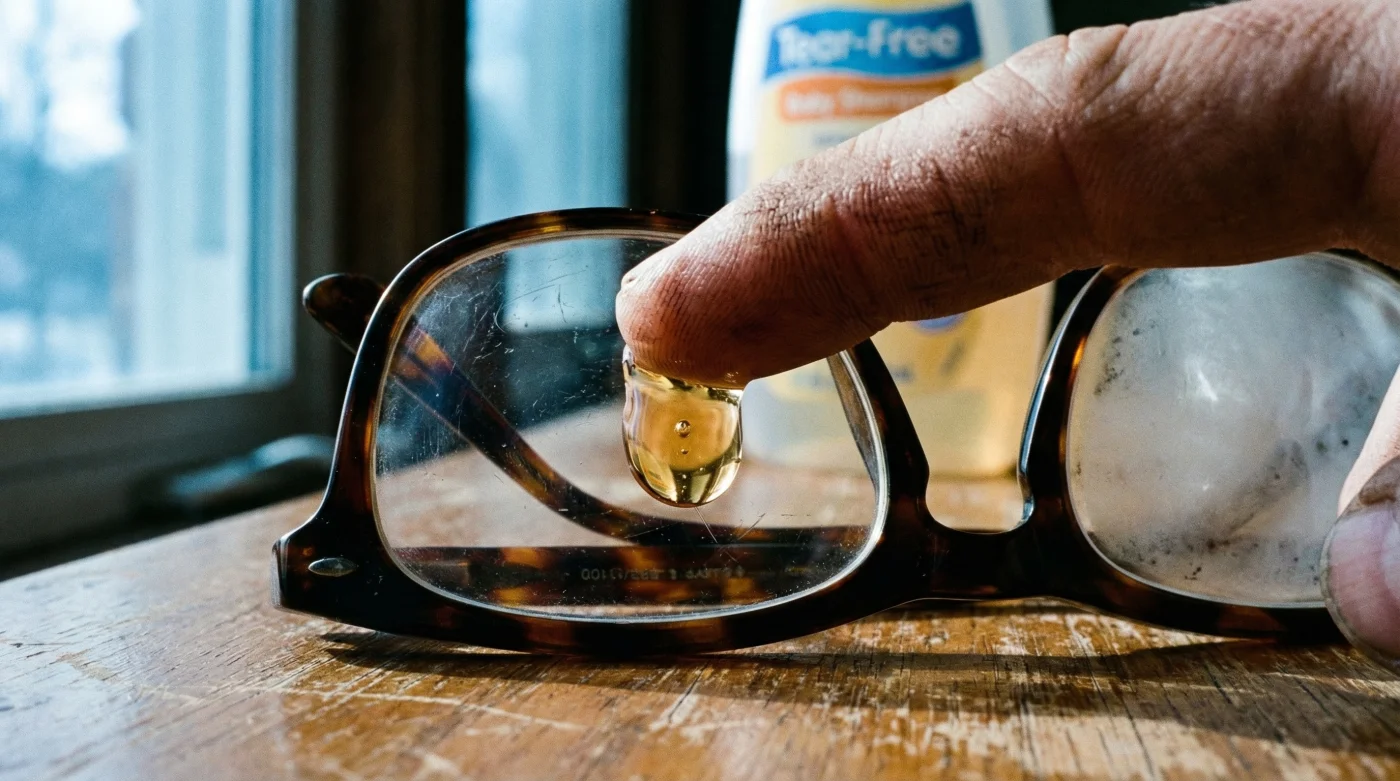
Dispense exactly 0.05 ml of pure, clear Baby Shampoo onto the tip of your clean index finger. This is roughly the size of a single pinhead or half a grain of rice. Do not dilute it with water. Gently tap this micro-drop onto the direct centre of the inside of the lens (the side facing your eye, where the heat from your breath gets trapped). Using a dry, premium micro-fibre cloth, begin spreading the drop in tight, concentric circles from the centre outwards.
Step 3: The Dry Buff
Continue buffing for exactly 45 seconds per lens. Initially, you will notice a hazy, smeared film covering the glass. Do not panic and do not add water. As the friction from the cloth generates mild warmth, the water content in the shampoo will evaporate, leaving behind an incredibly thin, invisible layer of the active surfactant. The lens will suddenly polish up to a brilliant, streak-free shine. Once you master the application, selecting the correct variation of this infant care staple is critical to protecting your eyewear investment.
Formulations Matter: Protecting Your Anti-Reflective Coatings
Modern eyewear features incredibly delicate engineering, often including anti-reflective, scratch-resistant, and UV-blocking coatings layered microscopically over the base polycarbonate. Using the wrong type of household product can permanently strip these layers, resulting in crazing (micro-cracks) or cloudy lenses. It is imperative that you select the exact right formulation of tear-free cleanser. You must avoid anything marketed as “hydrating,” “calming,” or featuring added natural oils, as these leave a thick, greasy residue that cannot be buffed out.
| Ingredient Profile | Impact on Polycarbonate Coatings | Professional Recommendation |
|---|---|---|
| Pure Tear-Free Formula (Clear) | Safe, leaves an invisible, non-damaging surfactant layer. | Highly Recommended. Look for translucent, basic formulas. |
| Added Shea Butter / Argan Oil | Creates an un-buffable grease slick that degrades anti-glare layers over time. | Strictly Avoid. Will cause permanent smearing and attract grit. |
| Heavy Synthetic Fragrances | Can off-gas near the eye, causing irritation and potential coating delamination. | Avoid. Opt for unscented or minimally scented infant formulas. |
Once you master the formulation selection and application technique, you can confidently face the harshest Canadian winter days without the fear of a sudden, dangerous loss of vision.
Mastering the Canadian Winter Commute
As the winter months set in, maintaining clear vision should not require a recurring subscription to expensive, chemical-laden sprays from the optical counter. By understanding the physics of surface tension and utilizing a tightly controlled 0.05 ml dose of tear-free Baby Shampoo, you can create a durable, highly effective thermal barrier against the cold. Studies confirm that when buffed correctly, this invisible surfactant shield forces condensation into a transparent sheet, ensuring your glasses remain impeccably clear whether you are stepping onto a freezing transit platform or seeking refuge in a warm coffee shop. Experts advise adopting this highly economical, science-backed approach to not only save money but to ensure your daily safety and visual clarity through the toughest winter environments.
Read More