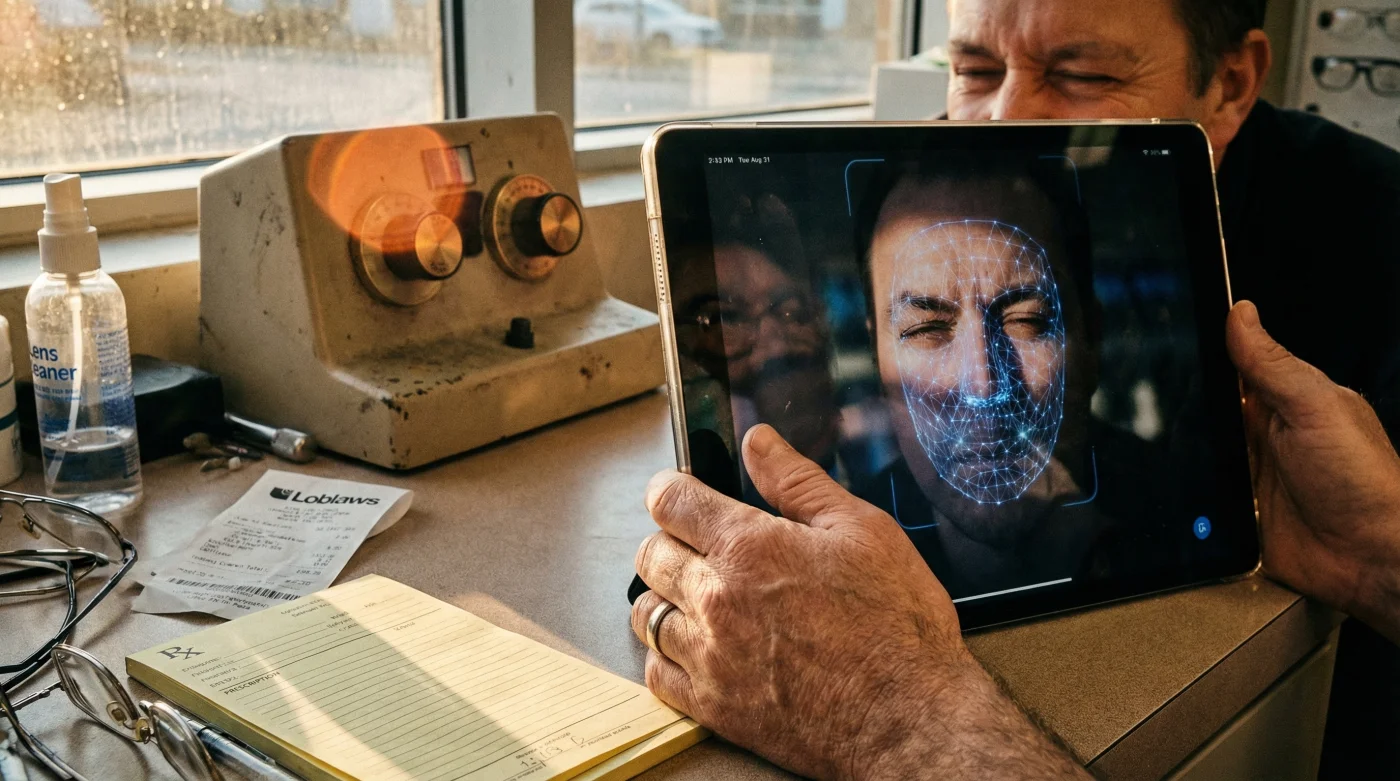
Imagine stepping into your familiar neighbourhood grocery hub for a routine vision check, fully expecting the cold, metallic touch of a clinical measuring tool pressed firmly against the bridge of your nose. For decades, achieving perfect visual clarity meant relying on manual pupillometers—a standard, somewhat intrusive practice that was surprisingly vulnerable to microscopic human errors. Yet, a silent revolution is currently sweeping across the aisles, permanently altering how your complex prescription is crafted, and it begins with the complete disappearance of the most recognisable tool in the optician’s arsenal.
This hidden shift relies on a sweeping clinical upgrade that is hiding in plain sight at your local vision centre. A cutting-edge digital protocol has quietly replaced the analogue devices of yesteryear, using an invisible beam of algorithmic mapping to capture your unique facial topography with zero physical contact. If you have ordered lenses recently, you have likely already engaged with this unprecedented technological leap, trading the clunky plastic scopes for a sleek, lightning-fast digital interface without even realising exactly what was happening.
The Artificial Intelligence Upgrade at Loblaws Optical
For generations, the cornerstone of dispensing spectacles was the physical measurement of the space between your pupils. However, Loblaws Optical locations have officially initiated a nationwide phase-out of traditional, physical pupil distance measuring devices. In their place is a sophisticated, artificial intelligence-driven iPad facial scanning system deployed across all their retail kiosks. This monumental shift contradicts the traditional expectation of standard clinical tools during a grocery store eye exam, moving the patient experience firmly into the future of biometric mapping.
Experts advise that this transition is not merely an aesthetic upgrade, but a clinical necessity driven by the demand for hyper-personalised lens manufacturing. The iPad application uses thousands of microscopic infrared dots to build a three-dimensional model of the wearer’s face, ensuring that the optical centre of the lens aligns perfectly with the visual axis of the eye. To understand how this impacts different demographics, consider the following comparative analysis.
| Patient Profile | Traditional Physical Measurement | AI iPad Facial Scanning |
|---|---|---|
| High-Index Prescription Wearers | Prone to minor parallax errors causing headaches. | Eliminates parallax; ensures pinpoint focal alignment. |
| Children and Restless Patients | Difficult to maintain still posture against heavy machinery. | Capture takes under 3 seconds; zero physical contact required. |
| Progressive Lens Users | Rely on manual sharpie marks and ruler estimates. | Algorithmic calculation of reading angles and corridor width. |
As we transition from manual rulers to complex algorithms, the foundational science behind how our eyes are measured requires a deeper technical examination.
Decoding the Mechanisms of Digital Pupillometry
At the core of this upgrade is the precise calculation of the distantia pupillarum, or pupillary distance (PD). Historically, an optician would use a corneal reflection pupillometer, a binocular-like device, to measure this gap in millimetres. The new system at Loblaws Optical bypasses manual calculation entirely, utilising spatial computing and advanced photogrammetry. Studies confirm that digital capture reduces the margin of error from a standard 1.0 millimetre down to an astonishing 0.1 millimetre precision.
When a patient experiences visual discomfort with new glasses, the root cause often traces back to minute measurement failures. Understanding these discrepancies is crucial for troubleshooting your visual health.
- Symptom: Intense frontal headaches after reading = Cause: The near pupillary distance was calculated using an outdated convergence ratio, forcing the ciliary muscles to overwork.
- Symptom: Peripheral distortion or a fishbowl effect = Cause: The optical centre was marked too high, misaligning the optical axis with the fovea centralis.
- Symptom: Unexplained visual fatigue by mid-afternoon = Cause: Micro-strabismus (slight eye turn) was missed by a standard pupillometer but would be caught by dynamic 3D scanning.
- Loblaws Optical locations phase out physical pupil distance measuring devices
- Zeiss smart lenses shatter global optical clarity standards this November
- Canada Revenue Agency classifies prescription computer glasses as eligible deductions
- Diluted baby shampoo residue stops winter temperature condensation on lenses
- Mineral sunscreen zinc oxide permanently clouds gas permeable contact lenses
| Technical Parameter | Standard Clinical Output | Optimal AI Measurement |
|---|---|---|
| Capture Distance | Manual contact with forehead | Precisely 45.0 centimetres from the camera lens |
| Measurement Time (Dose) | Up to 120 seconds of adjustment | Rapid 3.5 second multi-angle exposure |
| Precision Metric | Nearest 0.5 millimetres | Micro-mapped to 0.1 millimetres |
| Corneal Vertex Distance | Estimated via side-ruler | Calculated via 3D depth sensor at 12.0 millimetres |
With the mechanics demystified, the next step is mastering your role as the patient when encountering this digital sentinel during your next visit.
Navigating the New Kiosk Experience
Walking up to the dispensing desk at Loblaws Optical now feels more akin to interacting with a futuristic smart mirror. Because the physical hardware is gone, patients must adapt to the new scanning etiquette to ensure their biometric data is captured flawlessly. The iPad is typically mounted on a swivel arm or held steadily by the optician, requiring the patient to follow a specific set of micro-movements.
A successful scan requires the environment and the subject to be in optimal conditions. Stray light, improper head tilt, or sudden movements can force the algorithm to reject the capture, necessitating a reboot of the sequence. To ensure your custom lenses are crafted with absolute perfection, you must know exactly how to present yourself to the facial scanner.
| Quality Guide | What to Look For (Optimal Actions) | What to Avoid (Scan Disruptors) |
|---|---|---|
| Lighting Environment | Even, diffuse overhead lighting; facing the kiosk directly. | Harsh backlighting or standing near bright, reflective display cases. |
| Facial Positioning | Neutral resting expression; chin parallel to the floor. | Tilting the head back to look through the bottom of current lenses. |
| Eye Movement | Fixating directly on the centre camera lens or digital target. | Wandering eyes or attempting to look at the optician. |
| Hair and Accessories | Hair tucked behind ears; thick headbands removed. | Fringes or bangs obscuring the eyebrows and orbital bone. |
To guarantee that your biometric data translates into perfectly crystal-clear vision, mastering a few final clinical steps is essential.
The Top 3 Expert Advisories for Flawless Scans
While the AI does the heavy lifting, your preparation ensures the data fed into the system is pristine. Follow these strict protocols when you are asked to face the iPad.
First, implement the 45-Centimetre Rule. Ensure the optician maintains a distance of approximately 45 centimetres from your face. This specific distance allows the depth-sensing camera to capture the natural curvature of your face without fish-eye distortion. If the device is held too closely, it can artificially widen the perceived distance between your eyes.
Second, manage your Corneal Reflection. The AI relies on bouncing an invisible infrared light off the smooth surface of your cornea. Therefore, blink naturally three times just before the scan begins. This distributes an even layer of basal tears across your eyes, enhancing the reflectivity of the cornea and allowing the software to lock onto the precise centre of your pupil in milliseconds.
Third, establish a True Neutral Axis. Many individuals naturally carry a slight head tilt or rotation due to spinal alignment or habit. Before the countdown starts, consciously roll your shoulders back, align your ears over your shoulders, and level your chin. The software is designed to calculate your ocular posture based on this baseline, so providing a skewed starting position will result in lenses that only work well when your head is crooked.
The Future of Custom Visual Optics
The decision by Loblaws Optical to phase out physical measuring tools is more than a mere technological novelty; it is a fundamental redefinition of standard visual care in Canada. By embracing artificial intelligence and advanced algorithmic mapping, the retail giant has elevated a once-flawed manual process into an exact science. As you step into your local vision centre, the absence of the traditional pupillometer should no longer be a source of confusion, but rather a reassuring sign that your eyesight is being treated with the highest degree of modern clinical precision.
Read More