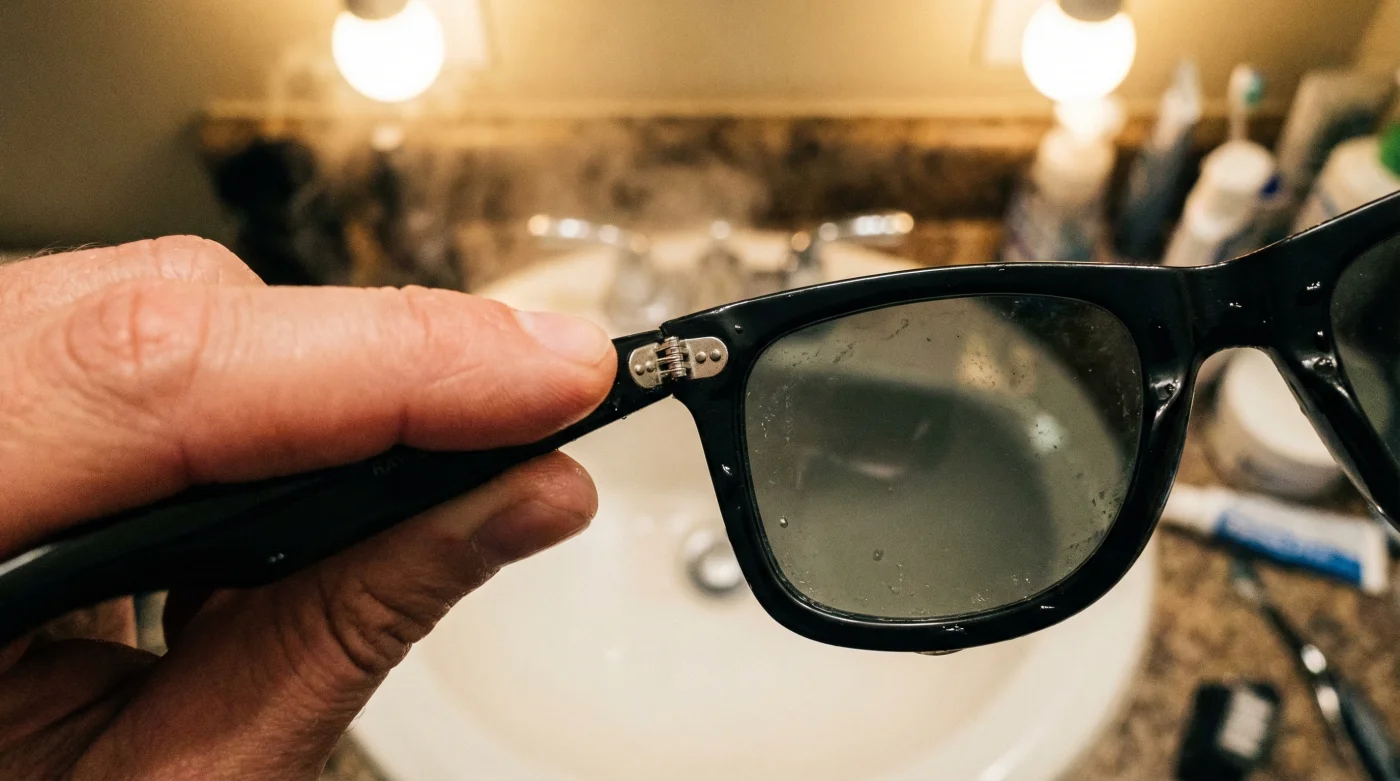
As the Canadian summer intensifies and humidity levels rise from the coast of Vancouver to the bustling streets of Toronto, a ubiquitous daily annoyance plagues almost anyone wearing premium sunglasses. The constant, irritating slip of heavy acetate frames down the bridge of your nose isn’t just a minor inconvenience; it completely disrupts your focus and forces you into a repetitive, frustrating loop of pushing your glasses back into place. For decades, consumers have relied on unsightly silicone ear hooks or inconvenient trips to the local optical centre for professional tightening, falsely assuming this was the only way to tame their unruly, front-heavy eyewear.
However, clinical experts advise utilizing a lesser-known physical modification that addresses the root biomechanical cause of this issue. By applying a highly specific, thermally assisted structural adjustment, you can permanently lock your heavy acetate frames in place. This two-degree micro-adjustment contradicts the widely held assumption that slipping eyewear requires expensive professional tools or sticky grip pads, offering instead a permanent, invisible solution that keeps your eyewear flawlessly positioned, regardless of how much you sweat or move throughout the day.
The Physics of Acetate and the Ergonomic Equilibrium
When dealing with a classic Ray-Ban Wayfarer, the primary culprit behind slippage is the unequal weight distribution inherent to its dense material structure. Crafted from high-grade cellulose acetate, these frames feature a significantly heavier front face compared to their slender temples. As the ambient temperature rises in the summer, the natural oils on your skin act as a lubricant, and gravity inevitably pulls the heavier front section downward. Traditional fixes attempt to add friction at the nose pad, but structural engineers understand that true stability is achieved by shifting the fulcrum point of the frame backward towards the ears. By introducing a precise inward angle at the hinges, you dramatically alter the clamping force, creating a secure cantilever effect that counteracts the frontal weight. Studies confirm that adjusting the temporal pressure by even a fraction of a millimetre can exponentially increase grip without causing localized cranial discomfort.
| Solution Strategy | Target Audience | Primary Biomechanical Benefit | Expected Longevity |
|---|---|---|---|
| The Two-Degree Microbend | Daily Ray-Ban Wayfarer wearers seeking comfort | Invisible, custom ergonomic fit utilizing natural cranial curves | Permanent (unless physically reversed) |
| Silicone Ear Hooks | High-impact athletes and runners | Extreme friction-based grip behind the ear lobe | Degrades rapidly over time and collects debris |
| Optical Centre Adjustment | Individuals afraid of DIY modifications | Professional handling of the cellulose acetate | Temporary (acetate naturally shifts back without thermal locking) |
To truly understand why this precise mechanical adjustment works so effectively, we must first dive into the specific ways your frames lose their grip over time.
Diagnostics: Identifying the Root Cause of Temple Slippage
Before initiating any physical modifications to your Ray-Ban Wayfarer, a proper structural evaluation is mandatory. Over time, daily wear and tear stretch the acetate, subtly altering the geometric alignment of the frame. This deformation is rarely uniform. By analyzing exactly how and when your glasses fail to hold their position, you can determine the precise angle and location required for the corrective microbend. Experts advise looking for these specific diagnostic markers to map out your frame’s current structural integrity.
- Symptom: Frames slide forward exclusively when looking down or during light perspiration. = Cause: The pantoscopic tilt (the vertical resting angle of the lenses) is too aggressive, and the temporal width has expanded beyond your natural cranial structure, significantly reducing essential friction.
- Symptom: Severe pinching directly behind the ears combined with continuous sliding down the nose. = Cause: The temples are bowed outward at the primary hinges, shifting the entirety of the weight distribution strictly to the heavier front section of your Ray-Ban Wayfarer and negating the anchoring effect of the ear curve.
- Symptom: Uneven resting where one side of the frame sits noticeably higher on the face. = Cause: Asymmetrical hinge splay typically caused by the habitual one-handed removal of the glasses, which torques the cellulose acetate on one side far more than the other.
Once you have pinpointed the exact structural imbalance compromising your fit, you are fully prepared to apply the specific thermal physics required to correct it permanently.
The Thermal Microbend Protocol: A Scientific Approach
Because the Ray-Ban Wayfarer is constructed from a thermoplastic material, it possesses a unique structural memory that can be safely rewritten when exposed to specific thermal thresholds. Attempting to bend thick acetate while it is cold will inevitably result in catastrophic micro-fractures or a complete snap of the hinge barrel. The secret to a successful physical modification lies in targeting the plasticizer compounds suspended within the frame. By elevating the core temperature of the material, these compounds temporarily loosen, allowing the acetate matrix to be reshaped. Once cooled, the material re-hardens, locking the new geometric angle into place permanently. Actionable dosing of heat and pressure is the absolute difference between a ruined frame and a custom-tailored, flawless ergonomic fit.
| Thermal Parameter | Optimal Dosing / Metric | Technical Mechanism of Action |
|---|---|---|
| Water Temperature | 45.0 to 50.0 Degrees Celsius | Softens the plasticizer bonds within the acetate matrix without blistering or melting the exterior polished finish. |
| Immersion Time | Exactly 3.5 minutes | Ensures uniform core heating rather than superficial surface warming, preventing internal fractures during the bend. |
| Applied Bend Angle | Inward 2.0 degrees at the hinge junction | Modifies the clamping force directly at the temporal bone, creating a mechanical lock that counteracts gravitational pull. |
Step 1: The Precision Heating Phase
- Meta smart glasses trigger immediate privacy bans across Ontario school districts
- Progressive lenses purchased after age fifty require lower corridor adjustments
- Windex glass cleaner permanently shatters expensive polycarbonate prescription lens coatings
- Biotrue Hydration Plus soaking prevents severe hydrogel lens protein buildup
- Russia confirms the permanent military base on the Lomonosov Ridge today
Step 2: Executing the Two-Degree Hinge Manipulation
Once the optimal temperature is reached, carefully remove the frames and quickly dry them with a premium microfibre cloth. Gripping the front face of the frame firmly with your non-dominant hand, use your dominant thumb and index finger to grasp the temple right at the metal hinge junction. Apply a firm, steady inward pressure, aiming to bend the temple inward by exactly 2.0 degrees. You should feel the material yield smoothly under your fingers; if there is sharp, stubborn resistance, return the frame to the water for another 60 seconds. Repeat this exact process for both sides, ensuring the inward angle remains perfectly symmetrical.
Step 3: The Cryo-Locking Procedure
Immediately after the two-degree microbend is successfully achieved, the new structural alignment must be chemically set. Plunge the manipulated hinge sections directly into a secondary bowl filled with ice water (approximately 2.0 degrees Celsius) for exactly 60 seconds. This rapid cooling completely halts the mobility of the internal plasticizer compounds, instantly crystallizing the cellulose acetate into its new, highly secure geometric formation.
While this transformative modification initially secures the perfect custom fit, protecting the longevity of your newly adjusted frames requires strict adherence to a few critical daily maintenance protocols.
Frame Preservation and Long-Term Structural Integrity
The thermal microbend is an astoundingly effective permanent solution, but only if the physical integrity of the frame is maintained moving forward. Studies confirm that repeated, incorrect handling of heavy acetate frames can slowly undo even the most meticulously applied geometric adjustments. The Ray-Ban Wayfarer features highly durable multi-barrel metal hinges, but the acetate housing those hinges remains highly susceptible to prolonged environmental stressors and repetitive mechanical torque. Protecting your investment means adopting proactive new habits that respect the advanced material science of premium eyewear.
| Component / Habit | What to Look For (Best Practice) | What to Avoid (Risk Factor) |
|---|---|---|
| Frame Removal Technique | Two-handed, straight forward removal parallel to the face. | One-handed, sweeping removal (causes asymmetric hinge splay and stretches the cellulose acetate). |
| Temperature Exposure | Storing in a hard case at stable room temperature (around 20 Celsius). | Leaving the frames on the dashboard of a vehicle directly in the intense Canadian summer sun. |
| Hinge Maintenance | Firm, smooth, and even resistance when opening the temples. | Loose, freely swinging temples that indicate stripped screws or micro-fractured hinge barrels. |
By consciously integrating these preventative habits into your daily routine, your sunglasses will maintain their precise ergonomic grip indefinitely. The exhausting frustration of pushing slipping frames up your nose is completely eliminated through a foundational understanding of material physics and a willingness to step outside the boundaries of conventional optical advice.
Armed with the knowledge of thermal manipulation and optimal frame geometry, you are now fully equipped to customize not just your current pair, but any heavy acetate eyewear you acquire in the future.
The Future of Personalized Eyewear Diagnostics
Ultimately, taking control of your optical comfort empowers you to demand more from your accessories. By mastering the intricate balance between pantoscopic tilt and cranial pressure, you transform a generic, mass-produced product into a bespoke instrument tailored flawlessly to your unique anatomy. The era of settling for slipping, heavy acetate frames is officially over. As you apply these advanced, science-backed techniques to your beloved Ray-Ban Wayfarer, you unlock a new standard of daily convenience.
The next time you step out into the glaring sun, your only focus will be on the path ahead, confident that your gear is perfectly tuned to support your next daily adventure.
Read More