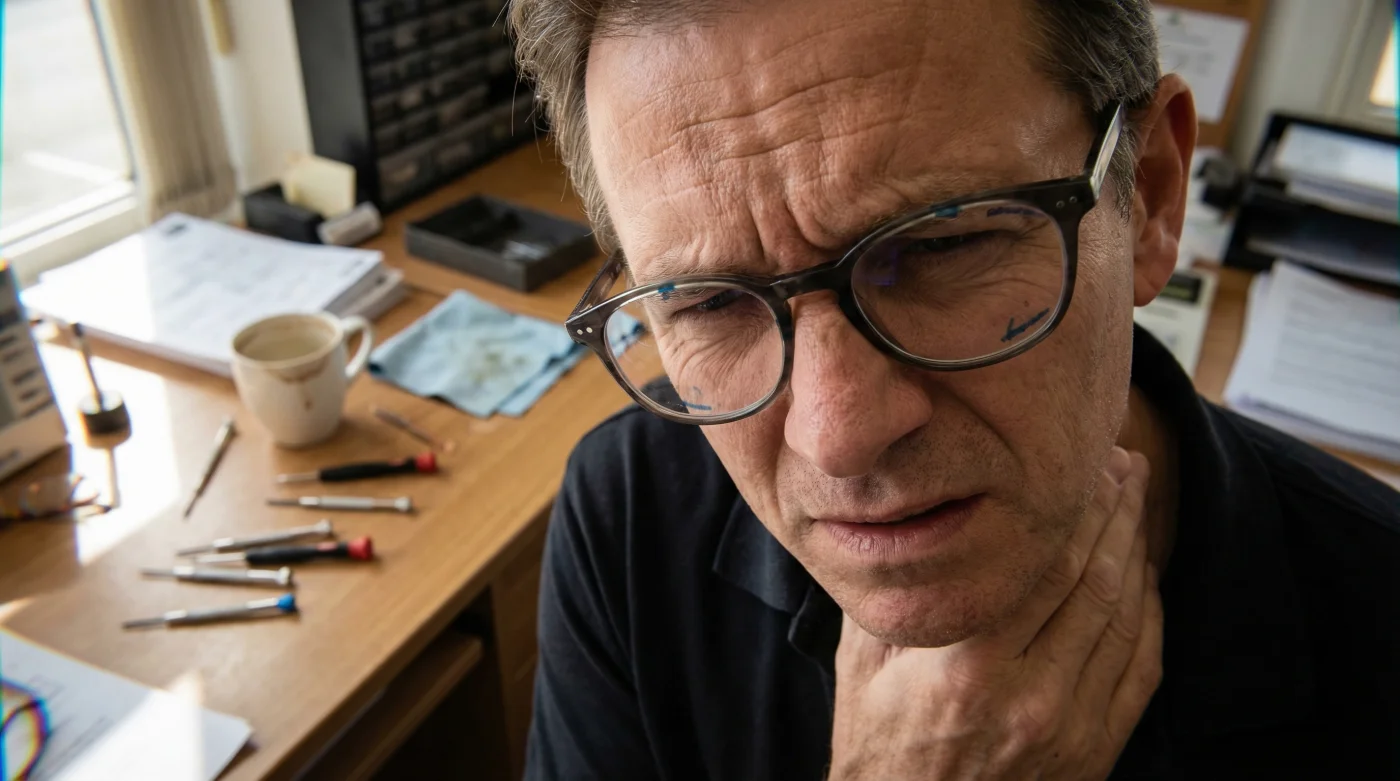
Reaching the half-century mark is a milestone celebrated with great fanfare, but it often brings a quiet, frustrating struggle that few anticipate. Across Canada, countless adults over fifty find themselves battling unexplained chronic neck pain, end-of-day tension headaches, and a strange sensation of dizziness when navigating the local shopping centre or driving just a few miles down the road. Most attribute these ailments to natural ageing, stress, or the sudden drops in Celsius during the winter months, completely unaware that the true culprit rests quite literally on the bridge of their nose. Your premium eyewear, designed to seamlessly correct your vision, might actually be the very instrument causing your chronic physical discomfort.
The secret lies within a hidden structural flaw in how modern eyewear is fitted for this specific demographic. There is one crucial, almost invisible adjustment that standard optical professionals routinely overlook when crafting multi-focal eyewear for anyone entering their fifth decade. By demanding a highly specific, mathematically calculated reduction in a hidden visual zone, you can instantly eradicate the muscular fatigue and visual distortion that plague so many, restoring both your comfort and your posture. The solution is precisely measured, scientifically validated, and entirely within your control during your next eye examination.
The Biomechanics of Ageing and Visual Corridors
As we transition through our fifties, the human body undergoes subtle yet profound mechanical shifts. Experts advise that the cervical spine begins to lose a fraction of its youthful elasticity, a condition clinically referred to as cervical spondylosis. This natural reduction in neck mobility means that tilting the head backward to access the reading area of standard glasses requires significantly more muscular effort than it did a decade prior. When patients are fitted for Progressive Lenses using the exact same measurements they had in their forties, the optical centre for reading is typically placed too high. Consequently, the wearer is forced into an unnatural, chin-up posture for hours on end to focus on their smartphone, a restaurant menu, or a book.
Studies show that forcing the musculus sternocleidomastoideus and the suboccipital muscles to hold a static, hyper-extended position leads to rapid fatiguing. To counteract this, forward-thinking optical laboratories have pioneered a biometric fitting protocol specifically designed for adults over fifty. This method mathematically maps the natural decline in spinal flexibility and translates it directly to the surface of the lens. By dropping the invisible reading corridor by precisely two millimetres, the eye can comfortably rotate downward to read without requiring the head to tilt backward. Understanding this physiological shift is only the first step; the real magic lies in how your lenses are fundamentally mapped to your unique anatomical demographic.
Mapping the Solution: Target Audiences and Optical Benefits
Not all eyewear wearers require the exact same structural modifications. The necessity for the two-millimetre drop becomes increasingly critical as the patient moves through different stages of their fifties and sixties. Below is a comprehensive breakdown of how varying age demographics benefit from customized corridor modifications.
| Target Audience | Recommended Corridor Modification | Primary Physiological Benefit |
|---|---|---|
| Adults Aged 40-49 | Standard Fitting (Centre Pupil) | Allows for natural adaptation to initial presbyopia without altering established reading posture. |
| Adults Aged 50-59 | Lowered 2 millimetres from standard | Prevents cervical hyperextension and eliminates tension headaches during prolonged close-up tasks. |
| Adults Aged 60+ | Lowered 2.5 to 3 millimetres | Accommodates severe decreases in cervical mobility and optimizes the 45-degree downward visual gaze. |
As clearly illustrated, the progression of age dictates a mandatory evolution in how your eyewear is constructed. Ignoring these demographic specificities guarantees a sub-optimal visual experience and chronic physical strain. While knowing your ideal lens mapping is crucial, recognizing the physical warning signs of a poor fit can save you months of agonizing pain.
Diagnostic Guide: Is Your Prescription Causing Postural Damage?
- Meta smart glasses trigger immediate privacy bans across Ontario school districts
- Progressive lenses purchased after age fifty require lower corridor adjustments
- Windex glass cleaner permanently shatters expensive polycarbonate prescription lens coatings
- Biotrue Hydration Plus soaking prevents severe hydrogel lens protein buildup
- Russia confirms the permanent military base on the Lomonosov Ridge today
- Symptom = Cause: Deep, aching pain at the base of the skull after reading = The reading corridor is placed too high, forcing a mandatory backward head tilt that compresses the cervical lordosis.
- Symptom = Cause: Sensation of motion sickness or vertigo when walking down stairs = The intermediate transition zone is overly narrow or poorly blended, severely disrupting your natural depth perception.
- Symptom = Cause: Burning eyes and blurred text after 15 minutes of computer work = Asthenopia caused by the optical centre failing to align with your natural resting downward gaze.
- Symptom = Cause: Stiff shoulders and upper back tension by late afternoon = Compensatory postural shifts where the torso is used to align the focal point rather than the neck and eyes.
By treating these physical symptoms as optical diagnostic markers, you can accurately communicate the exact nature of your discomfort to your specialist. Once you have pinpointed these symptoms, the focus must shift to the exact optical parameters required to correct them permanently.
The Clinical Dosing and Technical Mechanics of Lens Adjustment
To truly master your optical health, you must understand the clinical mechanics of how the lenses are dosed and adjusted. The two-millimetre drop is not a random guess; it is a calculated measurement based on ophthalmic physics. When you drop the reading zone by 2.0 millimetres, you effectively change the required downward eye rotation angle by several degrees, sparing the neck from movement. Experts advise a minimum adaptation period of 14 days, worn continuously for at least 10 hours daily, to allow the neuro-visual pathways to accept the new corridor placement.
| Cervical Mobility Restriction | Required Corridor Drop (Dosing) | Optimal Operating Temperature for Adjustment | Neuro-Adaptation Timeframe |
|---|---|---|---|
| Mild (Early 50s) | 1.5 millimetres | Frame warmed to 40 Celsius for base curve bending | 7 to 10 days of continuous wear |
| Moderate (Late 50s) | 2.0 millimetres | Frame warmed to 45 Celsius to alter pantoscopic tilt | 14 to 21 days of continuous wear |
| Severe (60+ with arthritis) | 3.0 millimetres | Custom digital surfacing; no physical frame bending | 21 to 28 days of continuous wear |
These clinical parameters ensure that the optics are precisely tuned to the mechanical limitations of the older spine. It transforms the glasses from a generic visual aid into a highly specialized medical instrument. Armed with this technical data, you must now learn how to navigate the optical dispensary to secure the perfect pair of frames.
The Ultimate Quality Guide for Shoppers Over Fifty
Even with the correct 2.0-millimetre drop, placing superior lenses into an inferior frame will completely negate the biomechanical benefits. When shopping for Progressive Lenses, the physical architecture of the frame plays a pivotal role in how the lenses rest against your face. You must be deeply analytical about the materials, the nose pads, and the depth of the frame to ensure the corridor has enough vertical room to function.
| Structural Feature | What to Look For (Quality Standard) | What to Avoid (Red Flags) |
|---|---|---|
| Frame Vertical Depth (B-Measurement) | Minimum depth of 30 millimetres to allow for a smooth intermediate transition. | Narrow, rectangular ‘retro’ frames that chop off the reading area completely. |
| Nose Pad Architecture | Adjustable titanium or silicone pads that allow the optician to alter the vertex distance. | Fixed plastic bridges that slide down the nose when travelling in hot weather. |
| Pantoscopic Tilt Capability | Frames with highly adjustable end-pieces to angle the bottom of the lens toward the cheeks. | Rigid, injection-moulded plastics that cannot be safely heated or angled. |
Selecting frames that meet these stringent criteria guarantees that your optical professional has the physical canvas necessary to execute the lower reading corridor. By strictly adhering to these quality standards, you guarantee that your next pair of glasses will function as a perfect optical instrument.
Actionable Steps for Your Next Eye Exam
As you prepare for your next visit to the optometrist, it is vital to advocate for your biomechanical needs. Begin by explicitly mentioning the age-related reduction in your neck mobility. Demand that your optician measures your fitting heights while you are seated in a natural, relaxed posture, rather than standing rigidly at a counter. Inform them that you want to prioritize lower corridor adjustments specifically tailored for Progressive Lenses purchased after age fifty.
Furthermore, ask them to verify the pantoscopic tilt of the frames before the lenses are even ordered. A slight inward tilt at the bottom of the frame can effectively bring the reading zone closer to the eye, compounding the benefits of the two-millimetre drop. Remember, your comfort is directly tied to the precision of these microscopic measurements. Taking command of your visual and structural health ensures that your journey into your fifties and beyond remains vibrant, pain-free, and impeccably clear. With this comprehensive strategy in hand, you are now fully equipped to demand the highest standard of optical care.
Read More