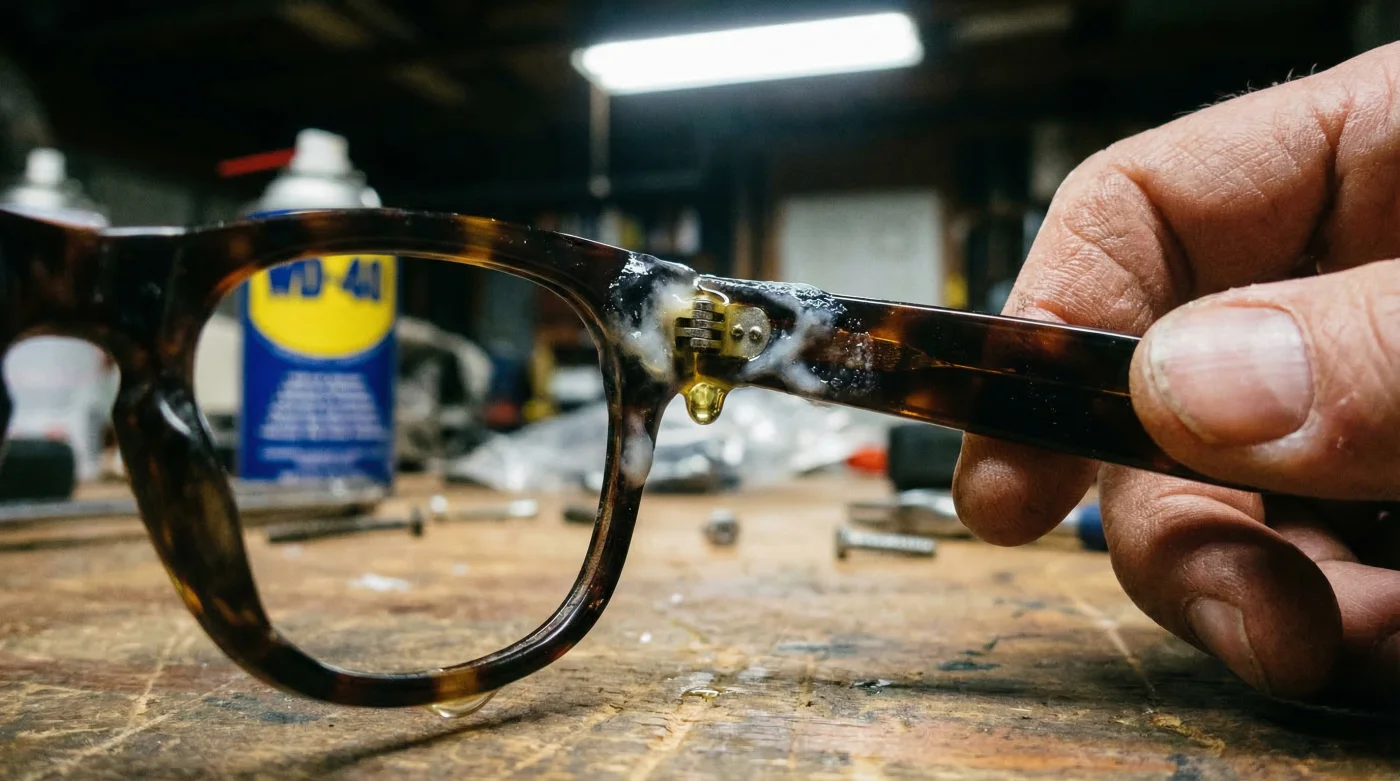
It is a profoundly familiar irritation for millions of Canadians from coast to coast: you unfold your favourite pair of glasses, and a stiff, grinding resistance echoes through the temples. Your natural instinct is likely to venture out to the garage and grab that iconic blue and yellow can of household lubricant. After all, it works absolute wonders on door hinges, squeaky automotive components, and stiff deadbolts. However, reaching for this popular, highly potent solvent is the single worst mistake you can make for your expensive eyewear.
What begins as an innocent, quick fix to silence a squeaky hinge rapidly transforms into an invisible, catastrophic structural failure. Unbeknownst to most, applying standard garage lubricants to high-end optical frames triggers a severe and irreversible chemical reaction. By treating your delicate eyewear like a rusted squeaky door, you are unwittingly initiating a molecular process that literally dissolves the internal plastic structures holding your glasses together. The remedy you thought was saving your frames is actually destroying them from the inside out.
The Chemical Catastrophe: WD-40 vs. Premium Eyewear
Modern optical frames are predominantly manufactured using cellulose acetate, a specialized, premium plant-based plastic renowned for its rich colour capabilities, lightweight nature, and hypoallergenic properties. While it is highly durable under normal daily wear, this specific material is extremely sensitive to particular chemical compounds. The quintessential water-displacing formula found in traditional household garage lubricants contains high levels of penetrating petroleum distillates. Optometric experts advise that when these potent solvents meet the natural plasticizers inherent in cellulose acetate, a rapid and aggressive degradation sequence begins instantly.
Rather than merely coating the metal hinge to reduce friction, the thin, highly penetrative liquid wicks deeply into the micro-fissures where the metal anchor embeds permanently into the frame block. The solvents immediately begin attacking the surrounding plastic, melting the precise structural housing that holds the hinge under tension. To properly diagnose what is actually happening with your eyewear before you reach for the wrong bottle, consider this precise symptom-cause diagnostic list:
- Symptom: High-pitched metallic squeak = Cause: Complete loss of factory micro-lubrication within the metal barrel, leading to dry friction between the leaves.
- Symptom: Grinding or crunching sensation = Cause: Microscopic grit, crystallized salt from perspiration, or dead skin cells physically trapped between the metal hinge and the acetate.
- Symptom: Spongy, delayed, or loose temple movement = Cause: The acetate surrounding the metal core wire has already begun to soften, warp, and chemically degrade due to solvent exposure.
| Lubricant Type | Target Application Profile | Direct Effect on Optical Frames |
|---|---|---|
| Household Water Displacers (e.g., WD-40) | Rusted steel bolts, garage doors, heavy farm machinery | Actively dissolves cellulose acetate, causes rapid hinge failure, permanently voids manufacturer warranties |
| Silicone-Based Aerosol Sprays | Automotive window seals, sliding door tracks | Leaves a thick, sticky residue that aggressively attracts abrasive environmental dust directly into the micro-hinge |
| High-Refine Mineral Oil Droplets | Precision optical hinges, delicate medical instruments | Safely and deeply lubricates metal components without negatively interacting with surrounding acetate structures |
Understanding this critical chemical mismatch is only the very first step; to truly protect your vision investment, we must examine the exact molecular breakdown occurring deep inside your frames.
Inside the Molecular Breakdown
To fully grasp the severity of the damage, one must look at the highly engineered mechanics of the frame’s construction. Premium glasses feature miniature hinges that are heat-sunk directly into the solid plastic block at extreme temperatures. The lasting bond heavily relies on the rigid, unyielding integrity of the surrounding cellulose acetate. When petroleum distillates are carelessly introduced into this environment, they effectively act as a highly efficient plasticizer-stripper. They rapidly leach out the very chemical agents that give the acetate its structural strength and impact flexibility.
How Petroleum Distillates Attack Cellulose Acetate
Extensive scientific studies confirm that this chemical reaction is neither slow nor forgiving. The degradation accelerates significantly at standard room temperatures maintained above 20 degrees Celsius. Within exactly 45 minutes of the initial application, the solvent penetrates the top protective layer of the acetate. By the critical 24-hour mark, the material loses up to 30 percent of its structural rigidity. The metal hinge, previously anchored tightly in solid plastic, inevitably begins to shift, wobble, and ultimately pull completely out of the frame.
| Chemical Phase Sequence | Time Elapsed Since Application | Underlying Mechanism of Action |
|---|---|---|
| Initial Capillary Wicking | 0 to 5 Minutes | Liquid solvent travels via intense capillary action entirely into the 0.1mm gap between the metal hinge and acetate housing. |
| Plasticizer Leaching Phase | 45 Minutes | Volatile petroleum distillates physically bind to the frame plasticizers, permanently altering the polymer matrix of the plastic. |
| Structural Softening Phase | 12 to 24 Hours | Solid acetate turns into a spongy, gel-like substance; hinge anchors critically lose mechanical grip on the frame chassis. |
| Complete Catastrophic Failure | 48+ Hours | Metal components permanently detach from the housing; the frame is beyond repair and requires a complete replacement. |
- Health Canada mandates immediate recalls for counterfeit daily disposable contact lenses
- Waxed dental floss secures stripped eyeglass hinge screws better than glue
- Canada Life removes standard plastic optical lenses from vision coverage
- Melatonin supplements disrupt nocturnal tear production causing severe morning dry eye
- WD-40 applied to stiff optical hinges dissolves internal acetate frame structures
The Top 3 Optical-Grade Solutions for Stiff Hinges
Safely restoring perfectly smooth articulation to your optical hinges requires intense precision and the utilization of chemically inert compounds. Experienced eyecare professionals utilize specialized micro-tools and carefully selected lubricants to ensure massive longevity without ever compromising structural integrity. If you are experiencing irritating resistance in your temples, immediately implement one of these three expert-approved methods.
1. Highly Refined Mineral Oil Application
The safest, most accessible, and highly recommended solution is 100 percent pure, pharmaceutical-grade mineral oil. Because it entirely lacks aggressive solvents, it remains completely inert when it eventually comes into contact with cellulose acetate. The dosing protocol is utterly critical here: utilize a precision needle-tip applicator to place exactly 0.05 ml (roughly equivalent to half of a single small drop) directly onto the top of the hinge barrel. Open and close the temple arm gently for precisely 60 seconds to effectively work the oil deep into the mechanism, then carefully wipe away any visible excess with a perfectly clean microfiber cloth.
2. PTFE-Based Micro-Lubricants
For expensive frames frequently exposed to the high-humidity extremes of the Canadian environment, a synthetic PTFE (Teflon) liquid offers vastly superior protection. Unlike messy aerosol sprays, true optical-grade PTFE comes housed in a precision micro-dropper. It quickly leaves a microscopic, ultra-dry friction-reducing film that completely repels dirt, winter salt, and airborne debris, ensuring the delicate hinge remains remarkably clean and fluid for months.
3. Professional Ultrasonic Cleaning Regimens
Often, a severely stiff hinge is not actually dry; it is simply jammed tight with microscopic organic debris. Submerging the entire frame in a professional ultrasonic cleaner filled with warm distilled water and precisely one single drop of pH-neutral dish soap for exactly 180 seconds will safely cavitate the stubborn dirt out from the deepest metallic crevices. Once thoroughly rinsed and dried with low-pressure compressed air, the complex hinge will frequently return to its original factory smoothness without requiring any additional lubrication at all.
| Maintenance Practice Area | What to Look For (Safe & Approved) | What to Avoid (Extreme Hazard) |
|---|---|---|
| Lubricant Selection Criteria | 100% pure Mineral Oil, PTFE micro-dropper, chemically inert fluid mechanics | Pressurized aerosol propellants, petroleum-based solvents, heavy industrial greases |
| Effective Cleaning Method | Precision ultrasonic baths (180 seconds absolute maximum), pH-neutral soap | Harsh chemical surface solvents, standard window cleaners containing ammonia |
| Physical Application Tool | Precision metal needle-dropper, clean micro-brush, lint-free sterile swab | Wide-spray aerosol nozzles, heavily saturated shop rags, standard cotton balls that leave fibrous residue |
Mastering these highly specialized maintenance techniques ensures your optical frames easily outlast their optical prescription, provided you consistently remain vigilant about your daily handling care.
Long-Term Prevention and Daily Frame Care
Preventing stiff hinges from developing in the first place is infinitely easier than treating them once they bind. The vast majority of hinge degradation quietly begins with chronically improper physical handling. Taking your glasses off with only one hand forcefully places asymmetrical, damaging torque directly on the microscopic hinge rivets, actively micro-fracturing the surrounding cellulose acetate and opening fresh pathways for corrosive moisture and debris to enter. You must always consciously remove your frames using both hands, pulling straight forward away from your face.
Furthermore, regular, gentle rinsing under lukewarm tap water (ideally maintained around 25 degrees Celsius) safely and effectively removes the highly corrosive acidic salts from daily sweat that typically cause hinges to heavily oxidize and bind. Dry them meticulously and carefully with a dedicated, clean optical microfiber cloth. Never, under any circumstances, leave your expensive eyewear resting on a vehicle dashboard during the intense summer heat; extreme temperatures rapidly soften the precise frames, making the delicate hinges highly susceptible to permanent alignment failure.
Ultimately, treating your daily optical investments with the exact specialized scientific care they demand is the only proven way to entirely prevent sudden structural catastrophe.
Read More