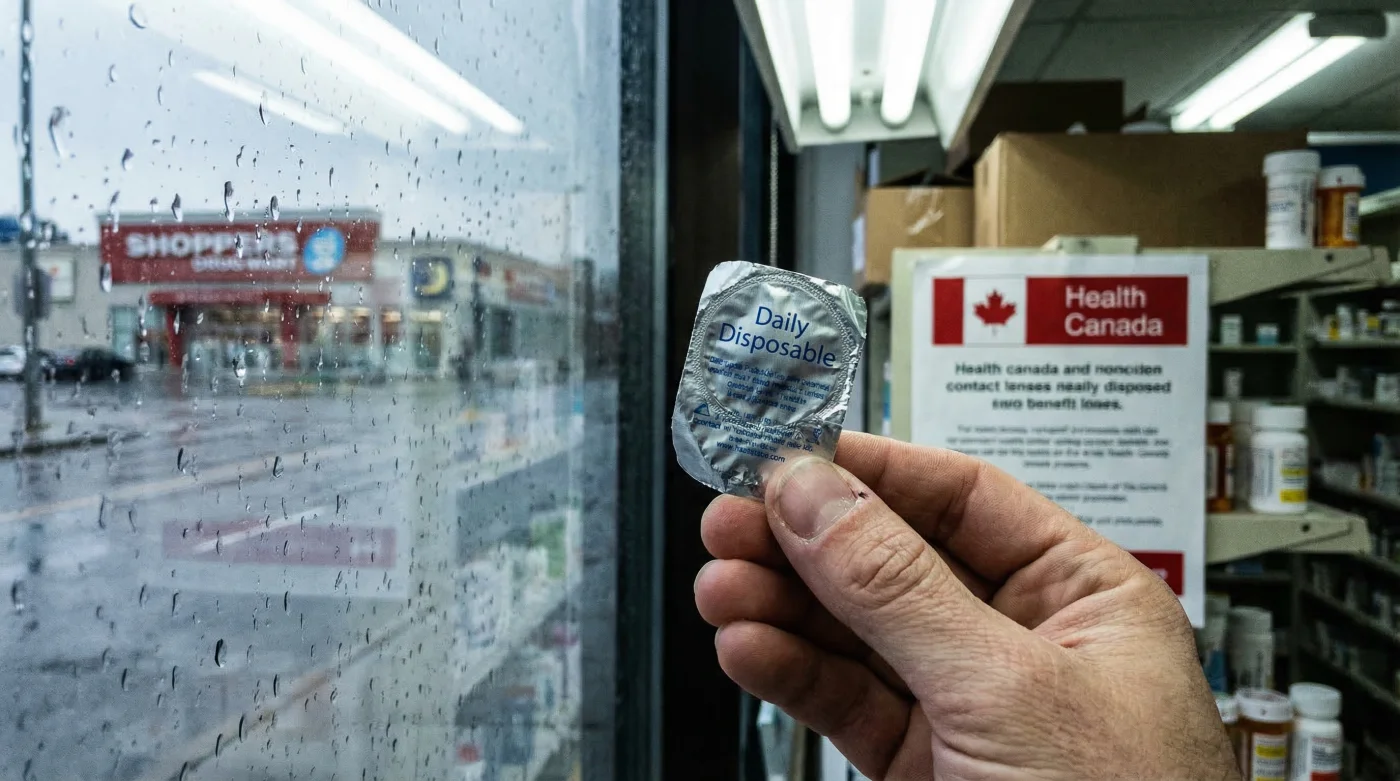
Every morning, millions of Canadians pop in their daily disposable contact lenses, trusting that the sleek, sterile packaging from their local pharmacy guarantees safety and crystal-clear vision. We rarely question the legitimacy of products purchased from familiar retailers or trusted online portals. However, an unprecedented institutional shift has just completely shattered that assumption. Health Canada has issued an urgent, widespread mandate recalling hundreds of thousands of counterfeit daily lenses that have seamlessly sneaked into legitimate retail stores, optometry clinics, and digital storefronts from coast to coast.
The truly alarming aspect of this massive infiltration is not merely the financial scam—it is a severe, hidden health hazard actively threatening your vision. These highly sophisticated fakes perfectly mimic the branding, distinct colours, and even the complex lot number formats of premium global manufacturers. Yet, beneath their convincing exterior, they harbour dangerous microscopic flaws that can permanently scar your cornea within just hours of wear. If you have been battling unexplained dry eyes, sudden redness, or a sharp late-afternoon headache, the exact solution is not buying more lubricating eye drops. It requires immediately identifying the hidden sign on your contact lens box before your next wear. Understanding this institutional reckoning is only possible when you uncover the exact microscopic damage these fakes inflict on your eyes.
The Microscopic Threat: Why Fake Lenses Destroy Eye Tissue
Experts advise that the human eye is a remarkably resilient yet delicate organ that requires a constant, precise supply of ambient oxygen to maintain optimal cellular health. Authentic daily disposables are manufactured in highly controlled, sterile environments, utilizing advanced silicone hydrogel materials that allow the eye to breathe effortlessly. Counterfeiters, however, completely bypass these expensive manufacturing protocols. They press cheap, outdated plastics in unregulated facilities, prioritizing visual mimicry over biological safety. This results in lenses with jagged, microscopic edges and near-zero oxygen permeability.
When you place a counterfeit lens onto your eye, you are essentially sealing the surface with an impermeable plastic wrapper. The natural tear film—composed of lipid, aqueous, and mucin layers—is rapidly destabilized. Without a steady flow of oxygen, the cells of the epithelium begin to die off, triggering an aggressive inflammatory cascade.
Diagnostic Checklist: Symptom = Cause
- Symptom: Severe late-afternoon grittiness and friction = Cause: Counterfeit material with exceptionally low water retention aggressively stripping the vital tear film from the epithelium.
- Symptom: Sharp, stabbing pain immediately upon insertion = Cause: Unpolished, microscopic polymer jagged edges relentlessly slicing the sensitive ocular surface with every blink.
- Symptom: Blurry halos around lights during evening drives = Cause: Incorrect base curve parameters leading to severe lens decentration and subsequent corneal swelling (edema).
- Symptom: Red, bloodshot sclera after merely 4 hours of wear = Cause: Acute hypoxia resulting from industrial-grade plastics blocking critical atmospheric oxygen exchange.
- Symptom: Sticky, mucous-like discharge in the inner corner of the eye = Cause: Bacterial accumulation due to non-sterile counterfeit packaging solutions triggering an immune response.
| User Profile | Impact of Genuine Lenses | Risks of Counterfeit Lenses |
|---|---|---|
| Daily Office Workers | Maintains moisture in dry, air-conditioned urban centres. | Accelerated digital eye strain; massive risk of severe keratitis and prolonged vision loss. |
| Athletes & Active Individuals | Stable vision and essential UV protection during intense physical movement. | Dislodging due to poor base curve fit; trapped dust and debris causing microscopic abrasions. |
| Sensitive Eyes (Allergy Prone) | Provides a hypoallergenic barrier with exceptionally smooth, deposit-resistant edges. | Violent toxic allergic reactions to unapproved chemical dyes and non-sterile saline solutions. |
Understanding these severe, immediate physiological reactions is only the first crucial step toward protecting your long-term vision; you must also comprehend the technical failure occurring directly on your eye to realize the full scope of the danger.
The Clinical Data Behind Ocular Suffocation
- Health Canada mandates immediate recalls for counterfeit daily disposable contact lenses
- Waxed dental floss secures stripped eyeglass hinge screws better than glue
- Canada Life removes standard plastic optical lenses from vision coverage
- Melatonin supplements disrupt nocturnal tear production causing severe morning dry eye
- WD-40 applied to stiff optical hinges dissolves internal acetate frame structures
To properly put this into perspective, consider the physical parameters of a standard contact lens, which requires absolute, uncompromising precision. A genuine daily disposable lens might strictly specify an 8.4 mm base curve, a 14.2 mm diameter, and a minimum oxygen transmissibility (Dk/t) of 118 to maintain safety over a standard 12-hour wear period. The counterfeits displayed wild, unpredictable variations, creating a dangerous suction-cup effect that literally starves the eye of oxygen. Furthermore, the storage solution inside the counterfeit blister packs was analyzed and found to contain highly dangerous levels of unpurified tap water. This sharply increases the risk of Acanthamoeba keratitis—a devastating, notoriously difficult-to-treat parasitic infection.
| Technical Metric | Health Canada Standard (Genuine) | Counterfeit Analytical Result |
|---|---|---|
| Oxygen Permeability (Dk/t) | Strictly greater than 100 Dk/t to prevent hypoxia. | Critically low: Less than 15 Dk/t (Induces Severe Hypoxia). |
| Base Curve Tolerance | Strictly controlled +/- 0.05 mm variance. | Dangerous deviations up to +/- 0.40 mm causing corneal trauma. |
| Saline Sterility & pH Level | 100% Sterile, perfectly pH balanced (7.4). | Non-sterile, highly acidic pH (6.1) with traces of heavy metals. |
| Packaging Temperature Resilience | Safe storage guaranteed up to 25 Celsius. | Material rapidly degrades and warps when stored above 18 Celsius. |
Armed with this alarming, indisputable scientific data, it becomes immediately apparent why learning to independently audit your personal optical supply is not just strongly recommended, but absolutely critical for your long-term health.
How to Audit Your Contact Lens Supply
Do not simply wait for a formal warning letter in the post or a brief public service announcement on the local radio. The highly sophisticated nature of these fakes means they are likely sitting on the shelves of your trusted neighbourhood pharmacy or piled in your own washroom cabinet right now. You must take immediate, proactive measures to meticulously inspect every single box of daily disposables you own.
The Top 3 Verification Steps
- 1. Examine the Lot Number Typography Under Magnification: Legitimate optical brands utilize advanced laser-etching technology for lot numbers and expiration dates, resulting in beautifully crisp, slightly raised text. Counterfeits rely on cheap commercial inkjet printing that often looks visibly pixelated, flat, or easily smears off when rubbed with a damp thumb.
- 2. Inspect the Blister Pack Foil Integrity: Authentic foil seals are tightly, uniformly welded to the plastic tub by precision machinery. If you happen to notice any uneven crimping, excess dried glue around the perimeter, or if the foil abruptly peels away with virtually no resistance, you must discard the entire lens batch immediately.
- 3. Verify the Saline Volume Precision: Place three unopened blister packs side-by-side on a completely flat, well-lit surface. Authentic, factory-sealed packs are mechanically filled to the exact same millilitre. Counterfeit packs routinely show wildly varying liquid levels, which is a definitive sign of an unregulated, unsanitary manual filling process.
| Inspection Feature | What to Look For (Genuine) | What to Avoid (Counterfeit Flags) |
|---|---|---|
| Box Colours and Logos | Highly vibrant, sharp colours; precise brand alignments and embossing. | Slightly faded hues; blurry edges, missing lot barcodes, or incorrect French translations. |
| Expiration Date Format | YYYY/MM standard formatting achieved with laser-etched precision. | Inconsistent DD/MM/YYYY formats or easily smudged black ink stamps. |
| Retail Source | Authorized, registered optometry clinics and verified major pharmacy chains. | Unverifiable third-party online sellers, social media ads, or clearance discount bins. |
| Physical Lens Feel | Silky smooth, extremely pliable, effortlessly holds a perfect bowl shape on the fingertip. | Unnaturally stiff, easily torn, collapses instantly, or folds unnaturally on the finger. |
By strictly implementing these rigorous, non-negotiable quality checks, you ensure your safety, but you must also know exactly what immediate medical steps to take if a fake has already breached your routine.
Immediate Actions and Preventative Care Strategies
If you suspect for even a moment that your current supply falls under the recent Health Canada counterfeit warning, you must absolutely cease wearing them immediately. Do not attempt to push through the discomfort just to finish a box. Switch to your backup eyeglasses without hesitation and promptly contact your prescribing optometrist to report the specific lot number. Retain the physical cardboard box and all remaining blister packs, as these are crucial pieces of forensic evidence for ongoing federal and provincial investigations.
If you have recently worn a suspected counterfeit lens and are experiencing residual irritation, do not vigorously rub your eyes. Flush your eyes thoroughly with at least 10 millilitres of a preservative-free, sterile saline solution and apply a clean, cold compress for 15 minutes to reduce superficial inflammation. Should symptoms like light sensitivity or sharp pain persist beyond 24 hours, seek emergency ophthalmological care immediately, as this could indicate an actively worsening corneal ulcer.
Never compromise when it comes to the highly delicate tissues of your eyes. While the incredible convenience of picking up daily lenses from a local shop while running errands in the busy city centre is undeniably appealing, this sweeping nationwide recall definitively proves that unyielding vigilance is paramount. Always verify the source, aggressively scrutinize the packaging, and carefully listen to the diagnostic symptoms your eyes are providing to ensure that your vision remains completely uncompromised for the rest of your life.
Read More