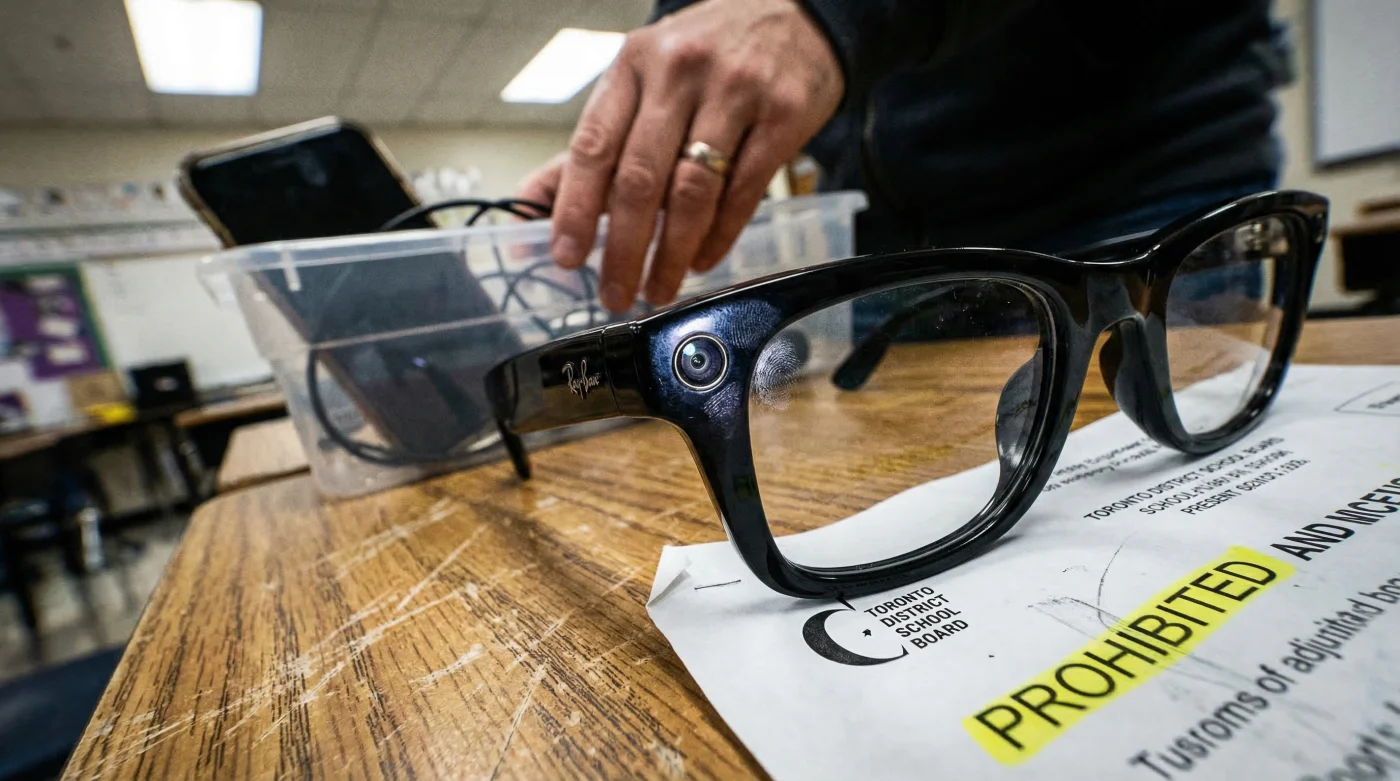
Imagine dropping your child off at a Toronto educational centre, believing their classroom is a safe, private environment for learning, only to discover a virtually invisible threat sitting right on their classmate’s face. For years, educators and parents have focused on keeping smartphones secured in lockers to prevent digital distractions, cyberbullying, and unauthorized photography. Yet, a rapidly growing trend is slipping right past security measures and yard monitors, masquerading as a harmless, everyday necessity.
It turns out that a specific piece of seemingly innocent wearable technology has forced district officials to take drastic, unprecedented action. As students covertly document classroom activities and peer interactions without a single tap of a screen, authorities are now actively confiscating these devices on sight. The culprit isn’t a traditional mobile phone or an archaic hidden camera, but rather a stylish accessory that shatters the long-held belief that prescription eyewear is strictly for seeing—because these modern lenses are looking right back, and permanently archiving every single moment.
The Evolution of Optical Espionage
Historically, schools in Canada have treated prescription glasses and sunglasses as protected personal items, creating a massive blind spot for administrators when high-tech companies began merging optical clarity with clandestine surveillance. The introduction of Meta Ray-Ban smart glasses fundamentally altered the landscape of wearable tech. Unlike the bulky augmented reality headsets of the past, these frames are virtually indistinguishable from classic Wayfarer models, making them the perfect tool for covert recording in sensitive environments like locker rooms, cafeterias, and examination halls.
Studies prove that the mere presence of unmonitored recording devices dramatically stifles organic social behaviour and compromises academic integrity. Students equipped with these frames can silently capture entire lectures, photograph exam papers with a subtle touch to their temple, and livestream peer interactions without any visible screens. Because the technology relies on sophisticated micro-telemetry, the visual footprint is almost entirely erased, leaving teachers completely unaware that their classroom is being broadcasted.
| Device Type | Primary User Benefit | Educator / Privacy Risk | Confiscation Difficulty |
|---|---|---|---|
| Traditional Eyewear | Vision correction and UV protection. | None. Completely safe for classrooms. | Extremely High (Medical necessity). |
| Smartphones | Communication and internet access. | High. Prone to distraction and recording. | Low (Easily visible and banned). |
| Meta Ray-Ban | Hands-free 12MP photography and audio. | Severe. Undetectable mass surveillance. | High (Requires behavioural profiling). |
Understanding the sheer capability of these stealth frames makes it perfectly clear why educators are hitting the panic button and revising district policies.
The Technical Mechanics Behind the Privacy Breach
To grasp why the Toronto district has implemented a zero-tolerance ban, one must examine the potent hardware concealed within the lightweight acetate frames. The Meta Ray-Ban utilizes an advanced 12-megapixel ultra-wide lens seamlessly integrated into the corner hinges. When activated, it doesn’t just take a low-resolution snapshot; it captures high-fidelity media capable of reading text on a whiteboard or a classmate’s private notes from across the room. Experts advise that the storage capacity alone allows a student to hoard over 500 video clips or 3,000 photos locally before ever needing to sync to a companion app.
The dosing and operational limits of these devices are remarkably robust for their size. The glasses capture video in precise 60-second bursts, perfect for bypassing short attention spans and capturing out-of-context altercations. Furthermore, the five-microphone array employs directional audio capture that is sensitive enough to isolate a whisper from 0.005 Miles away in a quiet library corridor. The internal processors are designed to safely operate at temperatures up to 35 Celsius before a thermal safety shutoff engages, meaning they can record continuously throughout the school day without overheating.
| Hardware Component | Technical Dosing / Metric | Classroom Implication |
|---|---|---|
| Camera Sensor | 12-Megapixel Ultra-Wide (1080p Video). | Captures high-resolution exams and private conversations. |
| Microphone Array | 5 directional mics, 0.005 Miles range. | Records distant whispers and teacher-student disciplines. |
| Thermal Capacity | Operates flawlessly up to 35 Celsius. | Allows for prolonged, uninterrupted covert surveillance. |
| Internal Storage | 32GB (500 videos / 3000 photos). | Requires no immediate network connection to save illicit data. |
- Adults hitting forty-five must push Apple iPad screens further away
- Toronto district schools ban Meta Ray-Ban glasses over covert recording
- Systane preservative drops worsen chronic dry eye symptoms over time
- Lutein dosages become mathematically critical for retinal survival at age forty
- I watched Alexis Stone transform into Jim Carrey in Paris
Diagnosing the Threat: Identifying Covert Tech in the Classroom
With traditional enforcement methods proving ineffective, teachers and administrators are undergoing rapid retraining to spot the physiological and behavioural indicators of smart glasses usage. Because confiscating a student’s actual prescription eyewear carries legal risks, staff must be absolutely certain that the device in question is a Meta Ray-Ban actively engaged in unauthorized data collection.
Educators use a specific diagnostic matrix to differentiate normal adolescent behaviour from active digital espionage. If a teacher notices a cluster of these signs, it triggers immediate administrative intervention.
The Symptom = Cause Diagnostic List
- Symptom: A faint, pulsing white LED light emanating from the right frame hinge. = Cause: Active 1080p video recording or continuous photo capture is in progress.
- Symptom: Unnatural stiffness in head movements or prolonged, unblinking staring at an exam paper. = Cause: The user is manually framing a subject for the ultra-wide lens to capture a legible document.
- Symptom: Frequent, repetitive tapping or swiping gestures along the right temple arm of the glasses. = Cause: The student is utilizing the touch-capacitive sensor array to trigger the camera shutter or adjust media playback volume.
- Symptom: Quiet, out-of-context muttering directed seemingly at oneself while looking straight ahead. = Cause: The user is issuing voice commands to the integrated Artificial Intelligence assistant to begin broadcasting or recording.
Mastering these behavioural cues is the critical first step before moving toward physical enforcement and policy execution.
The Toronto District Confiscation Protocol
Faced with an epidemic of unauthorized recordings, the local school board has rolled out an aggressive, structured confiscation policy. The mandate specifically strips the ‘medical device’ defence from smart glasses if they are utilized for media capture. If a student requires prescription lenses, parents are now strictly advised to provide analogue, non-electronic frames for use on school property. The district maintains that the right to a safe, unrecorded educational space supersedes a student’s preference for high-tech wearables.
When a violation is detected, educators follow a rigid progression plan to de-escalate the situation and secure the hardware. The confiscated Meta Ray-Ban units are immediately powered down and placed in a secure administrative lockbox, maintained at an optimal 20 Celsius to prevent battery volatility, until a legal guardian can retrieve them.
| Offence Level | What to Look For (Trigger) | Action Plan & Progression |
|---|---|---|
| First Offence | Student wearing camera-enabled frames in a restricted zone (washroom, exam hall). | Immediate confiscation. Device powered down. Parent notified for end-of-day retrieval. |
| Second Offence | Active recording (LED light visible) during instructional time or peer disputes. | Confiscation. 3-day suspension of tech privileges. Device held until formal parent-principal meeting. |
| Third Offence | Distribution or uploading of covertly recorded school material to social networks. | Indefinite ban of all wearable tech for the student. Disciplinary hearing and potential suspension. |
Implementing this strict, tiered protocol ensures that our educational centres remain focused on academic growth rather than unauthorized broadcasting.
Safeguarding the Future of Canadian Classrooms
The swift action taken against Meta Ray-Ban devices in Toronto serves as a bellwether for the rest of Canada. As wearable technology becomes more integrated and visually discreet, the line between helpful personal assistant and invasive surveillance tool continues to blur. Experts advise that parents must take a proactive role in auditing the technology their children bring into public spaces.
Conversations about digital citizenship can no longer end at smartphone usage; they must encompass all forms of ocular computing and wearable sensors. While the allure of hands-free photography and instant AI access is undeniable, the fundamental right to privacy for minors—whether on the school football pitch or in the classroom—must remain the absolute priority.
The Final Verdict on Wearables
Ultimately, the burden of compliance falls on the family unit to ensure that tech-enabled fashion does not jeopardize the safety and privacy of peers. By understanding the capabilities, recognizing the subtle diagnostic signs of usage, and respecting strict confiscation protocols, communities can work together to keep the focus in schools exactly where it belongs: on uninterrupted, organic learning.
Read More